

Household Science Experiments for Ages 4–12 That Kids Can Finish
Grab baking soda and vinegar, cornstarch and water, or vegetable oil and food coloring, and you’ve got a real experiment running in the next ten minutes. This page collects the household science experiments that consistently work for kids ages 4 to 12, with materials, timing, and one teaching prompt for each. All of them need an adult nearby, low mess is the goal, and none require a trip to a specialty store.
TL;DR:
- Most household science experiments can be set up quickly using common kitchen materials, with safety precautions such as adult supervision and protective gear.
- Experiments like baking soda volcanoes and milk fireworks demonstrate visible chemical reactions suitable for young children, while physics projects improve analytical thinking through activities like paper airplane testing.
- Longer-term experiments, such as tracking seed germination or gummy bear growth, teach children measurement skills and scientific patience over several days.
- Encouraging children to ask questions, predict outcomes, and record results deepens engagement and promotes a genuine scientific mindset.
Table of Contents
- Household Science Experiments Sorted by Type
- Safety and Low-Mess Setup Before You Start
- Turning a Demo Into Real Investigation
- Multi-Day Projects Worth the Patience
- Why Story and Experiment Pair So Well
- Ready to Keep the Curiosity Going?
- Where to Find More Experiments
- Sources
Household Science Experiments Sorted by Type
Some kids want fizz and drama. Others want to touch something weird. A few just want to watch something float or sink. Sorting by category makes it faster to match the experiment to the kid in front of you.
Chemistry (reactions you can see)
- Baking soda volcano. Materials: baking soda, vinegar, dish soap, food coloring, a small bottle. Time: 10 minutes. Ages 3 to 12. Pack baking soda into the bottle, add soap and color, then pour vinegar and step back. This teaches an acid base reaction that produces carbon dioxide gas, which is why it foams. Variation: change the vinegar amount and time how long the fizz lasts. Full steps live in Brainiecomics’s baking soda vinegar experiments guide.
- Homemade lava lamp. Materials: vegetable oil, water, food coloring, Alka Seltzer tablet, clear bottle. Time: 15 minutes. Ages 5 and up. Layer oil over colored water, then drop in a tablet piece. Oil and water don’t mix because of density and polarity, and the tablet’s fizzing carries color through the oil. See the full walkthrough in Brainiecomics’s lava lamp experiment.
- Chromatography flowers. Materials: coffee filters, washable markers, water, a cup. Time: 20 minutes. Ages 6 and up. Color a dot on the filter, dip in water, and watch the ink separate into its component colors as water travels upward.
- Milk fireworks. Materials: whole milk, food coloring, dish soap, a shallow dish. Time: 10 minutes. Ages 4 and up. Add color drops to milk, then touch soap to the surface. Fat molecules in the milk scatter away from the soap, creating swirling color. Try skim milk versus whole milk side by side to see fat content change the effect.
Physics and motion
- Balloon rocket. Materials: balloon, string, straw, tape. Time: 10 minutes. Ages 5 and up. Thread string through a straw, tape the balloon to the straw, inflate, and release. Newton’s third law pushes the rocket forward as air escapes backward.
- Egg drop cushion. Materials: raw egg, straws, tape, cotton balls, plastic bag. Time: 25 minutes plus a drop test. Ages 7 and up. Build a cushioned case and test from increasing heights. Brainiecomics covers more launch-based projects in nine fun physics experiments.
- Paper airplane distance test. Materials: paper, ruler. Time: 15 minutes. Ages 6 and up. Fold different designs and measure flight distance, a clean intro to aerodynamics and controlled testing, detailed in paper airplane science for kids.
Materials and engineering
- Oobleck. Materials: cornstarch, water, a bowl. Time: 5 minutes. Ages 3 and up. Mix two parts cornstarch to one part water. It acts solid under pressure and liquid when still, a non-Newtonian fluid, a favorite in KiwiCo’s kitchen science list for ages 3 to 8.
- Magnetic slime hunt. Materials: iron filings or paper clips, magnets, slime or oobleck. Time: 15 minutes. Ages 5 and up. More low-mess magnet ideas are in four low-mess magnetism experiments.
- Toothpick and marshmallow bridge. Materials: toothpicks, mini marshmallows. Time: 30 minutes. Ages 6 and up. Build a structure and test weight capacity with coins.
Biology and outdoor
- Dancing raisins. Materials: raisins, clear soda, a glass. Time: 5 minutes. Ages 4 and up. Bubbles attach to the raisin’s wrinkled surface and lift it, then release as they pop at the top.
- Capillary action rainbow celery. Materials: celery stalks or white flowers, water, food coloring. Time: setup 10 minutes, results over 24 to 48 hours. Ages 4 and up. Full instructions and variations are in capillary action experiments.
- Seed germination in a bag. Materials: bean seeds, paper towel, zip bag, water. Time: setup 5 minutes, observation over 7 to 10 days. Ages 4 and up.
- Sink or float sort. Materials: household objects, a tub of water. Time: 10 minutes. Ages 3 and up. Sort by prediction first, then test, an easy density lesson for the youngest scientists.
Physics projects like the paper airplane test and egg drop build real analytical thinking, while a volcano or dancing raisins deliver the instant payoff younger kids need to stay interested, according to HowStuffWorks’s breakdown of kids’ chemistry projects. Museum-tested lists, including the Michigan Science Center’s at-home activities, lean on the same mix: chromatography, egg-in-a-bottle, and friction racers, because they’re cheap and classroom-proven.
Safety and Low-Mess Setup Before You Start
Run through this quickly before any experiment begins:
- An adult stays present for the entire activity, no exceptions for anything involving heat, small parts, or chemicals mixed in quantity.
- Goggles for anything that fizzes near the face; nothing gets tasted or swallowed, even “safe” ingredients like baking soda.
- Skip open flames, aerosol sprays, and concentrated cleaning chemicals entirely. Check your local guidelines on chemical disposal if you’re working with anything beyond kitchen staples.
- Work on a tray or in a shallow tub over a washable surface, and pre-measure ingredients into small cups before you start.
- Rinse baking soda and vinegar mixtures down the drain with water; wipe up food coloring immediately since it stains grout and fabric fast; oobleck goes in the trash, never the sink, because cornstarch clogs pipes.
Pro Tip: If you’re running more than one experiment in a session, prep every tray the night before. Kids lose interest fast during setup, but they’ll wait patiently once the vinegar bottle is already in their hand.
Turning a Demo Into Real Investigation
A demo becomes an experiment the moment you ask a question before you start pouring. Use this sequence:
- Ask a question the child can actually test, like “what happens if we use less vinegar?”
- Predict an outcome out loud, even if it’s wrong.
- Test one variable at a time, keeping everything else the same.
- Observe closely, including things that seem boring.
- Record results in a simple table or with a phone photo.
- Repeat to see if the result holds up.
Try it with the volcano (change vinegar amount), the milk fireworks (skim versus whole milk), or capillary celery (food coloring concentration). Younger kids can just describe what they see; older kids can build a two-column table tracking time versus result. Experts at Michigan State University Extension recommend shifting from showing kids what happens to asking “what if” before you show them anything at all, since that one change measurably deepens engagement.
Multi-Day Projects Worth the Patience
Longer projects teach something quick demos can’t: how to measure change over time and track a variable honestly.
- Gummy bear growth. Soak gummy bears in water, salt water, and vinegar. Measure size daily for 3 to 5 days and chart growth by liquid type.
- Seed germination race. Track root length daily for a week using the paper towel bag method, then graph growth against light exposure.
- Homemade rain gauge. Mark a clear jar in centimeters and log rainfall daily for two to three weeks, comparing to local weather reports.
- Keep a dedicated notebook or clipboard per project so measurements don’t get scattered across scraps of paper.
These slower projects build the same measurement habits scientists use every day, just on a kitchen counter timeline instead of a lab schedule.
Why Story and Experiment Pair So Well
Kids remember an experiment longer when it’s tied to a story they care about. Brainiecomics builds its comics around exactly that pairing. A balloon rocket experiment lands harder right after a character in Gravity Gang uses thrust to escape a tight spot, and journaling the results afterward locks in the physics. Parents consistently report their kids ask to redo the experiment days later, which is the real marker of curiosity taking hold.
— Brainie Comics
Ready to Keep the Curiosity Going?
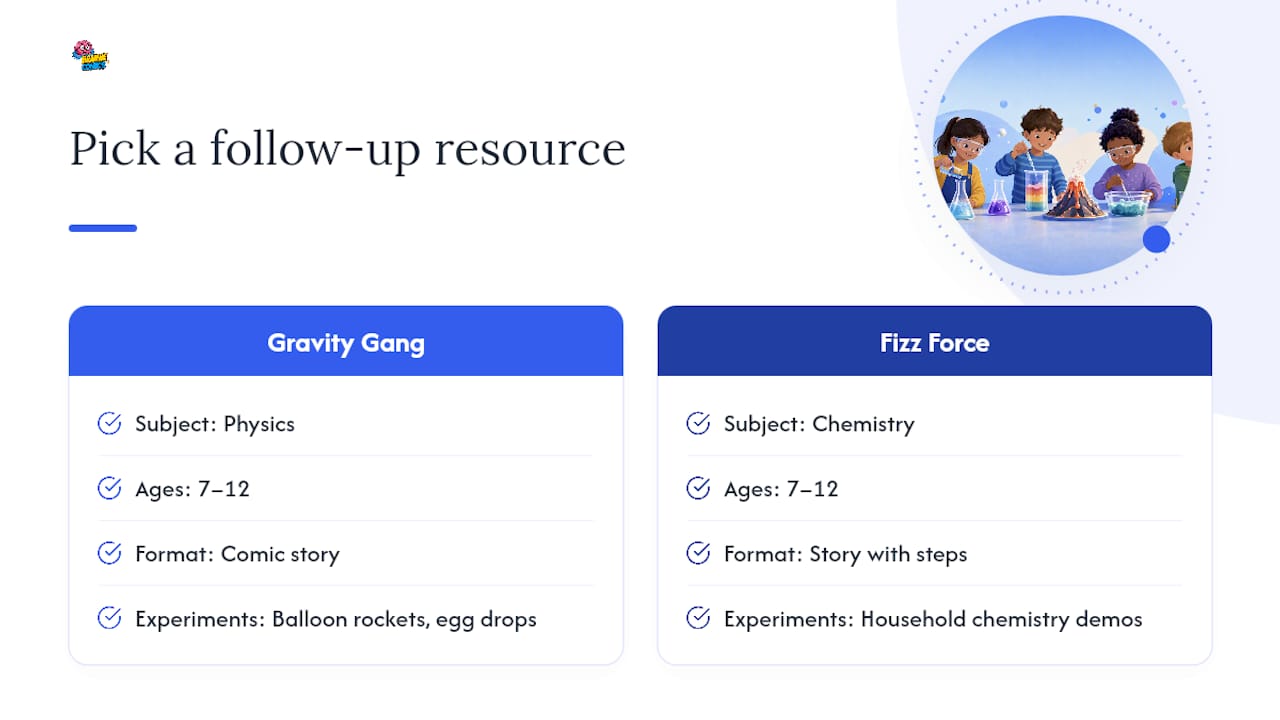
If the fizz and the foam already hooked your kid, the next step is a resource that keeps delivering new experiments without you hunting down instructions every weekend. Gravity Gang wraps physics experiments like balloon rockets and egg drops into a comic story built for ages 7 to 12, and Fizz Force does the same for chemistry, with step-by-step household experiments woven right into the plot. Each book comes with activity prompts that turn a one-off demo into a running project, plus quizzes and a completion certificate that give kids a reason to finish what they started. Instead of assembling a new tray every week, you get a stack of ready-made lessons your kid actually wants to read. Check out Gravity Gang for physics or Fizz Force for chemistry and pick the one that matches what got them excited today.
Where to Find More Experiments
For deeper protocols, try Science Buddies for measurement-heavy projects, the Michigan Science Center for museum-tested activities, and Trinity Education’s science resources for tutoring-style follow-up. Brainiecomics’s homeschool science experiments guide covers additional inquiry-based ideas.
Sources
- Science projects for kids: chemical reactions (HowStuffWorks)
- Tips for nurturing a child’s love of science (Michigan State University Extension)
- At Home Science Experiments (Michigan Science Center)
- STEM activities (Science Buddies)