

Nine Fun Physics Experiments You Can Run at Home Today
Here are nine fun physics experiments you can run at home or in school. Each one uses common materials, takes 10 to 30 minutes, and comes with a one-line science explanation kids actually get. Groups like the Exploratorium and Science Buddies have tested versions of most of these for decades, and Brainiecomics builds on that same hands-on approach in its own comic-format science books. Pick one from the list below and start.
- Floating ping-pong ball — easy, Bernoulli’s principle
- Marshmallow puff tube — easy, Newton’s second law
- Density column — easy, density and buoyancy
- Balloon rocket — easy, Newton’s third law
- Falling objects (feather vs. coin) — easy, gravity vs. air resistance
- Paper roller coaster — medium, energy conversion
- Seltzer boat — easy, action and reaction
- Cartesian diver — easy, pressure and buoyancy
- Simple electromagnet — medium, magnetism
Key Takeaways
Nine household-material physics experiments cover the core middle-school concepts of force, pressure, density, and energy in 10 to 30 minutes each.
| Point | Details |
|---|---|
| Start with the shortlist | Pick one of the nine experiments based on your kid’s age and the time you have available. |
| Match time to attention span | Under 10 minute demos work for younger kids; 30 minute builds suit ages 8 and up. |
| Treat failure as data | Ask “what do you notice?” before fixing a flopped trial to build troubleshooting skills. |
| Supervise heat, electricity, small parts | Keep adults nearby for the electromagnet, hair dryer, and any choking-hazard pieces. |
| Extend the story with Brainiecomics | Comic-format books like Gravity Gang turn a single demo into an ongoing STEM habit. |
Table of Contents
- Fun Physics Experiments You Can Set Up in Under 30 Minutes
- What You Need and How to Keep Experiments Safe
- How to Pick the Right Experiment for Your Kid
- Famous Physics Experiments Worth Retelling
- Frequently Asked Questions
- Sources
Fun Physics Experiments You Can Set Up in Under 30 Minutes
Each experiment below lists what you need, how long it takes, and what’s actually happening physically. Run through the steps once yourself before you hand it to a kid. It saves you from troubleshooting live in front of an audience.
1. Floating ping-pong ball (Bernoulli’s principle) Materials: a hair dryer or straw, a ping-pong ball. Time: 10 minutes. Age: 5 and up.
- Point the hair dryer straight up.
- Turn it on and place the ball in the air stream.
- Watch it hover instead of flying off.
- Tilt the dryer slightly and see how far it can lean before the ball drops.
Fast-moving air has lower pressure than the still air around it, so the ball gets pushed back toward the center of the stream instead of escaping. Steve Spangler Science has documented how straw diameter and airflow speed change how stable the ball stays. If the ball keeps shooting out sideways, your air stream is probably too narrow. Widen it or slow the airflow. Extension: time how long the ball hovers at different tilt angles and graph the results.
2. Marshmallow puff tube (Newton’s second law) Materials: a cardboard or PVC tube, mini marshmallows. Age: 6 and up.
- Cut the tube to about 12 to 18 inches.
- Load a marshmallow into one end.
- Blow sharply through the other end.
- Measure how far it flies.
- Try a shorter tube, then a wider one, and compare distances.
More force over the same mass means more acceleration, which is why a sharper puff sends the marshmallow farther than a gentle blow. The Exploratorium’s Marshmallow Puff Tube activity breaks down exactly how tube length and diameter change the range. If the marshmallow doesn’t move, check for a loose seal at the mouth end or try a narrower tube for a tighter air seal.
3. Density column (density and buoyancy) Materials: honey, dish soap, water, vegetable oil, rubbing alcohol, a tall clear glass. Age: 7 and up. Pour each liquid slowly, in order from heaviest to lightest, letting each settle before adding the next. The layers stay separated because denser liquids sink below lighter ones instead of mixing. Science Sparks offers a version of this same demo with small object drops for extra visual proof. Extension: drop small objects (a grape, a bead, a bit of cork) and predict which layer each one settles in.
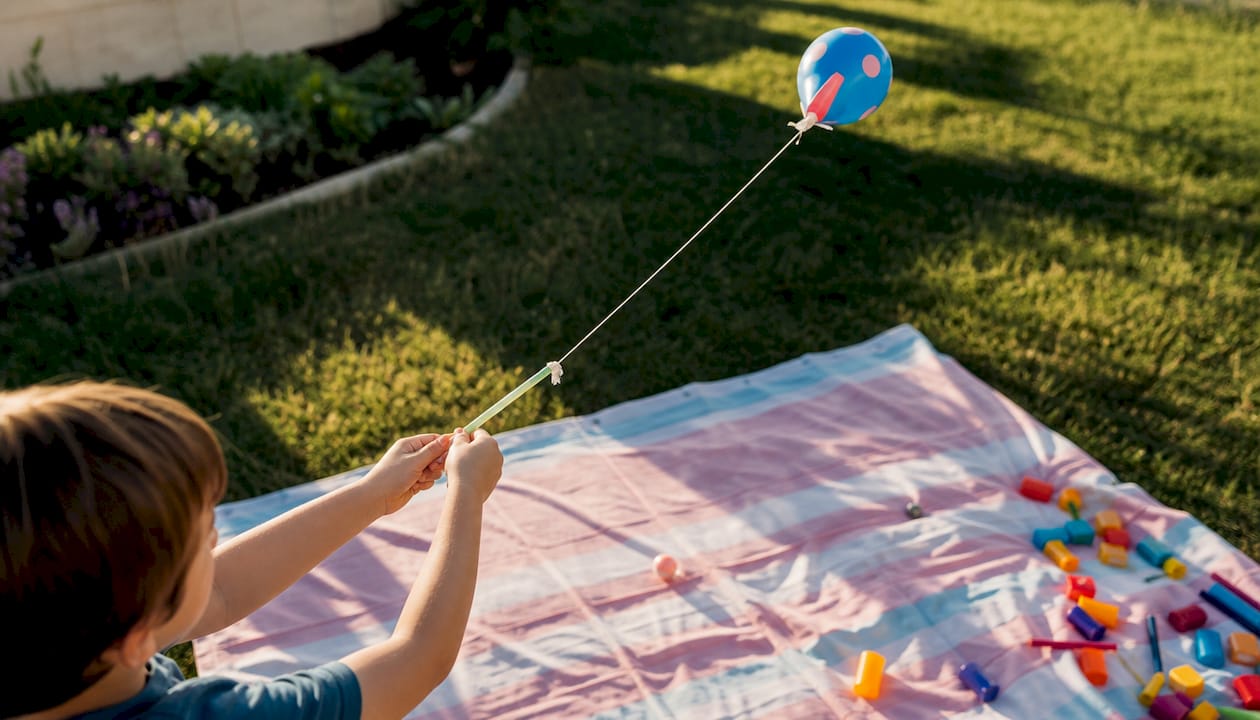
4. Balloon rocket (Newton’s third law) Materials: a balloon, string, a straw, tape. Age: 6 and up. Thread string through the straw, tape the straw to an inflated balloon, and let go. Air rushing backward out of the balloon pushes the balloon forward, which is Newton’s third law in its simplest form. Extension: measure travel distance with different balloon sizes.
5. Falling objects: feather vs. coin (gravity and air resistance) Materials: a feather, a coin. Age: 5 and up. Drop both from the same height at the same time. The coin lands first because air resistance slows the feather far more than gravity’s pull differs between them. The Exploratorium’s falling-feather activity notes that this demo works best with minimal air movement in the room, and that similar drop demos often take 15 to 30 minutes when you add multiple trials.
6. Paper roller coaster (energy conversion) Materials: foam pipe insulation or cardstock strips, tape, a marble. Age: 8 and up. Build a track with hills that get progressively shorter, then release the marble from the top. Height converts to speed as the marble drops, which is why later hills must be lower than the first. Science Buddies lists dozens of variations on this build with measurement extensions built in.
7. Seltzer boat (action and reaction) Materials: a foam tray or plastic lid, a seltzer tablet, a film canister with a snap lid. Age: 6 and up. Half-fill the canister with water, drop in a tablet piece, snap the lid shut, and set it upside down on the boat before the lid pops. Gas escaping in one direction pushes the boat in the other. Little Bins for Little Hands has a version of this with troubleshooting tips if the lid pops too early.
8. Cartesian diver (pressure and buoyancy) Materials: a plastic bottle, a glass pipette or ketchup packet, water. Age: 7 and up. Fill the bottle with water, drop in the diver, seal it, and squeeze the sides. Squeezing raises the pressure inside, compressing air in the diver so it sinks, and releasing lets it float back up.
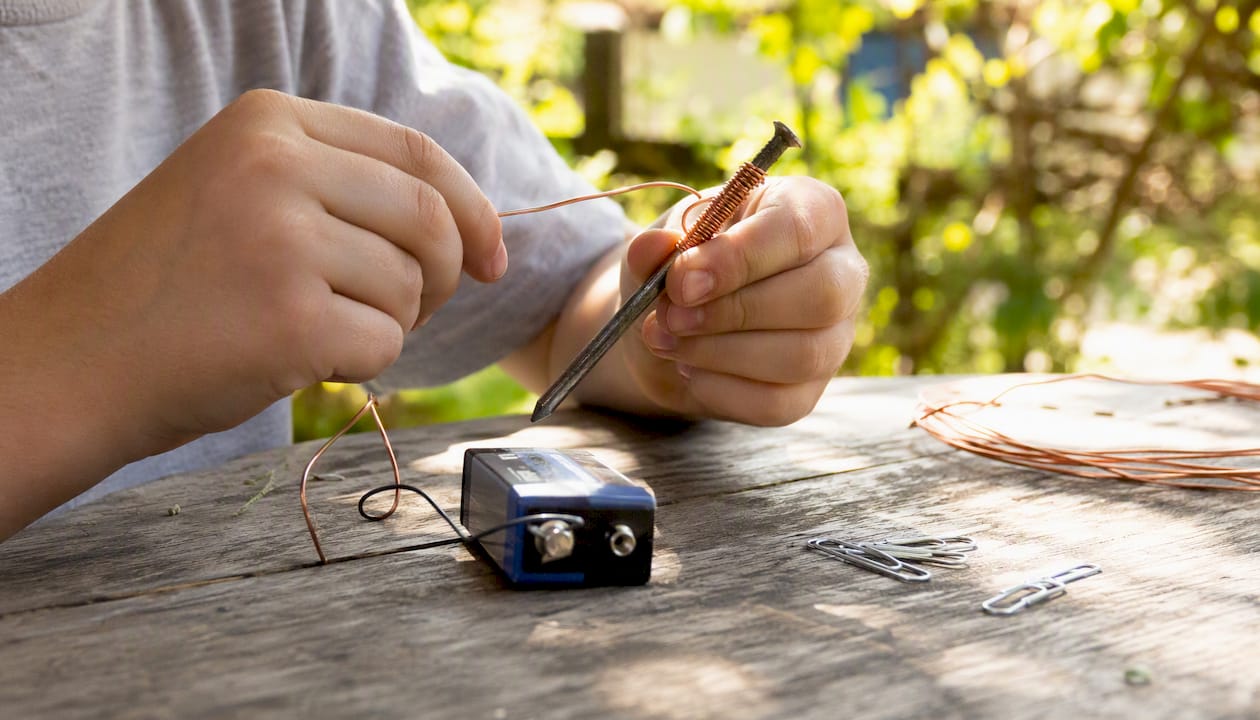
9. Simple electromagnet (magnetism) Materials: an iron nail, insulated copper wire, a battery. Age: 9 and up. Have an adult check the wire wrapping before connecting the battery. Wrap wire tightly around the nail, strip the wire ends, and touch them to the battery terminals to pick up paper clips. Electric current running through the coiled wire creates a magnetic field around the nail.
Pro Tip: Keep a kitchen timer running during any experiment involving multiple trials. Kids retain the concept better when they can compare “trial 1 took 4 seconds, trial 2 took 6” rather than eyeballing it.
What You Need and How to Keep Experiments Safe
Most of these experiments run on things already in your kitchen: tape, string, balloons, cardboard tubes, cooking oil, food coloring. Substitutions work fine in most cases. No pipette for the Cartesian diver? A ketchup packet does the same job.
A few materials need closer supervision. Rubbing alcohol should stay away from open flames and small children shouldn’t handle it unsupervised. Hair dryers and any electrical setup, including the electromagnet, need an adult nearby. Small parts like beads, marbles, and film canister lids are choking hazards for kids under 5.
- Adult supervision for anything involving heat, electricity, or small parts
- Safety glasses for the electromagnet build if wire ends are exposed
- A designated cleanup zone before you start (spills happen)
- A phone stopwatch or kitchen timer for any experiment with a measurable outcome
Pro Tip: Set up a “physics tray” with your most-used tools (timer, ruler, tape, scissors) so you’re not hunting for supplies mid-experiment while a kid loses interest.
How to Pick the Right Experiment for Your Kid
Match the experiment to the child, not the other way around. A 6-year-old wants something that moves fast and looks dramatic, like the balloon rocket. A 10-year-old wants to measure something, like puff tube distance across three trials.
- Check the age range and difficulty listed for each experiment first.
- Match the time available. Fifteen minutes before dinner calls for the Seltzer boat, not the roller coaster.
- Decide on one learning goal (motion, energy, pressure) rather than trying to teach three concepts at once.
- Ask a prediction question before starting: “Which will hit the ground first?”
- Let the first attempt fail if it’s going to. Ask what might have gone wrong instead of fixing it yourself.
- Repeat the trial with one variable changed.
- End with a one-sentence explanation in the kid’s own words.
Framing a flopped trial as a troubleshooting puzzle rather than a mistake builds real scientific thinking, according to research on failure in STEM learning. Science Buddies recommends a simple predict-observe-explain loop after every trial, and that three-step habit works whether you’re running one demo or ten.
Pro Tip: If a kid says “it didn’t work,” ask “what do you think happened?” before you touch anything. Half the time they’ll spot the fix themselves.
Famous Physics Experiments Worth Retelling
The demos above echo real history, and kids pay closer attention when they know a real person once ran the same test.
- Galileo’s falling bodies: Galileo argued heavy and light objects fall at the same rate, absent air resistance. Your feather-versus-coin drop is a home version of that same question.
- Newton’s laws: Newton’s third law of action and reaction is exactly what powers the balloon rocket and the Seltzer boat.
- Bernoulli’s levitation: Daniel Bernoulli’s work on fluid pressure explains why the ping-pong ball hovers in an air stream.
- Archimedes and buoyancy: Archimedes’s principle on displaced water explains both the density column and the Cartesian diver.
Run the demo first, then tell the story. Kids remember Galileo better once they’ve already dropped the feather themselves.
A Teacher’s Take on Running These in Real Classrooms
I’ve watched a room of eight-year-olds go dead silent the moment a marshmallow actually flies across the room. That silence is the tell. Groups of three work best. Any bigger and one kid just watches. When a demo flops, don’t jump in. Ask “what do you notice?” first. If a kid can describe why it failed, the learning already happened.
A Story-Driven Way to Keep the Learning Going
Once a kid has puffed a marshmallow across the kitchen or watched a boat scoot across a tray, the natural next question is “what else can I try?” That’s exactly the gap Brainiecomics fills. Its comic books wrap physics and chemistry concepts into ongoing story arcs, so instead of a one-off demo, a kid gets a character-driven reason to run the next experiment, then the next one after that.
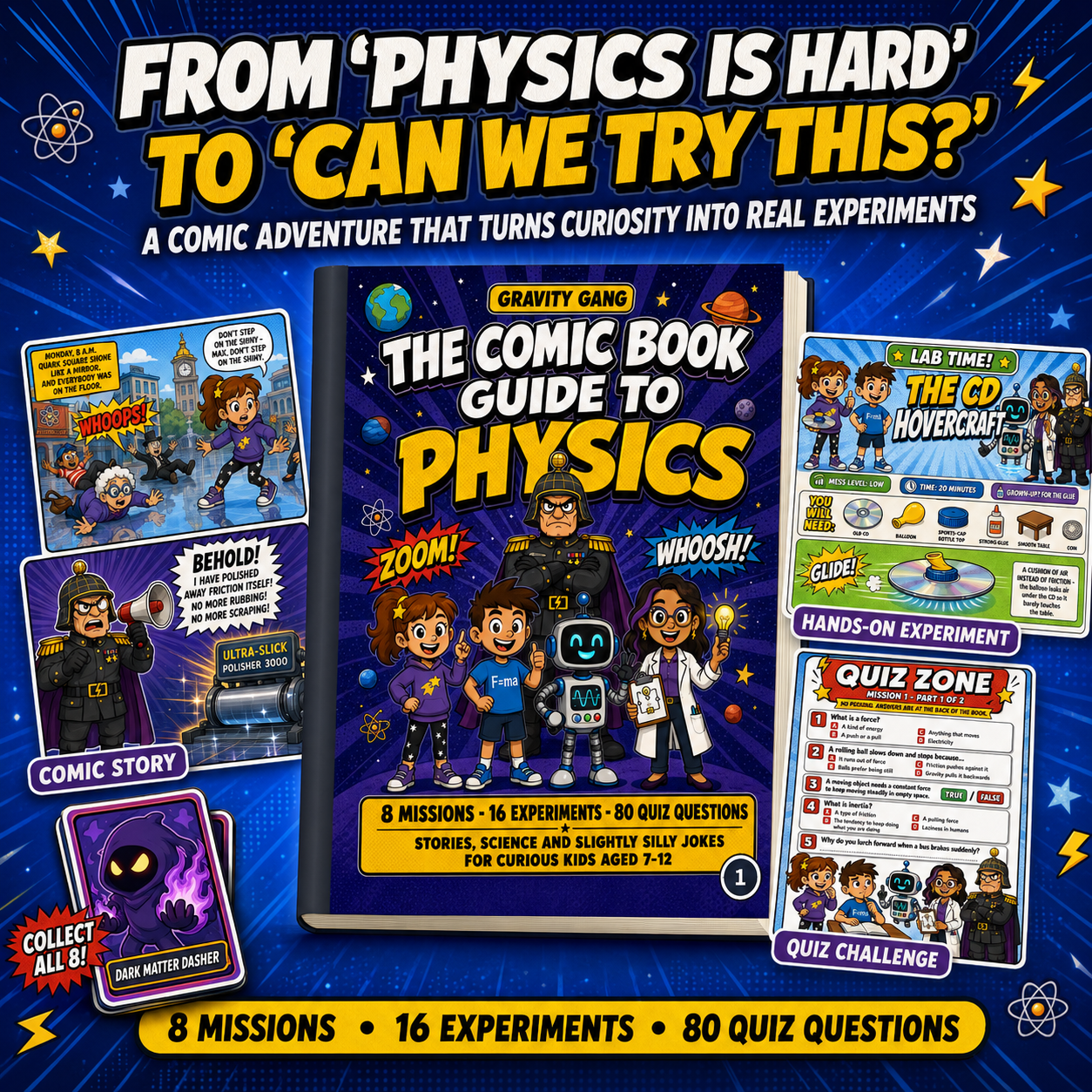
Gravity Gang walks readers ages 7 to 12 through kitchen-safe physics experiments packaged inside a comic story, with quizzes and a completion certificate at the end of each arc. For families leaning more toward chemistry, Fizz Force covers the same territory with kitchen-safe chemistry setups. If you’re looking for more screen-free activity ideas to round out a home science routine, this list of screen-free activities is a solid companion resource. Browse the full lineup at Brainiecomics and pick the title that matches your kid’s curiosity.
Frequently Asked Questions
What age is right for starting fun physics experiments at home? Most of the experiments here work for kids as young as 5, especially the balloon rocket and falling-objects drop. Anything involving electricity or small removable parts, like the electromagnet, fits better with kids 9 and older.
How long do easy physics experiments at home usually take? Most run 10 to 30 minutes including setup. The falling-object drop can take under 10 minutes, while a paper roller coaster build runs closer to 30.
What’s the most reliable simple physics experiment for kids who get frustrated easily? The Seltzer boat and balloon rocket tend to work on the first try with minimal troubleshooting, which makes them good starting points before moving to trickier builds like the puff tube.
Do I need special equipment for these physics experiments with household items? No. Every experiment listed uses items typically already in a kitchen or junk drawer, though the electromagnet needs copper wire and a battery, which some households may need to pick up separately.
How do I explain the science if my child asks “why” during an experiment? Give the one-line explanation listed for each experiment, then ask them to repeat it back in their own words. That quick repeat is often the clearest sign the concept actually landed.
Sources
- Falling feather — Exploratorium
- 5 physics experiments you can try at home — Science Sparks
- Easy physics experiments for kids — Little Bins for Little Hands