

NGSS Aligned 5th Grade Science Experiments to Teach Evidence
This page gives parents and teachers a curated set of age-appropriate, NGSS-aligned 5th grade science experiments that use household materials and focus on measuring evidence and explaining patterns. It covers matter and chemistry, energy and motion, Earth and space, ecosystems, engineering, electricity, and water systems, with planning and safety guidance built in. Every experiment asks students to measure something, run it more than once, and explain what happened, and every one needs an adult nearby.
TL;DR:
- Most experiments should be matched to available space and materials, with safety rules strictly followed and adult supervision maintained at all times.
- Experiments like density towers, oobleck, and baking soda vinegar tests must vary only one element across multiple trials to produce meaningful evidence and patterns.
- Quantitative data collection, such as timing pendulums or measuring plant growth, helps students develop skills in graphing and analyzing patterns over time.
- Low-risk water, earth, and ecosystem experiments emphasize observation, measurement, and drawing evidence-based conclusions while minimizing hazards.
- Incorporating story-driven prompts and comics enhances engagement and helps students ask sharper questions, supporting inquiry and comprehension.
Table of Contents
- Planning and safety come before any experiment
- Matter and chemistry experiments that show real evidence
- Energy, motion, and forces experiments with numbers attached
- Earth and space patterns you can observe and graph
- Ecosystems and life-science investigations worth running
- Engineering challenges that teach build-test-improve thinking
- Electricity, magnetism, and circuits without the risk
- Water science experiments that stay safe and measurable
- Connecting experiments to math and reading
- Adapting experiments for different learners
- Grading criteria that actually reflect the work
- Why story-driven experiments change how kids show up to science
- Bring the story to the experiment with Brainie Comics
- Sources
- FAQ
Planning and safety come before any experiment
Before picking a project, match it to the time and space you actually have. A kitchen-table experiment for one child looks different from a whole-class activity with twenty-five kids sharing three hot plates, so decide early whether the plan works solo, in pairs, or as a rotation.
Most of the experiments below run on items commonly found in a pantry or recycling bin, such as table salt, food coloring, baking soda, vinegar, cornstarch, paper cups, string, and a flashlight. When a recipe calls for something less common, a substitution usually works: dish soap instead of a surfactant, a mixing bowl instead of a graduated cylinder, a phone stopwatch instead of a lab timer.
Safety rules for this age group are consistent and worth posting where kids can see them:
- Adults supervise every step, especially anything involving heat, sharp tools, or a reaction in a closed container.
- Nothing gets tasted, even when it looks like food, and that rule holds for baking soda, vinegar, and any “kitchen” experiment.
- Goggles go on for anything that could splash or fizz upward.
- Hands get washed before and after, and materials get labeled and disposed of properly rather than poured down a drain without checking.
These match the elementary safety guidance in a grades 3-5 science lab safety agreement, which also recommends a signed parent safety agreement whenever an experiment leaves the classroom. If a project is headed for a school science fair, check the fair’s rules first: many require prior approval for anything involving hazardous materials or living subjects, and a set of elementary research rules and forms explains why low-risk household investigations are the safer, and usually the required, choice at this level.
Pro Tip: Keep a small “safety station” of goggles, paper towels, and a trash bag next to any experiment area so cleanup and protection are never the step that gets skipped.
Matter and chemistry experiments that show real evidence
Fifth grade chemistry works best when a demonstration becomes a test. NGSS’s fifth-grade matter standards ask students to measure and graph properties, and to argue that a new substance has formed rather than just watch something fizz, according to the combined fifth-grade DCI standards. The three experiments below follow that structure.
- Density tower with colored salt water. Dissolve different amounts of salt into four cups of water, tint each a different color, then layer them by pouring slowly down the side of a glass, densest on the bottom. Kids measure how many tablespoons of salt go into each cup, predict the stacking order before pouring, and record whether their prediction held. A step-by-step density tower guide walks through the layering technique in more detail, and a library of salt-based demos offers variations for repeat trials.
- Oobleck and the solid-or-liquid question. Mix cornstarch and water roughly two to one and let students punch it, then let it rest in an open palm. The material resists fast force but flows under slow pressure, which makes a great prompt for describing states of matter with evidence rather than a single label. Running the test three times with slightly different ratios turns a one-off “cool” moment into a real comparison.
- Baking soda and vinegar as evidence for chemical change, not a volcano. Instead of framing this as a lava demo, set it up as a controlled test: does the amount of gas produced change with more baking soda, more vinegar, or a different container shape? Have students measure how high a balloon inflates or how long the fizzing lasts, then repeat the trial to check consistency. A stepwise guide to baking soda and vinegar reactions includes several ways to frame the question, and a set of household experiment ideas has related low-mess options.
The strongest fifth-grade experiments change one variable, measure evidence across repeated trials, and ask students to explain a pattern, a shift the combined DCI standards point to directly. That means every one of these three works better with a simple data table (trial number, what changed, what was observed) than with a single dramatic run.
For assessment, ask students to write a one-sentence hypothesis before starting, record at least three trials in a table, and finish with a short written claim supported by their own numbers.
Energy, motion, and forces experiments with numbers attached
Motion experiments give fifth graders their clearest shot at collecting real quantitative data, which is exactly what NGSS’s energy and motion expectations call for.
- Balloon rocket race. Thread a straw onto a length of string stretched across a room, tape an inflated balloon to the straw, then release it and time how long it takes to reach the far end. Changing the balloon size or the string’s angle gives a second and third trial to compare.
- Pendulum swing timing. Hang a washer from a string and time ten full swings at three different string lengths. Longer strings swing slower, and having students graph length against time turns a swinging weight into a data set.
- Shadow-timing as a motion proxy. Track how a stick’s shadow length changes every twenty minutes across a school day, then graph the results. It doubles as a bridge into the Earth and space section below.
- Ramp friction test. Roll the same toy car down a ramp covered in different surfaces (carpet scrap, foil, sandpaper) and measure how far it travels past the ramp’s base each time.
Pro Tip: Have students represent their fastest and slowest trials on the same bar graph so a visual pattern shows up before any written explanation does.
Every one of these activities produces quantitative observations that students can plot, which matters more than the setup itself. A graph with three data points and a one-line explanation of the pattern demonstrates the science practice NGSS is after far better than a fast, single run of any of them.
Earth and space patterns you can observe and graph
Fifth-grade Earth and space standards ask students to notice patterns over time and connect them to a simple model, rather than memorize facts about the solar system.
- Shadow tracking across a school day. Mark a stick’s shadow tip every hour with chalk or tape, then measure and graph the length and direction of each mark. The pattern (shortest at midday, longest morning and evening) becomes evidence students collected themselves.
- Moon-phase modeling with a lamp and a ball. Using a flashlight as the sun and a foam ball as the moon, have students rotate the ball around their head and sketch what they see at eight points in the “orbit.” Comparing sketches to an actual eight-day phase log at home turns the model into a testable claim.
- Mini solar oven. Line a pizza box with foil, cover it with plastic wrap, and use it to melt a marshmallow or soften chocolate, timing how long it takes in direct sun versus shade. This connects sunlight, energy, and material choice in a way students can measure with a kitchen timer.
Classroom demonstrations of solar energy do not have to stop at a shoebox oven. Programs that connect school solar installations to STEM lessons show how the same sunlight-to-energy idea scales up to a real building, which is a useful extension conversation once the mini oven experiment is done.
Ecosystems and life-science investigations worth running
Plant growth experiments give fifth graders a built-in variable test: change one thing, measure another, and wait.
- Air, water, and light variable tests. Grow three identical bean seedlings, one with normal watering, one under-watered, and one kept in a dark closet, then measure stem height every three days and graph all three lines together. NGSS clarification statements note that plants get most of their growth materials from air and water rather than soil alone, which makes a good discussion point once the graphs are done.
- Decomposition-rate comparison. Bury or bag identical food scraps (a piece of fruit, a leaf, a bit of bread) in different conditions, sealed versus open, and check them every few days, recording changes in a simple table rather than just a description.
- Food-web modeling from backyard or schoolyard observations. Have students list every organism they can spot outside for ten minutes, then connect predator to prey with arrows to build a simple web, arguing from what they actually saw rather than a textbook diagram.
Each of these works best when students are asked to argue from their own evidence: not “plants need water” as a fact to memorize, but “my watered plant grew 4 more centimeters than my dark-closet plant over nine days” as a claim their own data supports.
Engineering challenges that teach build-test-improve thinking
Design challenges are where fifth graders get to fail productively, and NGSS treats engineering practice as equal in weight to the science content itself.
- Windmill or water-lift challenge. Build a simple paper or cardboard windmill blade set on a pencil axle, test how many paperclips it can lift with a small motor or hand-crank, then redesign the blade angle and test again. Set success criteria before building starts (for example, lift five paperclips in under ten seconds) so the redesign has a clear target.
- Bridge-building load test. Using straws, index cards, or craft sticks, build a small bridge across two chairs or books, then test how many coins it holds before failing, and compare designs across the group by shape rather than just materials used.
Pro Tip: Have students sketch their design before building it, then sketch the redesign next to it, so the improvement is visible on paper as well as in the test result.
Structure each cycle the same way: build, test, record the result, change exactly one thing, test again. A simple scoring rubric works well here, weighing how well the design met the stated goal, how clearly the team documented each test, and whether the final version improved on the first.
Electricity, magnetism, and circuits without the risk
Low-voltage circuits let students test real materials for conductivity without any real danger, provided the setup stays battery-powered rather than plugged in.
- Simple circuit and conductivity test. Connect a AA battery, a small bulb or LED, and two wires with a gap, then test which household materials (a paperclip, a rubber band, a coin, a pencil lead) complete the circuit and light the bulb.
- Brightness as a data proxy. Swap in two batteries instead of one and have students describe or rank how much brighter the bulb gets, turning a qualitative “brighter” into a simple ranked comparison across trials.
- Compass and magnet field mapping. Move a small compass around a bar magnet in a grid pattern, marking the needle’s direction at each point to build a simple field map by hand.
- Battery handling. Keep batteries away from mouths and standing water, and dispose of any swollen or leaking battery immediately rather than testing it.
Small groups of two or three work best here since everyone needs a turn holding the compass or watching the bulb; a whole class sharing one circuit loses the hands-on value fast.
Water science experiments that stay safe and measurable
Water-based investigations let fifth graders test density, filtration, and buoyancy with almost no risk of injury, which makes them a strong choice for take-home projects as well as classroom work.
- Salt-gradient density tower with temperature added. Repeat the density tower from the chemistry section but chill one layer and warm another before measuring how temperature changes the layering order.
- DIY filtration challenge. Layer sand, gravel, and cotton in a cut plastic bottle, pour muddy water through, and time how long filtration takes while comparing the water’s clarity before and after.
- Buoyancy design challenge. Build a small foil boat, add pennies one at a time until it sinks, and measure how much water it displaces at each stage.
More water-based options, along with buoyancy journaling prompts, are collected in a set of water science experiments and a buoyancy experiments guide built for the same age group.
Connecting experiments to math and reading
Every experiment above produces numbers, and those numbers are a math lesson hiding inside a science one. Graphing shadow lengths, pendulum times, or plant heights gives students direct practice with line graphs, averages, and reading a scale, skills that fifth-grade math standards already expect.

Reading strengthens the same experiments from the other direction. Writing a hypothesis before starting, a data table during the trial, and a short claim afterward gives students structured practice with clear, evidence-based writing, the same skill a science-fair judge or a teacher grading a lab report is looking for. A set of age-banded kitchen science experiments pairs each activity with prompts written for exactly this purpose, and pairing a printed story with an experiment, the model story-driven comics use, gives reluctant readers a reason to read the setup before they get to do the fun part.
Preservice teacher training research backs this up directly: explicit instruction in science practices like planning investigations and analyzing data measurably improves how ready teachers feel to lead inquiry lessons, according to a 2023 study on NGSS practices instruction. The same logic applies to students: naming the practice (“we are recording data,” “we are arguing from evidence”) rather than assuming it will be absorbed makes the cross-curricular link stick.
Adapting experiments for different learners
Not every student in a classroom or a household needs the same version of an experiment to hit the same learning goal. A student who struggles with fine motor tasks can direct a partner through the density tower pours while owning the data recording, and a student who reads below grade level can narrate observations aloud for someone else to write down.
For English language learners, pairing each step with a picture or a simple diagram alongside the written instructions removes a language barrier without changing the science. For students who need more structure, breaking a multi-step experiment like the windmill challenge into single-step checklists, with one box to check per stage, keeps the task manageable without lowering the actual content.
Gifted or advanced students benefit more from an added variable or a tougher constraint than from a harder topic altogether: ask them to test a fourth ramp surface, add a second control to the plant growth test, or design their own scoring rubric for the bridge challenge. The goal in every case is the same performance expectation reached by a different path, not a separate assignment.
Grading criteria that actually reflect the work
A rubric for a fifth-grade experiment works best when it rewards the thinking process, not just a correct-sounding conclusion. Four categories cover most of what matters: a clear, testable question or hypothesis; a fair test with only one changed variable; accurate, repeated data collection; and a written claim that is actually supported by the student’s own numbers rather than by what they expected to find.

A simple three-level scale (developing, proficient, advanced) applied to each category works better than a single overall grade, since it shows a student exactly where their report needs work. A student who ran a flawless trial but wrote a vague conclusion should see that gap reflected in the score, and so should a student whose data collection was messy but whose written reasoning was sharp.
NSTA guidance on inquiry-based teaching supports weighting the explanation heavily: it recommends spending more class time on evidence and interpretation than on the mechanics of the demonstration itself, according to its guidance on designing scientific tests. A rubric that gives equal or greater weight to the written claim, rather than to whether the experiment “worked,” reflects that priority directly.
Why story-driven experiments change how kids show up to science
Kids ask sharper questions when a story hands them a reason to care first. A comic panel showing a character stuck mid-experiment invites a reader to predict what happens next before flipping the page, which is the same move a good inquiry prompt makes with a class.
Teachers can borrow that structure without owning a comic at all: open an experiment with a one-line mystery (“why did the bridge in this story collapse before ours did?”) instead of a materials list, then let students propose their own test.
— Brainie Comics
Bring the story to the experiment with Brainie Comics
Every science comic book pairs an ongoing story with a step-by-step, kitchen-safe experiment and a short quiz, so the reading comes first and the hands-on science follows naturally rather than as a separate assignment. Fizz Force builds its experiments around chemistry, matching well against the density tower and baking-soda investigations covered above, while Gravity Gang centers on physics, pairing naturally with the motion and energy section. Both use only household materials and require zero screen time.
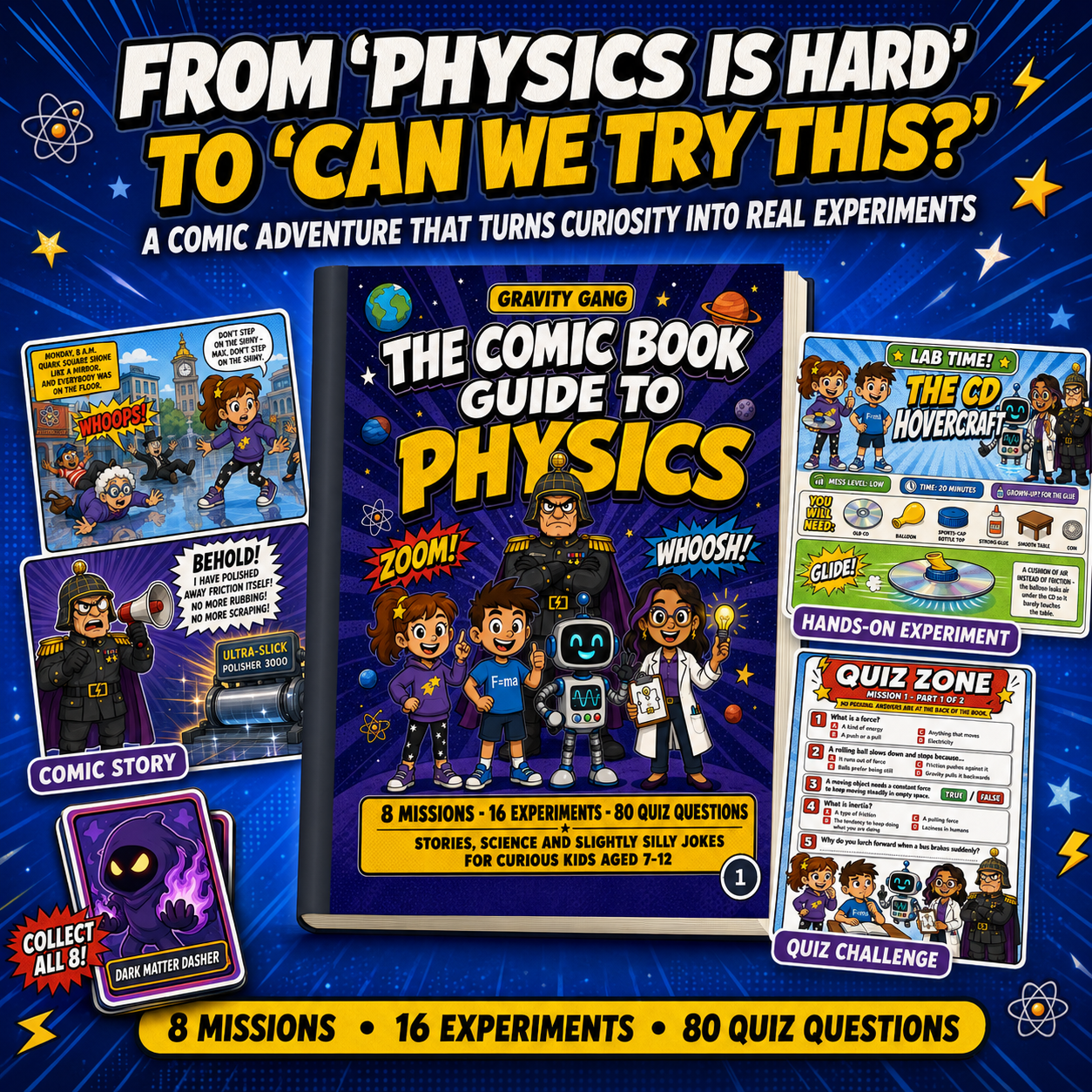
In a classroom, a chapter can open a lesson the same way the mystery-prompt approach above does: read the setup, predict the outcome, then run the matching experiment as a class before finishing the story. At home, the same sequence works as an evening activity instead of screen time. These books come with a money-back guarantee, so trying one with a reluctant reader carries little risk. Browse the full collection of Fizz Force and Gravity Gang books to find the right starting point for your student.
Sources
- NSTA: Designing Scientific Tests — Inquiry guidance
- Grades 3-5 science lab safety agreement (PWCS)
- Inquiry-Based student research project rules & forms for elementary students (CNM-STEMRC)
FAQ
What is the best science project for a 5th grader?
There is no single best project, but the strongest ones ask students to change one variable, measure a result across repeated trials, and explain the pattern in their own words. A density tower, a plant growth comparison, or a ramp friction test all fit that structure well.
What’s a good 5th grade science project?
A salt-gradient density tower is a reliable choice because it is low-cost, low-risk, and produces a clear visual result students can measure and graph. A bridge-building load test is another strong option since it doubles as an engineering design challenge.
What are 10 easy science experiments for kids?
This article groups more than ten age-appropriate options across matter and chemistry, motion, Earth and space, ecosystems, engineering, electricity, and water science, each with a materials list and safety notes. Start with the density tower, balloon rocket, shadow tracking, and plant growth test if you need a quick starting set.
What are some cool easy science experiments?
Oobleck (a cornstarch and water mixture that acts like both a solid and a liquid), a mini solar oven made from a pizza box, and a simple circuit that lights a bulb are all fast, low-mess options that still teach a real science concept. Each one takes under thirty minutes and uses items most households already have.