

Six Kitchen Buoyancy Experiments for Kids: Journals & Design Tasks
You can teach floating and sinking with six simple experiments using items already in your kitchen: a sink-or-float test, a foil-boat load challenge, a floating-egg salt-water demo, a Cartesian diver, a density column, and a clay-boat redesign. Each one takes under 20 minutes, needs no special equipment, and gives kids a hands-on answer to why some things float and others don’t.
TL;DR:
- Most household objects can be used to demonstrate buoyancy, showing that weight alone does not determine whether something floats or sinks.
- Adding salt to water increases its density, allowing eggs to float and illustrating how dissolved minerals impact buoyant force.
- A shape that displaces more water, such as a wider boat, can carry heavier loads without sinking, emphasizing how shape and displacement matter.
- The buoyant force in these experiments is governed by the volume of water displaced, not just the object’s weight, in line with Archimedes’ principle.
- Engaging kids with story-driven experiments and journaling helps solidify understanding by connecting personal memory to scientific concepts.
Table of Contents
- What Is Buoyancy? A Kid-Friendly Explanation
- Materials and Safety for At-Home Buoyancy Tests
- Six Hands-On Buoyancy Experiments to Try Today
- Turning Experiments Into a Real Learning Sequence
- Why Play-Based Buoyancy Experiments Actually Stick
- Bring the Experiments Home With a Story Attached
- Sources
- FAQ
What Is Buoyancy? A Kid-Friendly Explanation
Buoyancy is the upward push water gives back against anything you set in it. When that push, called buoyant force, is stronger than an object’s weight, the object floats. When gravity wins, it sinks. This is Archimedes’ principle in action: buoyant force equals the weight of the fluid an object shoves out of the way.
Density explains the rest. Density is just mass squeezed into a given amount of space, and it’s why a heavy steel ship floats while a small steel bolt drops straight to the bottom. Shape matters more than weight alone, since a spread-out shape displaces far more water than a lump does.
A few examples to use while talking with kids:
- A basketball floats because it’s mostly hollow, packing very little mass into a lot of space.
- A grape sinks in water but often floats in soda, because the sugar changes the liquid’s density.
- A cruise ship weighing thousands of tons floats for the same reason a foil boat does: shape spreads the weight over more displaced water.
Materials and Safety for At-Home Buoyancy Tests
Nearly every experiment below pulls from the same short supply list, so you can set up once and run all six.
Grab these household items:
- A clear plastic tub or large bowl, plus a smaller cup for the diver
- Aluminum foil, clay or Play-Doh, and small Lego pieces
- Eggs, table salt, and measuring spoons
- Coins or metal washers for load testing
- A plastic water bottle with a lid, for the Cartesian diver
- Cooking oil, dish soap, corn syrup, and food coloring for the density column
- A notebook or printed data sheet for recording results
Use plastic or metal containers instead of glass around younger children, keep loose coins away from kids under three, and stick to edible liquids since curious hands end up near mouths. Adult supervision matters most during the density column step, where several liquids get poured in sequence.
Run every experiment the same way: predict what will happen, test it, record the actual result, then talk about why it matched or didn’t. That prediction-test-record cycle is what separates a science experiment from a party trick, and structured observation journals measurably improve how much kids retain from hands-on activities.
Pro Tip: Keep a simple three-column chart taped to the fridge: “I think it will…”, “What happened”, “Why”. Kids as young as four can fill it in with drawings instead of words.
Six Hands-On Buoyancy Experiments to Try Today
1. Sink-or-float sorting test
Fill a clear tub with water and gather ten household objects: a cork, a coin, a plastic spoon, a rubber band, a rock, a crayon, a marble, a leaf, a paperclip, and an apple slice. Have kids predict each item’s fate before it touches the water, then drop it in and record the actual result. This is the fastest way to expose the misconception that heavy always means sinks. A small rock sinks, but a much heavier apple floats, because the fruit’s flesh is full of air pockets.
2. Foil boat load challenge
Cut a small square of aluminum foil and shape it into a small boat with raised sides. Float it in the tub and add pennies or washers one at a time until it takes on water and sinks. Record the maximum load, then flatten the foil into a ball and try again with the same amount of metal. The ball sinks almost immediately, since the buoyant force depends on how much water gets displaced, not on the foil’s weight. Try a wider hull or higher walls as a design variation and compare coin counts.
3. Floating egg in salt water
Set two glasses of water side by side, one plain and one stirred with salt dissolved in the water. Lower a raw egg gently into each. The egg sinks in the plain glass and floats in the salt water, because dissolved salt raises the water’s density enough to push the egg upward. For an extension, add salt gradually to the plain glass and watch the egg slowly rise off the bottom.
4. Cartesian diver bottle submarine
Wad a small piece of aluminum foil into a loose ball with a tiny air pocket inside, or use a glass pipette weighted with a paperclip, and drop it into a water bottle filled to the top. Screw the lid on tight. Squeezing the bottle’s sides makes the diver sink; releasing lets it rise. The squeeze compresses the air pocket, shrinking the volume of water it displaces and reducing its buoyant force until gravity takes over.
5. Density column with kitchen liquids
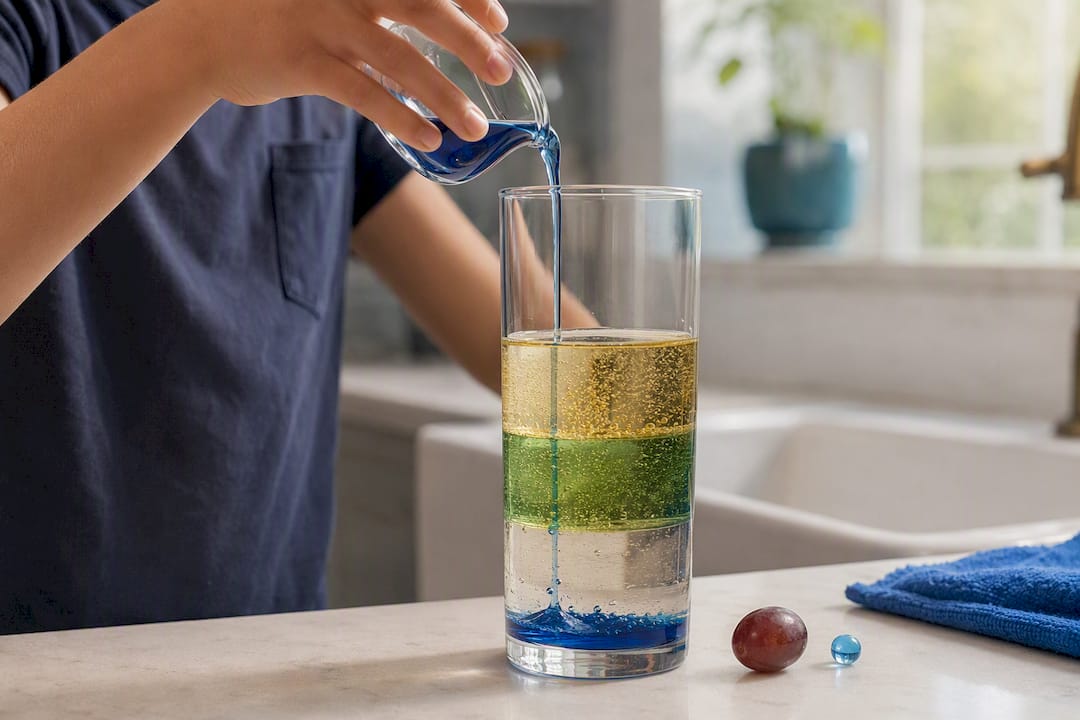
Pour corn syrup into a tall clear glass, then slowly add dish soap, water tinted with food coloring, and cooking oil, in that order, pouring each along the inside wall so it doesn’t mix. The liquids settle into distinct layers because each has a different density, heaviest at the bottom. Drop in a grape, a bead, and a small piece of foil to see where each object settles within the column.
6. Clay or Lego raft design challenge
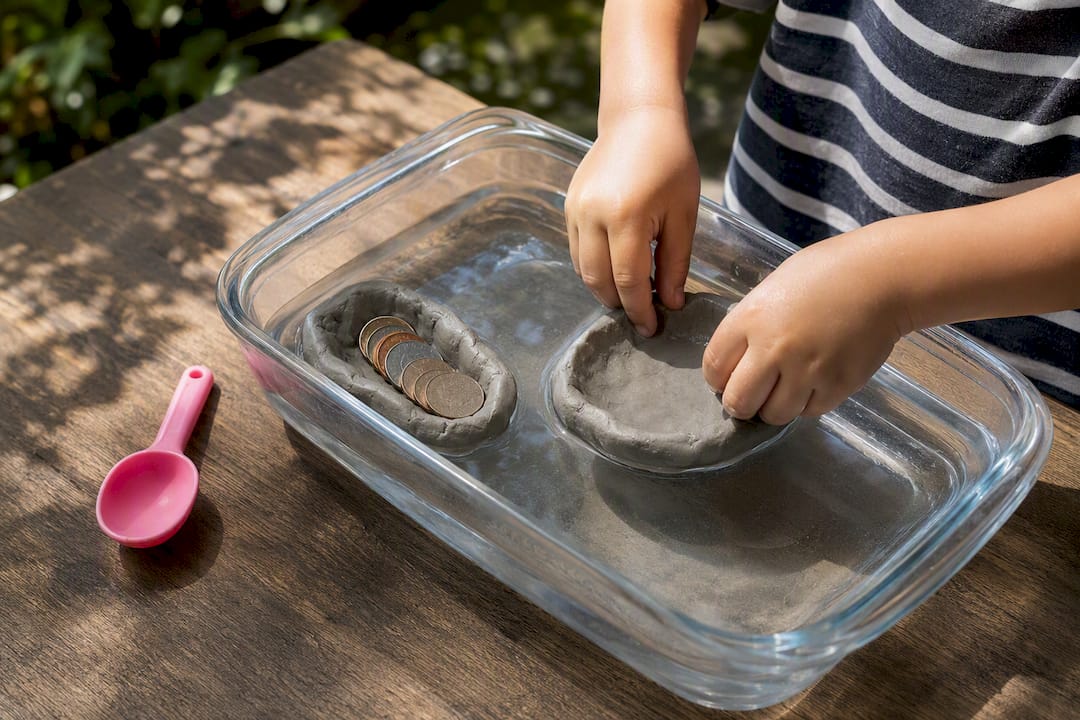
Give kids a golf-ball-sized lump of clay and watch it sink. Then challenge them to reshape that same lump into a boat, canoe, or raft that floats and holds cargo. Test each design by adding coins until it sinks, and record the winning shape’s coin count. This is the same principle engineering curricula use for boat-design challenges: a wider, shallower hull displaces more water for the same amount of clay, so it floats higher and carries more.
Turning Experiments Into a Real Learning Sequence
A single demo is fun for five minutes, but a sequence of demos with journaling and design challenges is where the science actually sticks. Have kids write a one-sentence prediction before every test, then a one-sentence explanation after, using words like “displace” and “density” once they’ve heard them a few times.
For scaffolded questions, adjust by age: younger kids answer “did it float or sink?”, while kids ten and up can answer “why did the shape change the result?” A simple rubric for the design challenges works well too, scoring boats on stability (does it tip?), load capacity (coins held before sinking), and repeatability (does the same design work twice in a row).
Story-driven formats matter here. Some educational comic books build their narratives around exactly this loop: a comic narrative sets up a question, then a kitchen experiment answers it, which keeps reluctant readers turning pages instead of closing the book.
Pro Tip: Have kids present their winning raft design to a sibling or parent and explain, out loud, why it works. Teaching the concept back is one of the fastest ways to confirm they actually understood it.
Why Play-Based Buoyancy Experiments Actually Stick
Kids don’t remember a definition of density. They remember the moment an egg they thought would sink started floating in salt water. That single surprising result builds a mental model of displacement far more durable than a worksheet ever could, because it’s tied to a specific, personal memory instead of an abstract rule.
Pairing a story with an experiment does something a plain instruction sheet can’t: it gives the science a reason to matter before the test even starts. Kids who read why a character needs a stronger boat approach the foil-boat challenge with a question already in mind, and that curiosity is what carries them through failed designs to a working one.
— Brainie Comics
Bring the Experiments Home With a Story Attached
Worksheets explain buoyancy. A story makes a kid want to test it. Some educational comic books wrap science concepts inside a comic adventure, with kitchen-safe experiments woven into the plot instead of bolted on afterward, and include hands-on activities that build on ideas like floating and sinking.
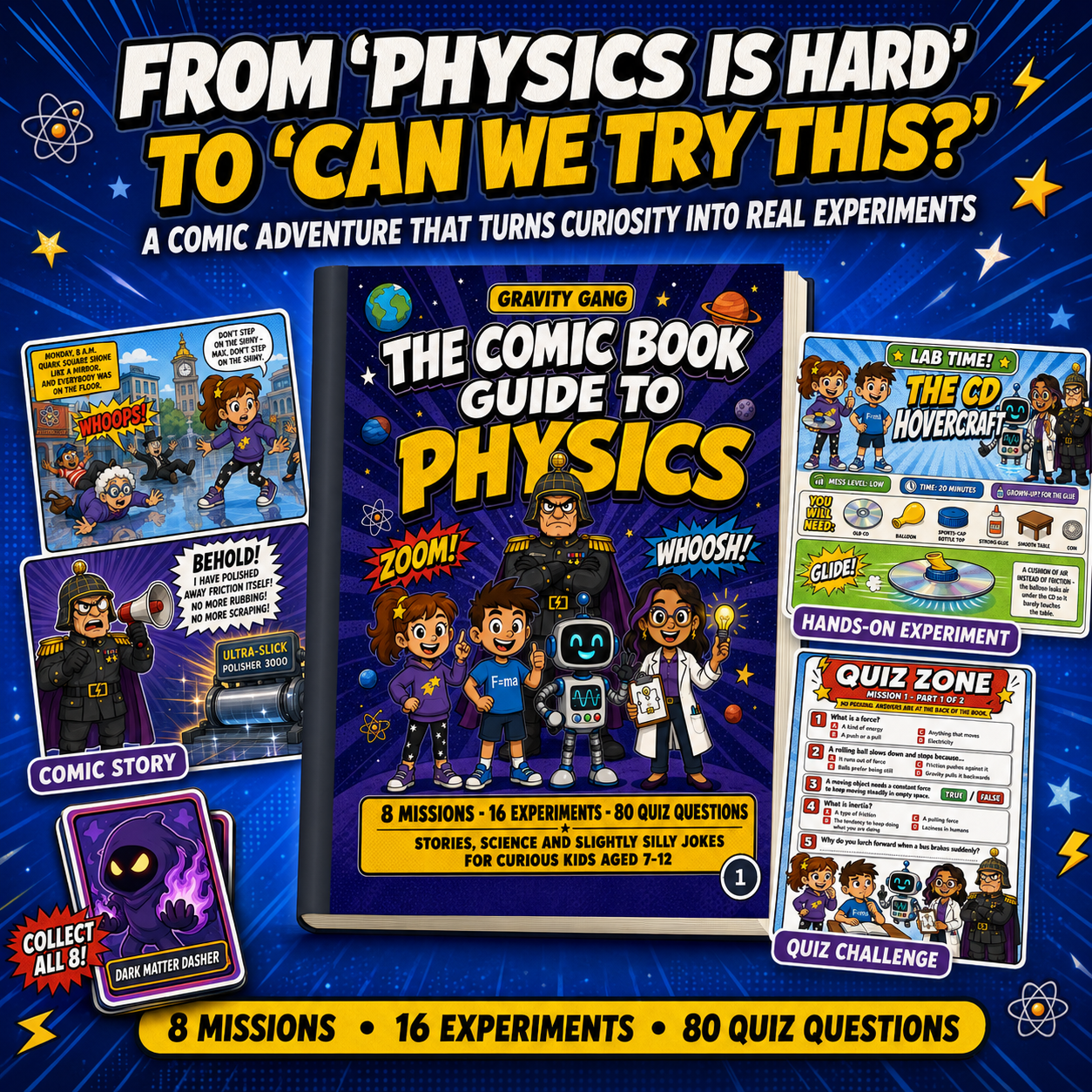
These types of books often come with step-by-step experiment instructions, worksheets, and sometimes a completion certificate at the end, so the six experiments above become a launchpad rather than a one-off afternoon. If your child burned through the foil-boat challenge and wants the next thing, preview Gravity Gang or Fizz Force and see which storyline hooks them first.
Sources
For the physics behind these demos, see the University of Illinois physics Q&A on buoyancy and Physics Classroom’s lesson on sinking and floating. For more at-home activities, visit Brainie Comics’ guides to sink or float experiments and the density tower experiment.
- University of Illinois physics Q&A: Buoyancy / Archimedes’ principle
- Physics Classroom — Sinking and floating
- Oxford Chemistry: Does it float or does it sink?
- TeachEngineering — Boat design and buoyancy activities
FAQ
What are some everyday examples of buoyancy?
Ships, life jackets, hot air balloons, fish adjusting their swim bladders, ice cubes floating in a drink, and oil sitting on top of vinegar in salad dressing all show buoyancy at work through differences in density.
Does adding salt to water make things float?
Yes. Salt raises the water’s density, which increases the buoyant force pushing up on an object, and that’s exactly why an egg that sinks in fresh water floats in salt water.
What are some fun sink-or-float experiments for kids?
The classic sorting test with ten household objects, the foil-boat load challenge, and the floating-egg salt-water demo are all quick, low-mess options that work well for ages four and up, and Brainie Comics’ sink or float guide walks through several more.
What is the law of floatation?
The law of floatation states that a floating object displaces a volume of fluid equal in weight to its own weight, which is the same idea behind Archimedes’ principle: buoyant force equals the weight of displaced fluid.
How do I explain buoyancy to a young child?
Tell them water pushes back on anything placed in it, and if that push is strong enough to beat the object’s weight, it floats. Demonstrating with the foil ball versus foil boat makes the point faster than any explanation alone.