

Ready Templates and Low Cost Materials for Project Based STEM Teachers
Project-based STEM asks students to spend sustained time solving an authentic, open-ended problem while applying physics, chemistry, engineering, or math concepts they can defend in public. A recent meta-analysis published in Scientific Reports found a large effect on students’ research and engineering skills, and the format also lifts motivation and teamwork. Below you’ll find planning templates, grade-banded project briefs, and low-cost materials lists you can use this week.
TL;DR:
- Research shows STEM project-based learning has a large effect size of 1.75 on research and engineering skills, with higher motivation and teamwork.
- Effective projects include a meaningful driving question, iterative build-test-revise cycles, student choice, and a public presentation to ensure rigor.
- Scaffolding through entry events, tiered supports, and household materials removes access barriers and supports diverse learners.
- Technology should enhance research, data collection, and sharing, but not replace the core design cycle or turn into superficial decoration.
- Partnering with community members, using story-driven entry events, and incorporating household materials increase authenticity and engagement.
Table of Contents
- What Project-Based STEM Learning Looks Like in Practice
- What the Research Actually Shows
- The 7 Key Elements of Rigorous Project-Based STEM
- Planning a STEM Project: Driving Questions, Timelines, and Iteration
- Classroom-Ready STEM Project Templates by Grade Band
- Assessment, Scaffolding, and Equity in STEM PBL
- Resources, Lesson Banks, and Classroom-Ready Supports
- Where Technology Fits Into STEM Projects
- Preparing Teachers to Facilitate STEM PBL
- Bringing Community and Industry Partners Into STEM Projects
- Why Brainie Comics Believes in Starting With a Story
- Bring Project-Based STEM Into Your Classroom and Home
- Sources
- FAQ
What Project-Based STEM Learning Looks Like in Practice
Project-based STEM learning is extended inquiry, not a one-day lab. Students tackle an authentic, complex problem that requires them to apply integrated STEM knowledge over time, testing ideas, failing, and revising before presenting a finished product to a real audience. NASA JPL’s water filter project is a clean example: students build a filter, test water clarity, then redesign based on what failed.
Genuine STEM PBL usually runs anywhere from a single extended lesson to several weeks, depending on scope. A few markers separate real PBL from a dressed-up worksheet:
- A driving question that has no single “correct” answer known in advance
- At least one build-test-redesign cycle, not just a single attempt
- A public product: a presentation, a demo, a poster session, or a pitch
- Sustained student ownership over decisions, not just following steps
Compare that to problem-based learning, which often centers on a single scenario solved in one or two sittings, or a hands-on demo, which teaches a concept but skips the iteration and public accountability that make PBL stick.
What the Research Actually Shows
The evidence for STEM PBL is stronger than most teachers realize, and it’s specific enough to cite in a staff meeting.
By the Numbers: A 2026 meta-analysis in Scientific Reports found an overall effect size of d = 1.75 for STEM project-based learning on research and engineering skills, with a related experimental study showing a post-test effect of d = 1.27, both considered large by standard benchmarks.
That’s a big jump for something as simple as changing how a unit is structured. A classroom intervention published in Frontiers in Education reported higher posttest cognitive scores alongside descriptive gains in motivation, confidence, and perceptions of teamwork after students worked through a socially relevant interdisciplinary challenge. The authors flag a caveat worth remembering: pretest-posttest designs like this show real gains but can’t fully isolate PBL from other classroom factors happening at the same time.
The pattern across reliable studies is consistent: PBL works best when it’s scaffolded deliberately and tied to a context students actually care about, not dropped into a curriculum as an unstructured free-for-all. A civic or socially relevant framing, in particular, tends to raise student buy-in and strengthen the interdisciplinary connections that make STEM PBL different from a standard lab.
The 7 Key Elements of Rigorous Project-Based STEM
PBLWorks outlines seven design elements that separate rigorous project-based learning from a themed activity packet. Here’s how each one maps onto STEM practice specifically:
- A challenging problem or question. The driving question should require engineering design thinking or data analysis to answer, not a Google search.
- Sustained inquiry. Students generate their own sub-questions and research paths across multiple class periods.
- Authenticity. The problem, materials, or audience connect to something real, ideally with community or industry relevance.
- Student voice and choice. Learners choose their design approach, materials, or presentation format within set constraints.
- Reflection. Built-in checkpoints where students evaluate what failed and why, mirroring the engineering design cycle.
- Critique and revision. Peer or expert feedback drives at least one redesign before the final product ships.
- A public product. Work is shared beyond the teacher, whether that’s a science fair, a class showcase, or a video pitch.
The most common mistake is skipping elements 5 and 6. Without built-in redesign, a project is just a longer demo with better packaging.
Planning a STEM Project: Driving Questions, Timelines, and Iteration
Start with the driving question, because everything else in the unit flows from it. A strong question is open-ended, tied to a standard, and rooted in something local: “How can we reduce plastic waste in our cafeteria?” beats “What is plastic made of?” every time, because it forces design decisions instead of recall.
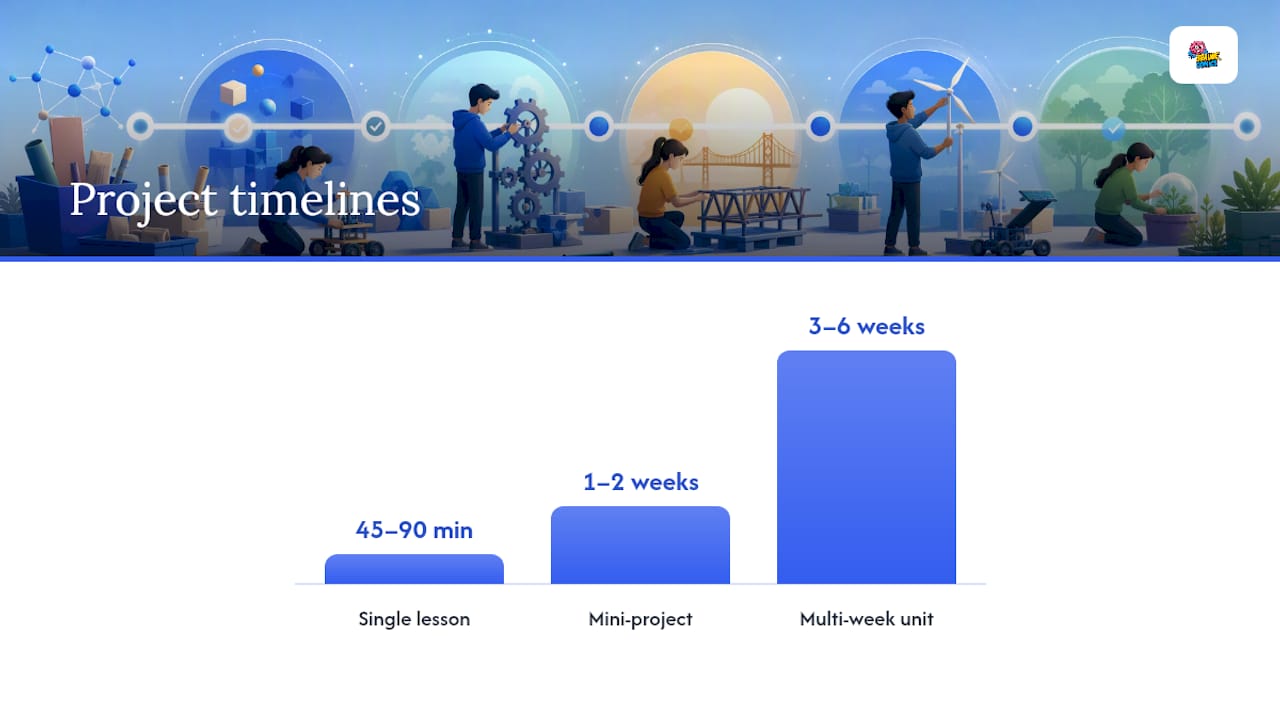
Pick a timeline that matches your scope:
- Single lesson (45–90 minutes): One build-test cycle, household materials, quick share-out.
- Mini-project (1–2 weeks): Two to three redesign cycles, a simple rubric, small-group presentations.
- Multi-week unit (3–6 weeks): Full engineering design cycle, data collection and analysis, a public product like a science fair or pitch night.
Materials matter less than the substitution list you have ready. Coffee filters swap for lab filter paper, sandwich bags stand in for beakers, and baking soda and vinegar cover most reaction-based demos without a supply order. Always run a safety check before handing over anything involving heat, sharp edges, or chemical mixing, even household-grade ones like vinegar and bleach.
Pro Tip: Build one deliberate “failure checkpoint” into every project, a moment where students must document what didn’t work before they’re allowed to redesign. It normalizes revision as data collection instead of a mark against them.
Collect formative data at each redesign checkpoint, not just at the final product. That single habit predicts learning gains better than a one-shot final grade.
Classroom-Ready STEM Project Templates by Grade Band
You don’t need to build these from scratch. Here’s a starting brief for three grade bands, each adaptable with materials most classrooms already have.
- Elementary (K–5): A 45-minute buoyancy challenge using household containers and clay. Students predict, test, and redesign a boat shape to hold the most pennies before sinking; see the sink or float project guide for a full materials list and worksheet.
- Middle school (6–8): A two-week egg-drop engineering challenge where teams design protective packaging from straws, tape, and cardboard, test drops from increasing heights, and redesign after each failure. A full teacher and parent guide walks through scoring and safety notes.
- High school (9–12): A four-week water filtration and data-analysis project modeled on NASA JPL’s engineering design process, where students test turbidity, graph results, and present filter designs to a panel of judges or community members.
Every one of these extends naturally into a family project using inquiry-based activities at home, and the egg-drop and filtration challenges both connect cleanly to a physics or engineering standard without extra planning.
Assessment, Scaffolding, and Equity in STEM PBL
Assessment in STEM PBL should track the process, not just the finished poster. Build formative checkpoints at each redesign cycle, use a rubric that scores both the engineering practice and the content standard separately, and run a peer critique protocol before the final iteration.
Scaffolding matters most for students who haven’t done open-ended work before. An entry event, like a short video or a provocative object, gives every student a shared starting point. Offer choice in materials or format, tier support with sentence starters or partial data tables for students who need them, and rotate your own role between coach and co-investigator rather than answer-giver.
- Use an entry event to build shared background before releasing students to design
- Offer at least two format choices for the public product
- Provide tiered data-collection sheets for students who need more structure
- Substitute low-cost household materials to remove cost as a barrier
| Focus area | What to check | Why it matters |
|---|---|---|
| Formative assessment | Progress at each redesign checkpoint | Predicts final learning gains better than end-only grading |
| Scaffolding | Entry event, tiered supports, role rotation | Gives every student an accessible starting point |
| Equity | Household materials, culturally relevant contexts | Removes cost and access barriers to full participation |
Resources, Lesson Banks, and Classroom-Ready Supports
You don’t have to build every unit alone. NASA JPL provides free engineering lesson plans with materials lists and safety notes. FIRST offers grade-banded activity cards for ages 6 to 13 that work well as warm-up challenges. PBLWorks supplies rubrics and planning frameworks you can adapt directly.
Brainie Comics fits a specific gap in that toolkit: the entry event. A comic-format story that dramatizes a physics or chemistry concept works as a hook before you launch a design challenge, and the built-in kitchen experiments double as a homework lab or family extension without requiring a supply order.
- NASA JPL: free lesson plans, materials lists, and engineering design steps
- FIRST: modular activity cards for quick challenges across grade bands
- PBLWorks: rubrics and standards-alignment frameworks
- Brainie Comics: story-driven entry events and take-home experiment extensions
Where Technology Fits Into STEM Projects
Technology should support the design cycle, not replace it. The strongest use of digital tools in STEM PBL happens at three points: research, data collection, and the public product.
For research, simple simulation tools let students test variables faster than physical trial and error allows, which is useful when class time is tight and materials are limited. For data collection, a shared spreadsheet or a simple sensor kit turns a single test into a data set students can graph and argue about, which pushes a project from “we tried it” to “here’s what the numbers show.” That shift matters for the research and engineering skills gains documented in the Scientific Reports meta-analysis, since data literacy is part of what’s being measured.
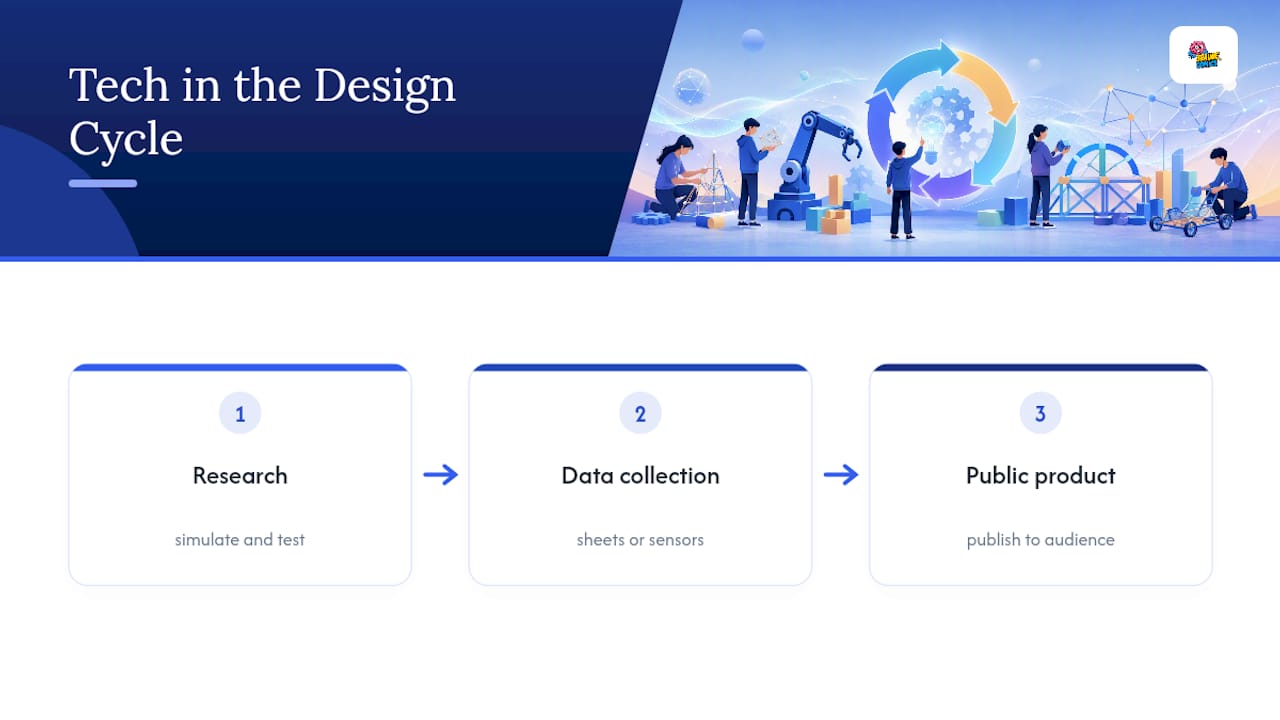
For the public product, digital platforms give students an authentic audience beyond the classroom wall. A collaborative platform like Noise lets teams publish a pitch, a design walkthrough, or a demo video for classmates, parents, or outside reviewers to respond to, which satisfies the “public product” element that separates PBL from a private assignment.
The mistake to avoid is treating a slideshow as the whole technology plan. Technology earns its place in a STEM project when it changes what students can test, measure, or share, not when it just formats a report. If a tool doesn’t add a capability students didn’t have with paper and a calculator, it’s decoration, not integration.
Preparing Teachers to Facilitate STEM PBL
Facilitating a STEM project well is a different skill than delivering a lecture, and most teacher preparation programs spend little time on it. The core shift is moving from “answer-giver” to “coach,” which means tolerating longer silences while students work through a failed test and resisting the urge to hand over the fix.
Effective professional development for STEM PBL usually covers three things: how to write a driving question that survives contact with real students, how to build a rubric that scores process alongside product, and how to manage a classroom where groups are at different stages of the same project simultaneously. That last skill trips up more new PBL teachers than anything else, since a traditional lesson plan assumes everyone moves in lockstep.
The Project Planning Pyramid approach described in a review of integrated STEM education offers one practical fix: sequence your content storyline and your practice pathway separately so a project stays discipline-rich even when groups progress at different speeds. Pairing that structure with a flipped-classroom or launch-design-pitch framework gives you natural checkpoints for formative assessment, which solves the pacing problem without forcing every group onto the same clock.
The fastest way to build this skill is small. Run one two-week mini-project before attempting a six-week unit, debrief with a colleague afterward, and adjust your rubric based on where students actually struggled, not where you assumed they would.
Bringing Community and Industry Partners Into STEM Projects
A project gains authenticity fast once someone outside the classroom has a stake in the outcome. That doesn’t require a formal partnership; it can be as simple as inviting a local engineer, nurse, or small-business owner to serve as the “client” who defines the problem or reviews final pitches.
Three entry points work well for most schools. First, use a real local problem as the driving question, like cafeteria waste, a nearby waterway, or a school garden’s irrigation, so students know the outcome could matter to actual people. Second, recruit one guest reviewer per project cycle rather than a full advisory board; a single parent or community member with relevant experience can sit on a panel for a final pitch session and give feedback that carries more weight than a grade alone. Third, loop in your PTA or a local library for material support. A PTA-run STEM kit builder can help fund low-cost supply kits so material access doesn’t determine which students get to fully participate.
Industry partners don’t need to run the whole unit to add value. Even a 15-minute video call where a local professional answers student questions about a design constraint adds the kind of authenticity that a socially relevant challenge thrives on, and it’s far easier to schedule than a full-day classroom visit.
Why Brainie Comics Believes in Starting With a Story
Every strong STEM project needs a hook before it needs a rubric. What we’ve seen work in classrooms using comic-led entry events is simple: kids who call themselves “not science people” ask to keep reading past the assigned chapter, then walk into the kitchen experiment already invested in the outcome. That’s the whole game with reluctant readers and reluctant scientists alike. Try one comic-led mini-project this term and watch what happens to your entry-event engagement.
— Brainie Comics
Bring Project-Based STEM Into Your Classroom and Home
Brainie Comics gives you a ready-made entry event without the prep time a from-scratch unit demands: open a comic, and the driving question is already built into the story. Fizz Force pairs naturally with chemistry projects, walking students through kitchen-safe reactions before they design their own experiment. Gravity Gang does the same for physics and engineering challenges, setting up motion and force concepts students can test with a build-test-redesign cycle of their own.
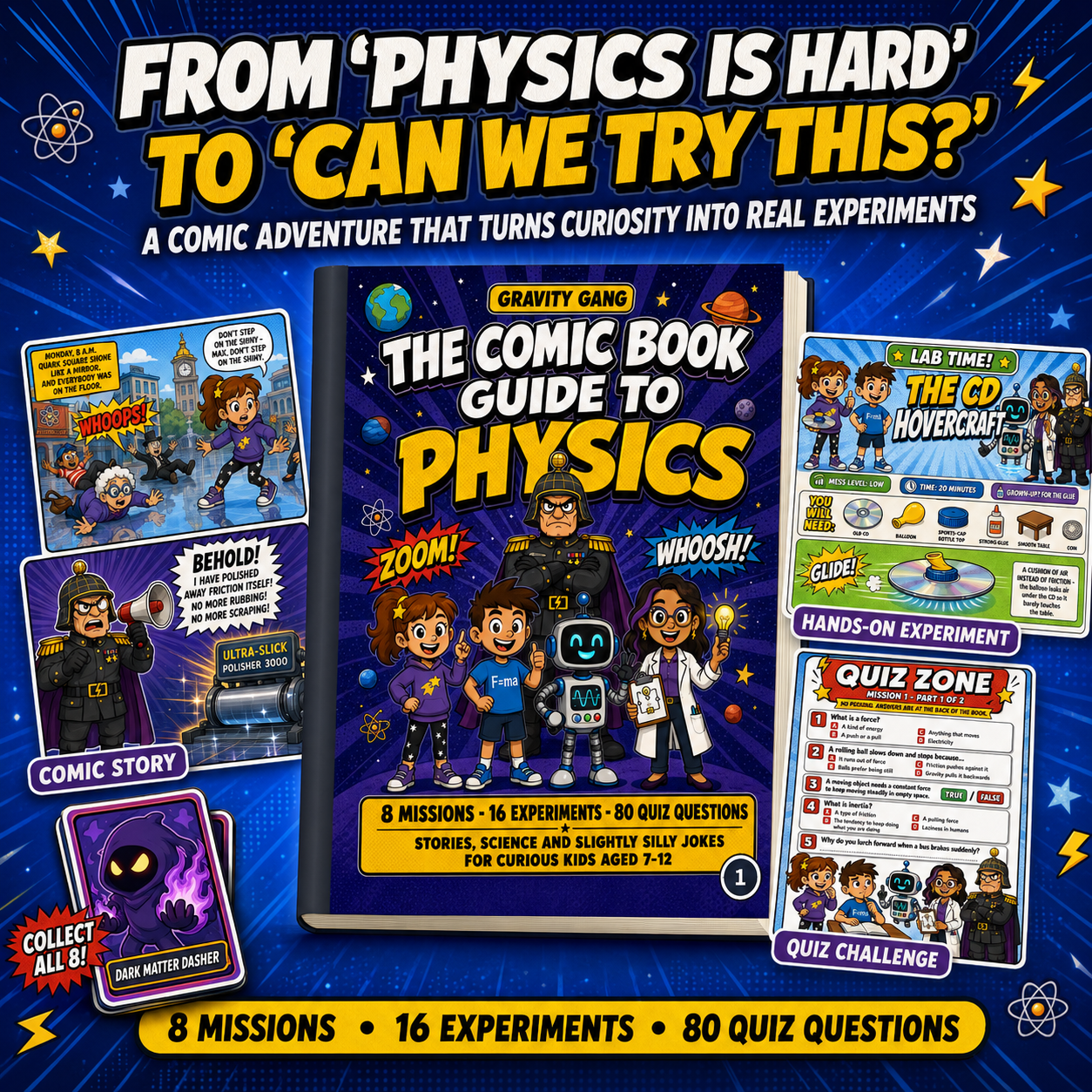
Both work as a homework lab, a sub-day activity, or a family extension you can send home alongside a classroom unit, and each comic includes quizzes that give you a built-in formative check without writing a new rubric. If you’re planning a chemistry unit, start with Fizz Force. For a physics or engineering challenge, Gravity Gang sets the stage. Browse the full catalog and classroom bundle options at Brainie Comics to find the right entry point for your next project.
Sources
- Impact of STEM Project-Based Learning on research autonomy and engineering thinking in solar energy education | Scientific Reports
- Project-based STEM learning through a socially relevant challenge: cognitive and affective outcomes | Frontiers in Education
- Make a Water Filter – Engineering Project | NASA JPL Education
- PBLWorks — What is PBL?
- FIRST at-home STEM curriculum series (activity cards and lesson resources)
FAQ
What Is a STEM-Based Project?
A STEM-based project is an extended, authentic inquiry where students apply science, technology, engineering, or math concepts to solve an open-ended problem, then present a public product after at least one round of testing and redesign.
Is Project STEM Free?
Many high-quality resources are free, including NASA JPL’s engineering lesson plans and FIRST’s activity card library, while paid resources like Brainie Comics add a story-driven entry event and structured experiment guide.
What Are Examples of STEM Projects?
Examples include a water filtration and testing challenge, an egg-drop engineering design task, a buoyancy and boat-design activity, and a chemistry reaction investigation using household materials like baking soda and vinegar.
What Are the 7 Key Elements of Project-Based Learning?
According to PBLWorks, the seven elements are a challenging problem, sustained inquiry, authenticity, student voice and choice, reflection, critique and revision, and a public product.
How Long Should a STEM Project Last?
STEM projects range from a single 45 to 90 minute lesson with one build-test cycle up to a six-week unit with multiple redesign cycles and a final public presentation, depending on the depth of the standard being taught.