

Egg Drop Challenge: Teacher and Parent Guide
The egg drop challenge is a hands-on STEM activity where students design a protective container to keep a raw egg intact after a fall. Three strategies cover most winning designs: slow the fall with drag (a parachute or wide flap), absorb the impact with cushioning (crumple zones, foam, or suspension), and land on the egg’s strongest end, the arch end pointing down. A single session typically runs around an hour and needs only everyday classroom supplies. Scoring is on criteria including egg survival, device compactness, and creativity.
Key Takeaways
The egg drop challenge succeeds when students slow the fall, absorb the impact, and orient the egg arch-end down, then iterate at least once based on what the data shows.
| Point | Details |
|---|---|
| Three core strategies | Slow descent (drag), cushion impact (elastic materials), and land arch-end down for maximum shell strength. |
| Budget and time | A single session runs 40–60 minutes; per-group materials cost under $5 using recycled supplies. |
| Fair scoring | Score on egg survival, device compactness, material reuse, and iteration documentation, not just who wins. |
| Iteration is the lesson | A broken egg is data; require at least one documented redesign change before the second drop. |
| Brainiecomics | Gravity Gang introduces energy and impact physics through comics before the session; Fizz Force extends into chemistry for the naked egg variant. |
Table of Contents
- What materials do you need for an egg drop challenge?
- How do you run an egg drop challenge step by step?
- What physics actually explains why some designs survive?
- Which design templates actually work?
- How do you score and record results fairly?
- Safety, cleanup, and age-based adjustments
- How does this activity connect to NGSS and other subjects?
- Why a story prompt makes the whole thing work better
- What experienced teachers notice during the test phase
- Brainie Comics makes the physics click before you even start
- Sources
What materials do you need for an egg drop challenge?
Keep the supply list short. Most of what you need is already in a classroom or kitchen drawer.
Shared classroom kit (teacher provides):
- Raw eggs (one per group, plus spares)
- Tape measure or yardstick
- Timer or stopwatch
- Drop zone tarp or plastic sheeting
- Paper towels and a trash bag for cleanup
Per-group build kit (each team assembles):
- 10–15 index cards or sheets of newspaper
- 1 plastic sandwich bag (Ziploc containment if the egg breaks)
- 1 rubber band bundle
- 30 cm of masking tape
- Cotton balls or tissue paper (cushioning)
- 1 small plastic bag or thin fabric scrap (parachute)
Low-cost substitutes work well: recycled cardboard from cereal boxes, packing paper, scrap fabric, or bubble wrap from online orders. The WYSE "Egg"cellent Engineering challenge runs the entire activity on a $12 budget per group, which is a useful ceiling for classroom planning.
Avoid gels, liquids, food products (peanut butter, pudding), and anything that creates a biohazard if the egg breaks. Foam spray and commercial packing peanuts are fine but tend to inflate device size and hurt compactness scores.
| Item | Budget option | Approx. cost |
|---|---|---|
| Raw eggs (6-pack) | Store brand | $2–$3 |
| Masking tape (1 roll) | Dollar store | $1 |
| Cotton balls (bag) | Dollar store | $1 |
| Newspaper/index cards | Recycled/school supply | $0–$1 |
| Plastic bags (box) | Dollar store | $1 |
Total per group typically lands under $5 when you use recycled materials for the structural elements.
How do you run an egg drop challenge step by step?
The sequence is plan, build, test, measure, and iterate. Announce it at the start so students understand that a broken egg on the first drop is data, not failure.
Single-session timeline (45 minutes):
- Brief and design (10 min): Introduce the rules, hand out materials, and give each group a blank design sheet to sketch their container before touching supplies.
- Build (15 min): Groups construct their device. No modifications allowed once the build phase ends.
- Test drop (5 min): Drop from a fixed height (start at 6 feet; Future Engineers uses an eight-foot standard). Record survival, device dimensions, and any observations.
- Measure and record (5 min): Teams fill in their data sheet: drop height, device size, survived (yes/no), and one observation about what happened on impact.
- Redesign and second drop (10 min): Groups make one targeted change based on what they observed, then drop again.
Roles to assign:
- Timekeeper: keeps build and drop phases on schedule
- Recorder: fills in the data sheet
- Dropper: releases the device at the marked height
- Observer: watches the landing and calls the result
For a multi-session version, split design and build into Day 1, testing and iteration into Day 2. That pacing lets students research materials overnight and produces noticeably more deliberate designs.
Safety rules: Mark a clear drop zone on the floor with tape. No one stands under the drop path. Use a stepladder only with an adult holding it steady. Place a tarp or plastic sheet under the landing area. If an egg breaks, the recorder notes it and the group cleans up before the next drop.
What physics actually explains why some designs survive?
When an egg is held at height, it stores potential energy. The moment it drops, that energy converts to kinetic energy. At impact, all that kinetic energy has to go somewhere, and the egg’s shell is the weakest link unless the design intervenes.
The key variable is deceleration time. Peak impact force drops as the collision stretches over a longer time interval. A design that spreads the stop across 0.3 seconds instead of 0.03 seconds reduces peak force by roughly a factor of ten. That’s the physics behind both parachutes and crumple zones: neither eliminates the energy, but both buy time.
Three mechanisms do the work:
- Drag: A parachute or wide flat surface creates air resistance that slows descent, reducing the kinetic energy at the moment of impact.
- Cushioning: Elastic materials dissipate kinetic energy by deforming on impact. Tissue, fabric, rubber bands, and grass are all effective because they compress and spring back rather than transmitting force directly to the shell.
- Orientation: An egg’s arch ends are structurally stronger than its sides. Landing arch-end down distributes force across the dome shape rather than concentrating it at a single point.
Teacher talking points for classroom discussion:
- “Where did the energy go when the egg hit the ground?”
- “What would happen if we doubled the drop height? Would the force double?”
- “Which part of your design did the most work: slowing the fall or absorbing the landing?”
- “How would you test just one variable at a time?”
These prompts align with NGSS Science and Engineering Practice 3 (planning and carrying out investigations) and Practice 6 (constructing explanations).
Which design templates actually work?
Parachute lander
Materials: 1 plastic bag or thin fabric square, 4 strings (30 cm each), tape, cotton ball nest inside a small box.
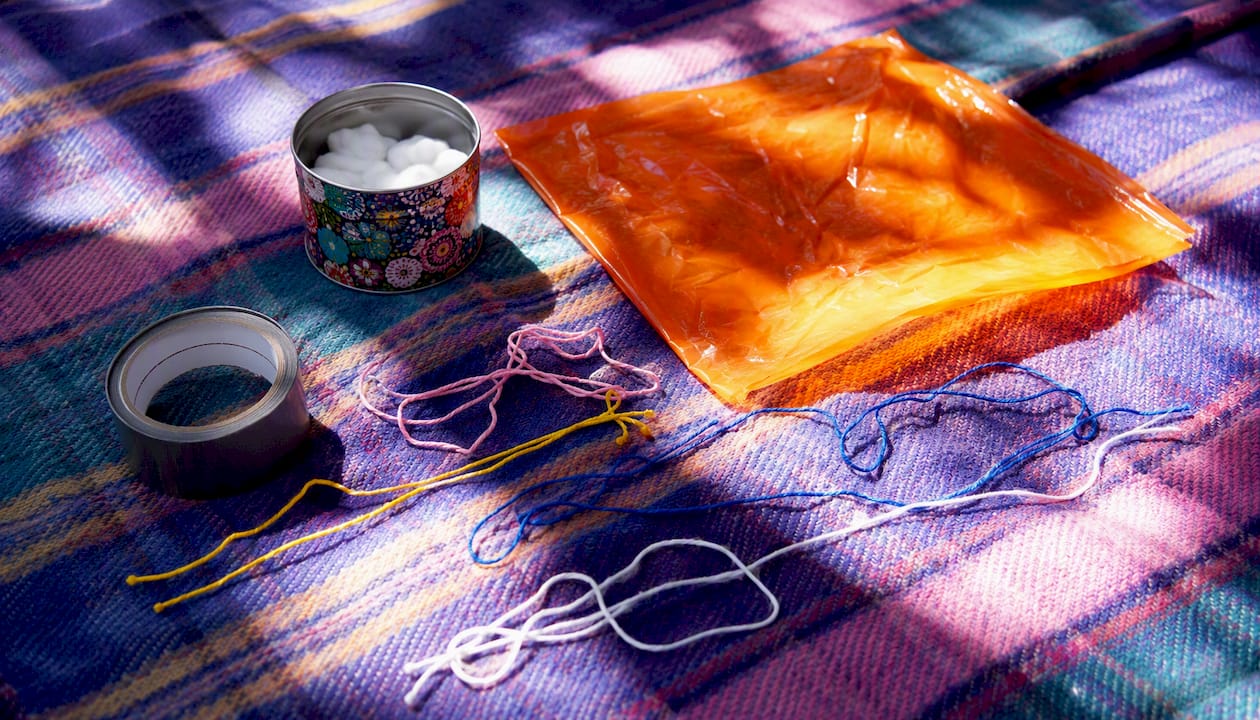
Build: Cut the bag into a square, tie one string to each corner, attach all four strings to the container lid, and pack the egg in cotton balls inside the box. The parachute deploys on release and slows descent.
Why it works: Drag reduces impact velocity. The cotton nest handles the remaining landing force. Main failure mode: parachute collapses if the device spins. Fix it by adding a small tail (a strip of paper) to stabilize rotation.
Crumple-box
Materials: Corrugated cardboard, newspaper, tape.
Build: Wrap the egg in several layers of crumpled newspaper, then enclose it in a cardboard box with crumpled paper filling every gap. The outer box deforms on impact; the inner layers absorb the rest.
Trade-off: More layers mean better cushioning but a larger, heavier device. Heavier devices hit harder. Find the minimum layers that still protect, then stop adding.
Suspension cradle
Materials: Rubber bands, cardboard frame, tape.
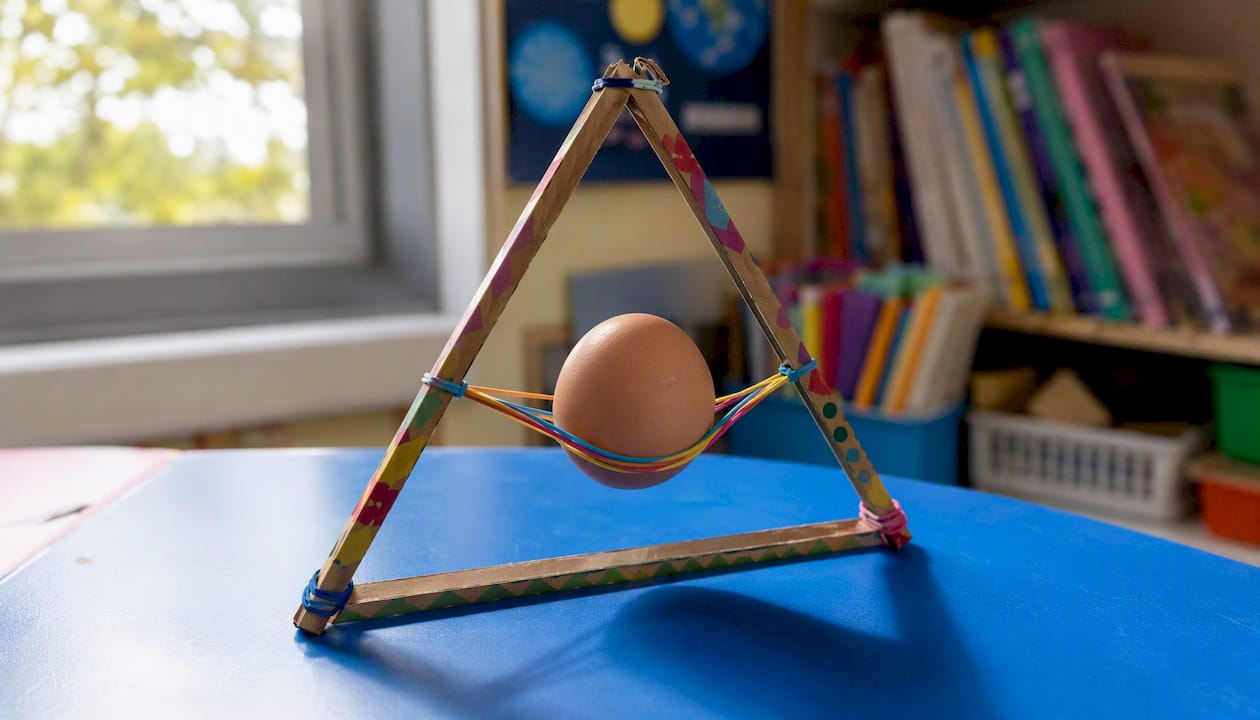
Build: Build a rectangular cardboard frame slightly larger than the egg. Stretch rubber bands across the frame in a grid pattern. Nest the egg in the center of the grid so it hangs suspended without touching any rigid surface.
Why it works: The rubber bands act as springs, extending deceleration time on impact. Experienced educators recommend replaceable inserts like these so teams can swap cushioning layers between drops without rebuilding the whole frame.
Balloon buffer
Inflate a small balloon to roughly the size of a fist, place the egg against it inside a bag, and seal. The air in the balloon compresses on impact and distributes force across a larger surface area. Simple, fast to build, and surprisingly effective from moderate heights.
Pro Tips:
Pro Tip: Put the egg inside a Ziploc bag before placing it in any container. If it breaks, cleanup takes 30 seconds instead of 10 minutes.
Pro Tip: If the egg rolls inside the container on landing, it’s absorbing force unevenly. Add a small foam ring or rubber-band nest to lock its position.
How do you score and record results fairly?
A compact rubric keeps scoring objective and gives students something to aim for beyond simple survival.
| Criterion | 3 points | 2 points | 1 point |
|---|---|---|---|
| Egg survival | Intact, no cracks | Cracked but not broken | Broken |
| Device compactness | Fits in a shoebox | Fits in a backpack | Larger |
| Material reuse | mostly recycled | Some recycled | None |
| Iteration documentation | 2+ documented changes | 1 documented change | No documentation |
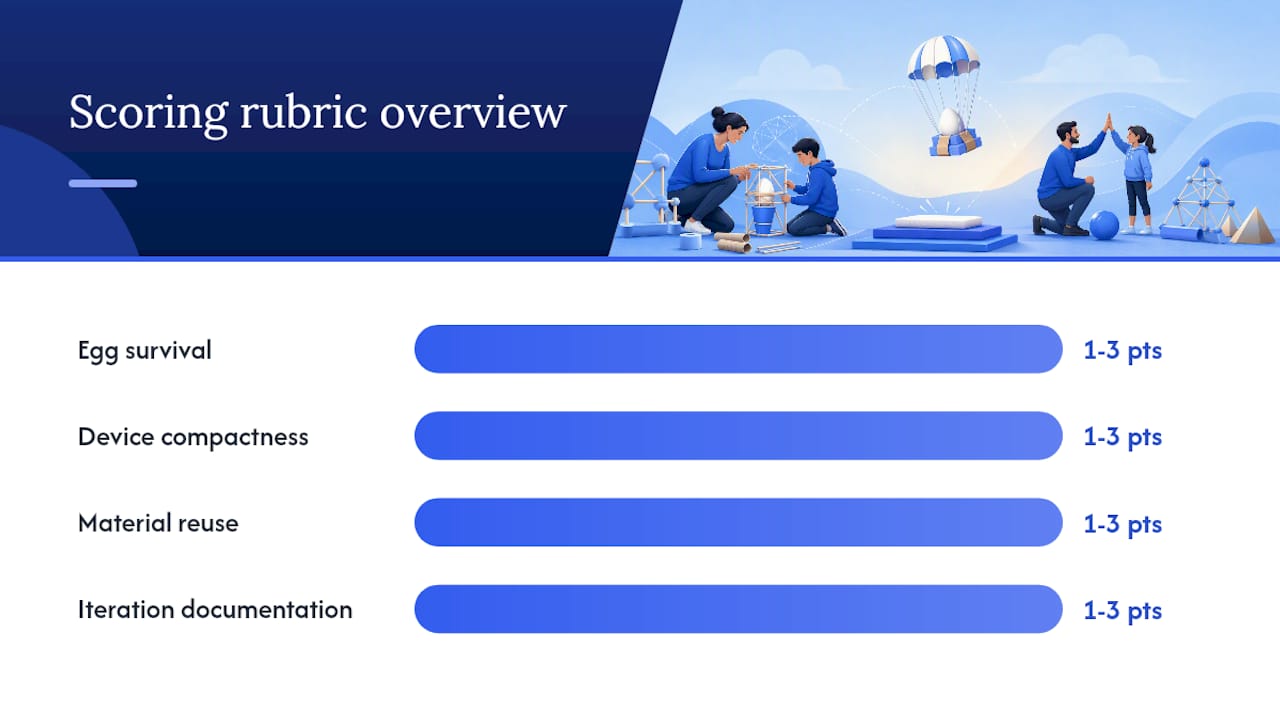
Future Engineers judges on survival, size, and creativity, which maps directly to the first two columns above. Adding the documentation row shifts the incentive toward learning rather than just winning.
Data record template (one row per drop):
| Team | Materials used | Drop height | Device size | Survived? | Notes for redesign |
|---|---|---|---|---|---|
| Team A | Newspaper, tape, cotton | 6 ft | 8×8×10 cm | Yes | Egg shifted; add foam ring |
For fair comparisons across groups, NASA’s lesson plan recommends measuring a drop-height-to-catcher-height ratio and keeping the landing surface level to prevent bounce. A quick speed calculation (speed = distance ÷ time) gives older students a math connection and a reason to time each drop carefully.
Safety, cleanup, and age-based adjustments
Drop zone rules:
- Tape a 3-foot square on the floor as the landing target.
- No student stands under the drop path during any drop.
- An adult holds any ladder; students do not climb above chair height without supervision.
- Wear safety glasses if dropping from above 8 feet.
Age-based modifications:
- Grades 2–4: Drop from 3–4 feet (chair height). Provide a pre-sorted materials kit so groups spend time designing, not hunting for supplies. Limit build time to 10 minutes.
- Grades 5–8: Drop from 6–10 feet. Add a budget constraint ($12 maximum per the WYSE model). Require a written prediction before each drop.
- High school: Introduce a weight penalty (device must weigh under 200 grams) and require velocity calculations using the NASA measurement method.
Cleanup checklist:
- Place a tarp or plastic sheeting under the drop zone before the first drop.
- Keep paper towels and a trash bag at the drop station.
- Collect all tape scraps and cardboard before dismissal.
- Broken eggs go directly into a sealed bag, then the trash.
How does this activity connect to NGSS and other subjects?
The egg drop maps cleanly to NGSS Disciplinary Core Idea PS2 (forces and motion) and Engineering Design practices at both elementary and middle school levels.
Extension activities:
- Data analysis: Graph survival rate vs. drop height across all groups. Ask: at what height does every design fail?
- Redesign challenge: Remove one material from the winning design and rebuild. What’s the minimum viable protection?
- Writing link: Students write a one-page engineering report explaining their design decisions and what they’d change next time.
- Math connection: Calculate landing speed using speed = distance ÷ time (timed with a stopwatch). Compare speeds across drop heights.
- Chemistry extension: Pair the activity with the naked egg experiment from the Exploratorium, where vinegar dissolves the shell and leaves only the membrane. Students observe osmosis and membrane elasticity, a direct chemistry tie-in that also shows what the egg drop is actually protecting.
NGSS alignment by grade band:
- Elementary (K–5): NGSS 3-5-ETS1-1 (define a problem), 3-5-ETS1-2 (generate solutions), 3-5-ETS1-3 (plan and carry out fair tests).
- Middle school (6–8): MS-ETS1-1 through MS-ETS1-4 (define, evaluate, and optimize solutions); MS-PS2-2 (Newton’s third law and force pairs).
For assessment, ask students to submit their design sketch, data sheet, and a one-paragraph reflection on what changed between drops. That documentation set covers the engineering design process from define through iterate.
Why a story prompt makes the whole thing work better
Framing the egg drop as a mission rather than a contest changes how students plan. When the egg becomes a payload that must survive re-entry to save a crew, groups spend more time on the design sketch and less time grabbing materials at random.
TeachEngineering notes that narrative framing encourages more methodical planning and documentation. A simple “mission brief” comic panel works well: draw or project a 3-panel strip showing the astronaut, the falling capsule, and the landing zone. Assign each group a role (structural engineer, materials lead, test pilot) and give the egg a name. Students who would otherwise rush straight to building will stop to sketch when they feel accountable to a character.
Pro Tip: Hand out the mission brief comic panel during the brainstorm phase, not at the start of the build. Groups that see it before they touch materials produce more deliberate first designs and iterate more meaningfully on the second drop.
What experienced teachers notice during the test phase
The most common mistake isn’t a bad design. It’s not iterating. Groups whose egg survives the first drop often declare victory and stop. Push them: “Your egg lived, but your device is the size of a suitcase. Can you cut it in half and still protect it?” That question produces the most interesting second-round engineering.
Watch for the group that adds more padding after every failure. More padding usually means more weight, which means higher impact force on landing. The better fix is almost always to extend deceleration time, either with a larger parachute or a more elastic suspension, rather than thicker walls. The designs that win competitions tend to be lighter and springier than the ones that look the most protective.
One-sentence recap: slow the fall, absorb the landing, and land arch-end down. Every iteration should move at least one of those three levers.
Brainie Comics makes the physics click before you even start
Physics concepts like potential energy, impact force, and deceleration are easier to teach when kids already have a mental picture. Gravity Gang is a comic book for ages 7–12 that walks through exactly those ideas through story and illustration, with hands-on experiments that use household materials. Read it the day before the egg drop and students arrive with the vocabulary already in place.
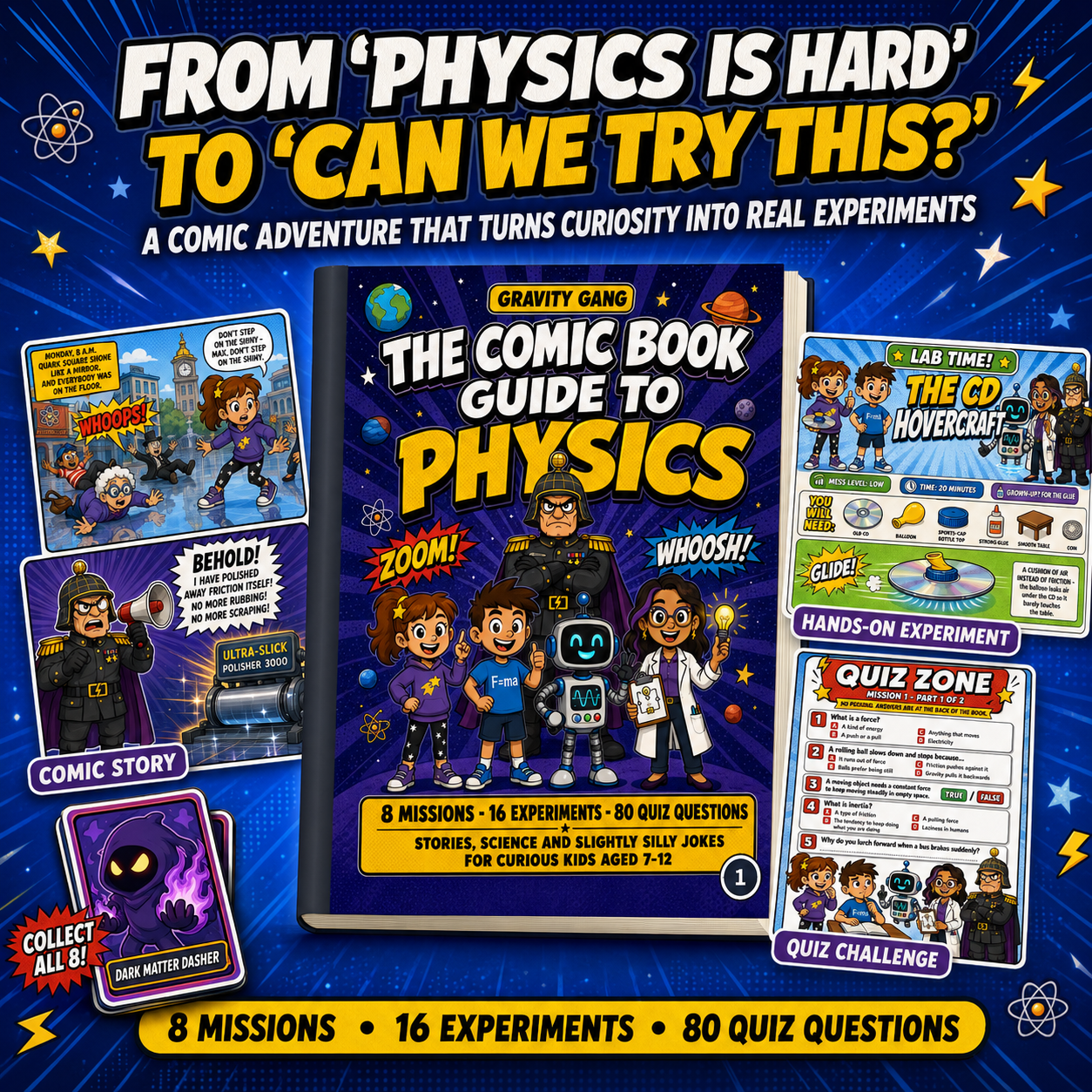
For teachers who want to extend into chemistry, Fizz Force pairs naturally with the naked egg variant, covering the vinegar-shell reaction and osmosis in the same comic-led format. Both books are available directly at Brainiecomics, with no subscription or classroom license required. Order one copy per student or a single copy to read aloud before the session.
Sources
- Naked Egg Drop - Activity - Teach Engineering
- Design Challenge: "Egg"cellent Engineering! | Worldwide Youth in Science and Engineering Program | Illinois
- Egg Drop Lander - NASA
- Future Engineers :: Egg Drop Challenge
- Naked Egg - Exploratorium