

Teach Kids 6–12 the Periodic Table: Low Prep Pictorial Activities
The easiest way to teach the periodic table to kids aged 6 to 12 is to start with atom basics and the first 20 elements, using pictorial charts instead of dense text lists. Pair that visual foundation with one low-prep activity, like a scavenger hunt or a candy atom model, and the ideas stick fast. Skip the memorization drills entirely.
TL;DR:
- Using pictorial charts with real-world images helps children connect symbols to familiar objects, making the periodic table more engaging and memorable.
- Hands-on activities like scavenger hunts, candy atom models, and pasta size charts reinforce understanding through tactile learning and visual patterns.
- Focusing on the first 20 elements simplifies concepts and aligns with children’s prior knowledge, avoiding overwhelming them with the full table.
- Introducing the table by navigating its layout and groups encourages pattern recognition and behavior prediction without heavy memorization.
- Incorporating stories and comics alongside experiments can motivate reluctant readers and sustain their interest over several weeks.
Table of Contents
- What to teach first: atoms, atomic number, and the table’s layout
- Hands-on activities that work right now
- Visual tools that make the table stick
- How to teach it well without losing kids to boredom
- Story-driven comics that turn reluctant readers into chemistry fans
- Resources and next steps you can use today
- Why hands-on, pictorial learning beats flashcards every time
- A story-driven complement worth considering
- Sources
- FAQ
What to teach first: atoms, atomic number, and the table’s layout
An atom is the smallest piece of matter that still counts as a substance, and an element is made of just one kind of atom. Every element has an atomic number, which simply tells you how many protons sit in its nucleus, and that number is also the reason each box on the table has its own spot. A symbol, like Fe or O, is shorthand for the element’s name so scientists everywhere can read it the same way.
The table’s rows are called periods and its columns are called groups, and both tell a story once kids know where to look. Elements in the same group behave alike: the alkali metals in the first column are soft and react fast, while the noble gases on the far right barely react at all. RSC Education advises against expecting children to memorize the table, and instead recommends teaching kids to navigate it and predict behavior from position.

Starting with the first 20 elements keeps things manageable, and educators recommend that range as the natural entry point for younger learners. Kids already know several of them: oxygen in the air they breathe, calcium in their bones, and aluminum in a soda can.
Hands-on activities that work right now
These four activities use materials most households and classrooms already have, and each one takes under an hour.
- Scavenger hunt: Give kids a list of five to eight elements (iron, oxygen, carbon, aluminum, sodium) and send them hunting for household objects that contain each one, then have them tape a printed element card next to their find.
- Candy or fruit atom models: Use a marshmallow or grape for the nucleus, then arrange smaller candies or beads in rings around it to represent electron shells, building simple Bohr-style models for elements like helium or carbon.
- Periodic pasta table: Following the Exploratorium’s periodic pasta project, cut spaghetti strands to lengths that represent atomic radius, then glue them onto a cardboard grid shaped like the periodic table to reveal size trends across a period.
- Fast use-case demos: Show a magnet sticking to an iron nail, a foil ball made of aluminum, or a balloon lifted by helium, and connect each demo to the element’s symbol on a chart.
Safety notes matter even for low-risk activities: supervise anyone under 8 during the candy models so nothing gets eaten mid-lesson, and keep spaghetti and scissors work seated at a table.
Pro Tip: Run the scavenger hunt first. It gives kids a reason to care about symbols before you introduce anything more abstract.
Visual tools that make the table stick
Pictorial periodic tables, where each box carries a small drawing of the element’s real-world use, help kids connect an abstract symbol to something concrete, like a lightbulb for tungsten or a balloon for helium. Printed posters and cards work well for repeated, casual exposure, while an interactive online table suits kids who are ready to explore on their own.
For a home or classroom setup, prepare:
- A set of first-20 element cards with pictures, names, and symbols for sorting games.
- One large pictorial poster kept at eye level for daily glance-and-learn exposure.
- Simple matching worksheets that pair a symbol with its everyday object or use.
When choosing an interactive table, look for one with clickable element boxes, a simple layout without excess jargon, and adjustable detail so younger kids see basics while older ones can dig into extra data.
How to teach it well without losing kids to boredom
A short, well-sequenced lesson beats a long one packed with terms. This order works for most ages 6 to 12:
- Introduce atoms with a quick model or drawing before mentioning the table at all.
- Move to the first 20 elements, matching pictures and objects to symbols.
- Explain one or two groups, like metals versus noble gases, using real examples.
- Finish with a hands-on activity, such as the pasta model or a scavenger hunt, to make the pattern visible.
The most common pitfall is piling on vocabulary too fast. Introducing terms like electronegativity or electron affinity too early overwhelms kids before they’ve grasped the basics, so save those for later grades. Rote memorization of the full table is another trap that kills curiosity fast.
To check understanding without a formal quiz, try matching cards (symbol to picture) or a two-minute mini-project where a child picks one element and draws where they’ve seen it that week. Tying lessons to a child’s own interests, whether that’s cooking, sports gear, or gadgets, tends to make the ideas stick longer.
Story-driven comics that turn reluctant readers into chemistry fans
Some kids need a story to pull them in before a diagram will hold their attention. Brainie Comics builds its Fizz Force books around that idea: a comic-book adventure carries the plot, and kitchen-safe experiments using household items sit alongside it, banded for readers aged 7 to 12. The format gives reluctant readers a reason to turn the page and a hands-on task to complete once they do.
For families who want more structured activities beyond the printables above, guides like household science experiments for ages 4 to 12 and kitchen science experiments banded by age offer step-by-step complements that pair naturally with periodic table basics.

Resources and next steps you can use today
Match the activity to the time you actually have.
- 10 minutes: A quick scavenger hunt for three or four elements around the house.
- 30 to 60 minutes: A candy atom model session followed by a matching worksheet.
- Multi-session project: The periodic pasta table, built over two sittings to allow glue-drying time between steps.
For printable first-20 cards, posters, and activity packs, the American Chemical Society’s resources for ages 6 to 11 cover scavenger hunts and downloadable materials built for that exact range. Combine one visual tool, one hands-on activity, and a two-minute check-in, and most kids retain the first 20 elements within a week or two of casual exposure.
Why hands-on, pictorial learning beats flashcards every time
Kids don’t fall in love with chemistry because a chart is well organized. They fall in love with it because a story made them curious first, then an experiment let them prove something to themselves with their own hands. Parents and teachers who try even one activity, a candy model or a five-minute scavenger hunt, often notice a kid asking to do “one more element” before bed. That’s the real signal that it worked, not a quiz score.
Try one activity this week. Watch what your child says about it afterward.
— Brainie Comics
A story-driven complement worth considering
If the printables and activities above feel like a good start but you want something a reluctant reader will pick up without being asked twice, Brainie Comics offers a packaged option built around the same principles: stories first, hands-on science second. The book wraps chemistry concepts into a comic narrative and pairs each chapter with a kitchen-safe experiment using everyday materials, no screens required.
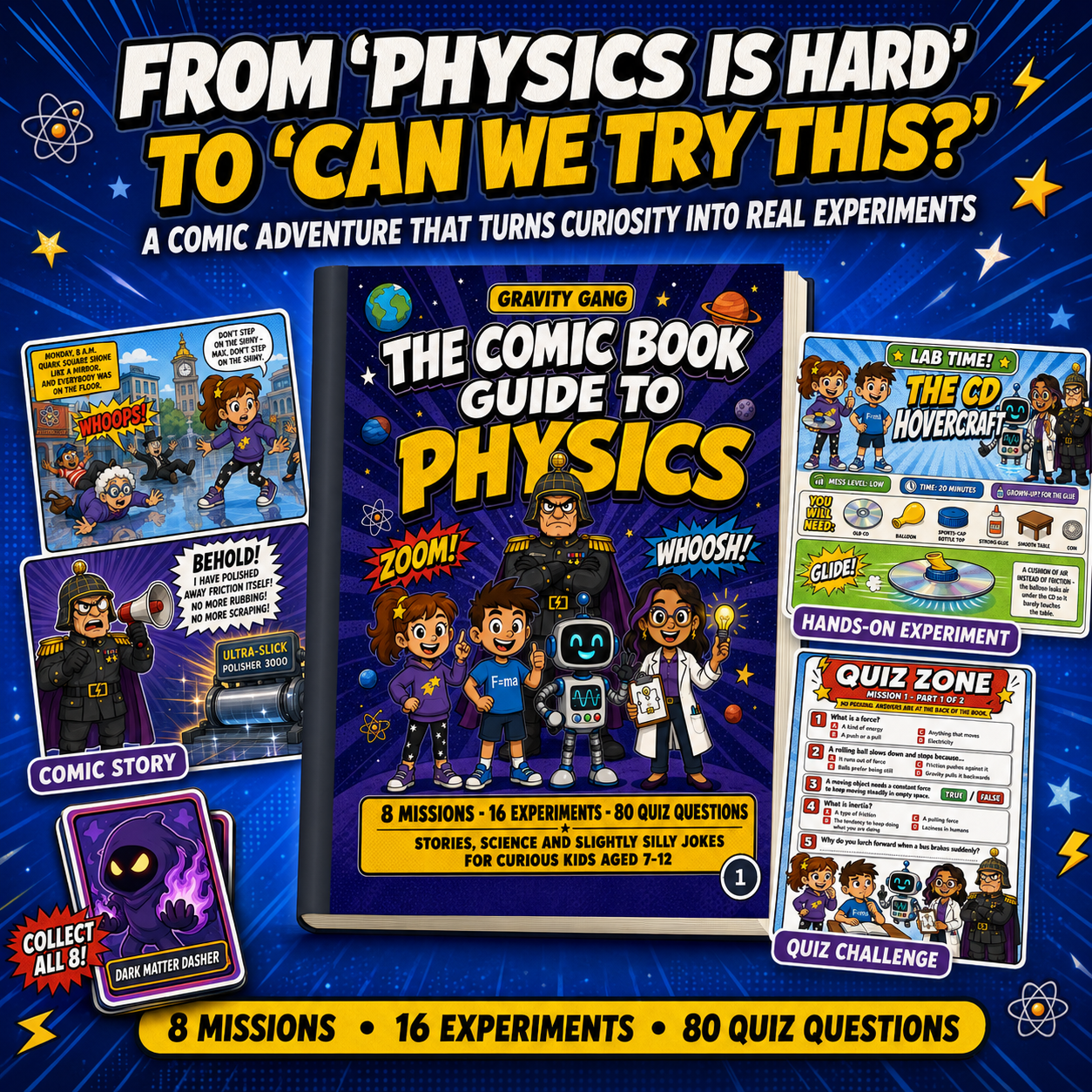
A free scavenger hunt works well for a single afternoon. A book makes more sense when you want several weeks of built-in lessons without planning each one yourself, especially for a kid who resists textbooks but loves a good story.
| What you get | Format | Guarantee |
|---|---|---|
| Comic story plus kitchen experiments | Physical comic book | 30-day money-back guarantee |
| Worksheets and completion certificate | Included with book | 30-day money-back guarantee |
Browse the Fizz Force chemistry comic book or the full comic book collection to see whether it fits your child’s reading style.
Sources
- Study
- The periodic table — RSC Education
- Periodic Pasta Table — Exploratorium
- Periodic Table educational resources for ages 6–11 — American Chemical Society
FAQ
How do you explain the periodic table to a child?
Describe it as a map where each box is a different building block of everything around us, sorted by how many protons it has. Start with the first 20 elements and connect a few to objects the child already knows, like oxygen in the air or aluminum in foil.
What age do kids start learning the periodic table?
Children can begin with basic atom structure and the first 20 elements around ages 6 to 11, using pictures and hands-on activities rather than the full table. Full navigation and pattern recognition tend to develop through the upper end of that range.
How can kids learn the periodic table in a simple way?
Pictorial charts that pair each symbol with a drawing of its real-world use make the table far easier to absorb than plain text. Adding one hands-on activity, like a scavenger hunt or the Exploratorium’s pasta model, turns abstract patterns into something visible.
How can kids learn the periodic table in a fun way?
Candy or fruit atom models, spaghetti trend charts, and comic-book stories that fold chemistry into an adventure all work better than flashcards for holding a child’s attention. Letting a child pick one element and hunt for it around the house also tends to spark genuine curiosity rather than forced memorization.