

Grow Crystals in Hours: Kid Safe Projects for Parents & Educators
Yes, kids can grow real crystals at home using safe, common materials, and the fastest wins take less than a day. Borax pipe-cleaner ornaments and Epsom salt gardens both form visible crystals in a few hours under adult supervision. Potassium alum seed crystals take longer, usually several days, but reward patience with clear, single crystals kids can actually keep. All three use kitchen-safe compounds and basic supervision, no lab required.
TL;DR:
- Borax crystals form within hours and are ideal for quick projects like ornaments, especially for children aged six and above.
- Potassium alum requires several days to grow large, clear crystals and is suitable for slightly older kids willing to wait.
- Epsom salt can produce overnight needle-like crystals in a refrigerator, making it suitable for very young children with immediate results.
- Proper saturation and steady temperature are key to successful crystal growth, while shaking or uneven cooling can hinder formation.
- All experiments involve kitchen-safe chemicals and adult supervision, with copper sulfate and cobalt chloride strictly avoided due to toxicity.
Table of Contents
- What You Need for Safe Crystal Growing Kids Can Handle
- Three Crystal Experiments Kids Can Start Today
- Why Crystals Actually Form: The Science in Plain Terms
- How Old Should Kids Be for Crystal Growing Kits?
- Troubleshooting Crystal Growth and Ideas to Take It Further
- Brainie Comics’s Take: Why Story Makes the Science Stick
- Get a Ready-Made Experiment Collection
- Where to Learn More
- Sources
What You Need for Safe Crystal Growing Kids Can Handle
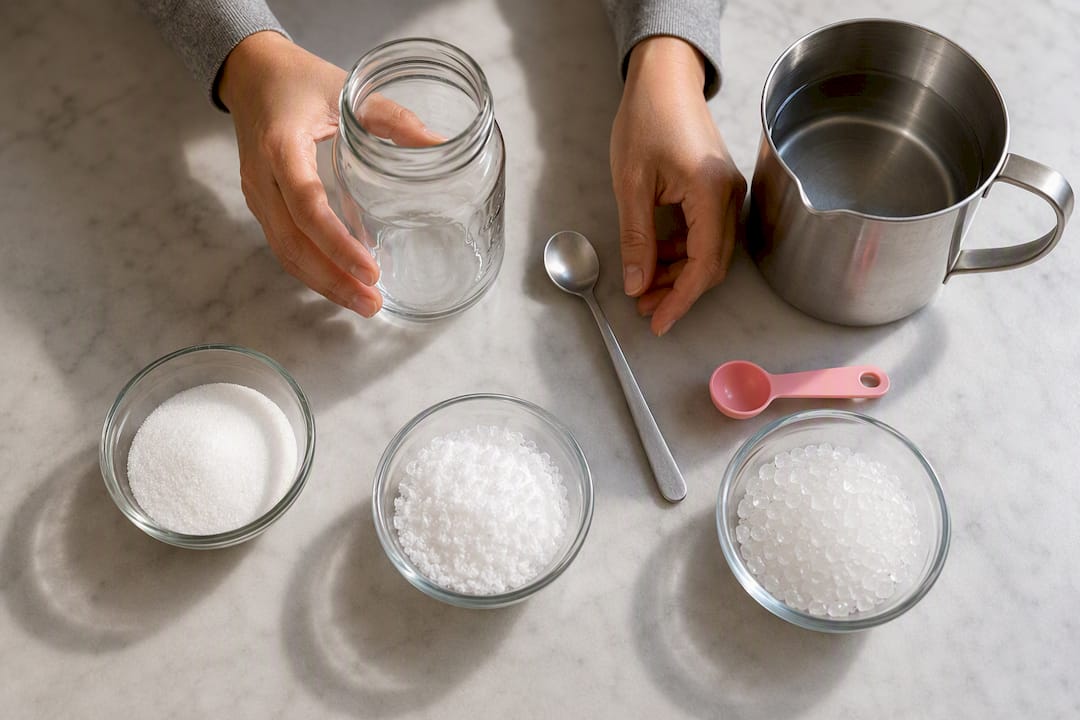
You don’t need a chemistry set. You need hot water, a mason jar, a stirring spoon, and one of four solutes: table salt, sugar, Epsom salt, or potassium alum. Borax also works well and shows up in the laundry aisle of most grocery stores.
Skip anything with copper sulfate or cobalt chloride. Copper sulfate makes gorgeous blue crystals, but it needs extra sealing and careful handling that isn’t worth the risk for a kitchen-table project. Cobalt chloride is outright toxic and has no place in a kids’ activity.
Here’s what to gather:
- A heat-safe glass jar or cup for each experiment
- Potassium alum, Borax, Epsom salt, table salt, or sugar (pick one to start)
- A pencil, pipe cleaner, or piece of string for suspending crystals
- A notebook and ruler for tracking growth day by day
- A phone or camera for progress photos
Adults handle the boiling water and the measuring. Kids handle the stirring, the labeling, and the daily crystal check.
Pro Tip: Label each jar with the date, the solute, and the water temperature you used. When a batch turns out better than another, that label is the only way to know why.
Three Crystal Experiments Kids Can Start Today
Each of these uses a different solute and teaches a slightly different lesson. Start with Borax if you want fast results, alum if you want something display-worthy, or Epsom salt if you’re working with a younger child who wants instant payoff.
1. Borax pipe-cleaner crystals (hours, ages 6+)
Shape a pipe cleaner into a snowflake or star and tie it to a pencil. Dissolve Borax in very hot water until no more will dissolve (an adult handles this step), stirring until no more dissolves. Suspend the pipe cleaner in the jar so it doesn’t touch the sides or bottom, then leave it undisturbed overnight. Borax forms fast, dramatic clusters that often finish within a few hours, which makes it the go-to choice for ornaments and classroom demos.
2. Potassium alum seed crystals (days, ages 8+)
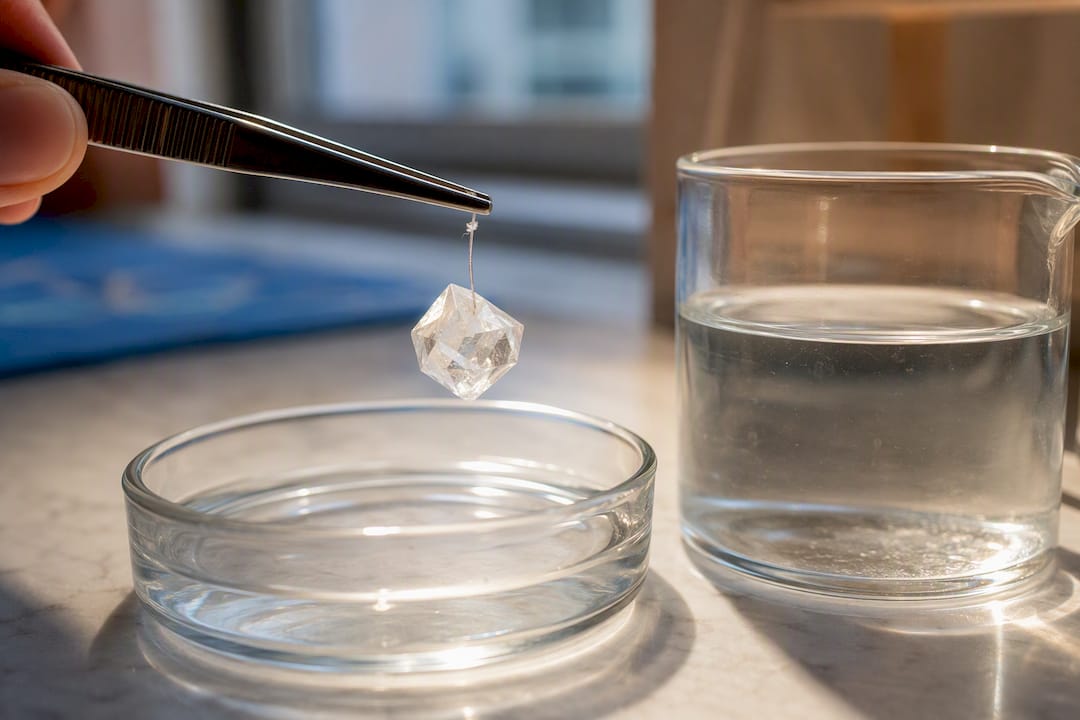
This is the slow, satisfying project. Dissolve alum in hot water until saturated, pour a thin layer into a shallow dish, and let small seed crystals form overnight. The next day, pick the clearest, most well-shaped seed with tweezers and tie it to a thread. Suspend that seed in a fresh, cooled alum solution, making sure it hangs freely without touching the container. Suspending a single seed crystal on fine nylon and keeping the temperature steady is the standard method for growing one large, clear crystal instead of a cluster. Potassium alum is widely considered the best beginner compound because it grows clean octahedral shapes that are forgiving of small mistakes.
3. Epsom salt overnight garden (hours, ages 4+)
Mix Epsom salt into hot water until it stops dissolving, pour it into a shallow dish, and pop it in the refrigerator overnight. By morning you’ll have a bed of feathery, needle-like crystals. This one skips the pencil and string entirely, which makes it the easiest entry point for younger kids who want to see results before bedtime.
Why Crystals Actually Form: The Science in Plain Terms
Every one of these projects runs on the same idea: supersaturation. Hot water can hold more dissolved solute than cold water can, so when you dissolve alum, Borax, or Epsom salt into hot water right up to its limit, you’ve created a solution packed with more material than it can normally hold. Supersaturation combined with slow, controlled cooling is what turns a dissolved solute back into solid crystal form, rather than just clumping randomly.
Cooling speed changes what you get. Fast cooling in a refrigerator produces lots of small crystals quickly. Slow cooling at room temperature produces fewer, larger crystals over more time. That’s why the Epsom garden works fast in the fridge, while the alum seed crystal needs a stable spot at room temperature for days.
- Seed crystals give new material a surface to latch onto instead of forming randomly.
- A steady temperature keeps the seed from redissolving overnight.
- Bumping or moving the jar can knock loose crystals off the seed entirely.
How Old Should Kids Be for Crystal Growing Kits?
Kids around six and up can run most of the guided steps themselves, from stirring to labeling to checking on progress each day. Adults should handle anything involving boiling or very hot water, along with precise measuring of the solute.
Stick to sugar, table salt, Epsom salt, and potassium alum. All four are non-toxic in the small quantities these projects use. Avoid copper sulfate and cobalt chloride entirely; if a kit or online recipe calls for either, skip it or find a substitute.
- Never let a child taste or drink the solution, even Epsom salt or sugar water.
- Keep solutions away from eyes, and rinse immediately with water if there’s contact.
- Store leftover alum or Borax out of reach and dispose of used solutions down the drain with running water.
Pro Tip: If a recipe you find online lists an unfamiliar chemical name, search it before you buy it. “Pretty crystal colors” and “safe for kids” aren’t always the same thing.
Troubleshooting Crystal Growth and Ideas to Take It Further
Nothing growing after a day? The solution probably wasn’t saturated enough, or the jar got bumped. Reheat and add more solute until it stops dissolving, then start over with a completely undisturbed spot.
- If crystals look cloudy or clustered instead of clear, your seed crystal likely touched the jar’s side. Re-suspend it so it hangs free in the middle.
- If growth stalls after a promising start, the room temperature probably fluctuated. Move the jar somewhere steadier, away from windows, radiators, or drafts.
- If you want a bigger single crystal, replace the solution every few days with a fresh saturated batch instead of letting it sit and dilute.
For science-fair projects, comparing crystal growth at room temperature, in the refrigerator, and in an ice bath turns a fun weekend activity into a real experiment with a testable hypothesis. Older kids can also compare solutes side by side, sugar against salt against alum, and graph crystal size over five or six days.
Brainie Comics’s Take: Why Story Makes the Science Stick
Kids remember experiments better when they’re tied to a story, not just a set of instructions. That’s the whole premise behind pairing a chapter of Fizz Force with a hands-on task: the narrative gives the chemistry a reason to matter before a single crystal forms. A kid who just read about a character solving a problem with supersaturation is far more likely to ask “wait, can I actually do that?” than one handed a bare procedure card. Try reading one chapter, then running that day’s crystal check together. The vocabulary sticks because it already has a story attached to it.
— Brainie Comics
Get a Ready-Made Experiment Collection
The experiments above work great on their own, but if you want a whole shelf of them with built-in structure, that’s exactly what Brainie Comics packages into its comic books. Fizz Force walks kids through kitchen-safe chemistry experiments woven into an actual adventure story, complete with step-by-step instructions and quizzes that check what stuck. Gravity Gang does the same for physics, for the days when you want a break from crystal jars.

Pair a chapter with a jar and a notebook: read the story, run the experiment, then log what happened before bed. It turns one afternoon activity into a repeatable routine instead of a one-off science fair scramble. If your kitchen counter already has a Borax cluster growing on it, browse the full catalog at Brainie Comics and pick the next book to pair with it.
Where to Learn More
- Science Buddies’ crystal growing guide for structured procedures and temperature-comparison experiments.
- University of Otago’s outreach page for the professional seed-crystal suspension technique.