

NGSS Aligned, Classroom Ready Mixtures and Solutions for Ages 7–12
A mixture combines materials without changing them, while a solution is a homogeneous mixture where a solute dissolves evenly throughout a solvent. Sand stirred into water stays a mixture: you can still see and scoop out the sand grains. Salt stirred into water becomes a solution because the salt disappears into the liquid at the particle level, though it can still be recovered later.
TL;DR:
- Dissolving substances like salt and sugar in water creates solutions where particles spread evenly at the molecular level, unlike mixtures with visible separation.
- The rate at which substances dissolve depends on their properties, with salt dissolving faster than flour or baking soda under the same conditions.
- Separation techniques such as filtration, evaporation, and magnetism depend on specific physical properties, like particle size or magnetic qualities.
- Classroom experiments with household items can demonstrate dissolving, mixture separation, and crystal growth within 20 to 60 minutes.
- Prediction and observation are key to effective learning, as children learn more from guessing incorrectly than simply watching demonstrations.
Table of Contents
- Kid-Friendly Definitions and Everyday Examples
- Three Quick Demos You Can Run in Under 20 Minutes
- Longer Investigations for a Full Science Period
- Matching Separation Methods to the Right Property
- Aligning Activities to Learning Goals and Standards
- Where Brainie Comics Fits Into These Lessons
- Why Prediction Matters More Than the Right Answer
- A Screen-Free Way to Keep the Curiosity Going
- Sources
- FAQ
Kid-Friendly Definitions and Everyday Examples
Start with the vocabulary before the vocabulary gets in the way. A mixture is two or more substances combined physically, with each substance keeping its own identity. A solution is a special kind of mixture where a solute (the thing being dissolved) spreads evenly through a solvent (the thing doing the dissolving), creating a homogeneous blend. A mixture where you can still see separate parts, like oil and water, is heterogeneous.
Kids grasp this faster with familiar examples than with definitions alone.
- Chocolate milk and lemonade are solutions once fully stirred and evenly colored throughout.
- Air is a solution of gases, mostly nitrogen and oxygen, mixed at the molecular level.
- Brass, a blend of copper and zinc, is a solid solution called an alloy.
- Sand and water, or oil and water, are mixtures because you can see or separate the parts.
- Trail mix and salad are heterogeneous mixtures where every bite looks a little different.
When a solute dissolves, it does not vanish. Its particles spread out so evenly among the solvent’s particles that they become too small to see, which is a useful line for correcting the common “it disappeared” misconception.
Three Quick Demos You Can Run in Under 20 Minutes
These demos need only kitchen supplies and work for a single classroom period or a rainy afternoon at home.
- Candy dissolve test. Drop an M&M and a Skittle into separate cups of warm water. Ask kids to predict which will dissolve faster and why, then watch the color spread. The American Chemical Society’s dissolving lesson uses this exact comparison to show that dissolving is a property of the substance itself, not a universal rule.
- Oil, water, and food coloring. Layer vegetable oil over colored water in a clear jar and shake gently. The liquids separate back into two visible layers within seconds, a clear demonstration of a heterogeneous mixture that will not become a solution no matter how hard you shake it.
- Salt versus sugar dissolve. Stir a spoonful of salt into one cup of water and sugar into another, without tasting either. Have kids describe clarity, smell, and how long stirring takes before the grains vanish from sight.
Pro Tip: Ask “what do you think will happen” before every demo. The prediction is what turns a demo into an investigation.
Longer Investigations for a Full Science Period
For 30 to 60 minute blocks, three investigations build toward real evidence-based reasoning.
- Salt-crystal growing lab. Dissolve salt into hot water until no more will dissolve, pour into a shallow dish, and let it sit uncovered. Within about 24 hours, water evaporates and crystals reappear, giving students physical proof that the salt never left the cup.
- Kitchen powder solubility comparison. Test how well flour, baking soda, and salt dissolve in equal amounts of water. A fair test controls variables: same mass of powder, same volume of water, same temperature, so any difference in results comes from the powder itself.
- Three-part separation challenge. Give students a mix of iron filings, sand, and salt dissolved in water, then ask them to recover all three using only a magnet, a filter, and evaporation.
Deliverables for older grades can include a written prediction, a data table of results, and a one-paragraph claim supported by observations.
Matching Separation Methods to the Right Property
Every separation method depends on a physical property that the target material has and the rest of the mixture does not.
- A magnet pulls out iron or steel from a mixture, leaving everything else behind.
- A filter catches solid particles like sand but cannot remove dissolved salt, because dissolved particles pass right through the paper with the water.
- Evaporation leaves dissolved solids behind once the liquid disappears, which is why it works where filtering fails.
- Distillation, a more advanced technique, separates liquids by boiling point rather than particle size, and is worth explaining conceptually even without building the setup.
Pro Tip: Have kids try filtering saltwater first. Watching the filter fail to catch the salt makes the “dissolved particles are too small” idea click instantly.
Aligning Activities to Learning Goals and Standards
NGSS-oriented lessons ask students to move past memorizing vocabulary and toward predicting, observing, modeling, and explaining with evidence, a shift reflected in resources like TeachEngineering’s mixtures and solutions materials. Build assessment around claim-evidence-reasoning rather than fill-in-the-blank recall.
- Objective: students predict an outcome, then revise their explanation based on what they observe.
- Objective: students build a simple particle-level model to explain dissolving and separation.
- Assessment prompt: “What evidence tells you this is a solution and not a mixture?”
- Differentiation: K to 2 students sort objects by sight and touch, while grades 3 to 5 add measurement, variables, and written claims.
Where Brainie Comics Fits Into These Lessons
Comic storytelling can be paired with kitchen experiments that use only household items and require no screens, making them a natural follow-up to a classroom unit rather than a replacement for one.
- The crystal-growing guide extends the salt-crystal lab with step-by-step photos for home practice.
- The salt science experiments post offers a dozen quick demos for teachers who want variety across a week.
- The capillary action and oobleck activities round out a broader unit on how liquids and mixtures behave.
Use a comic chapter as a hook before the lesson, or send it home as extension reading once the classroom demo is done.
Why Prediction Matters More Than the Right Answer
The value of these activities isn’t the demo itself, it’s the guess that comes before it. A child who predicts wrong and has to rebuild their thinking learns more than one who simply watches. Try the candy dissolve test this week and write down what your child or student predicted before revealing the result.
— Brainie Comics
A Screen-Free Way to Keep the Curiosity Going
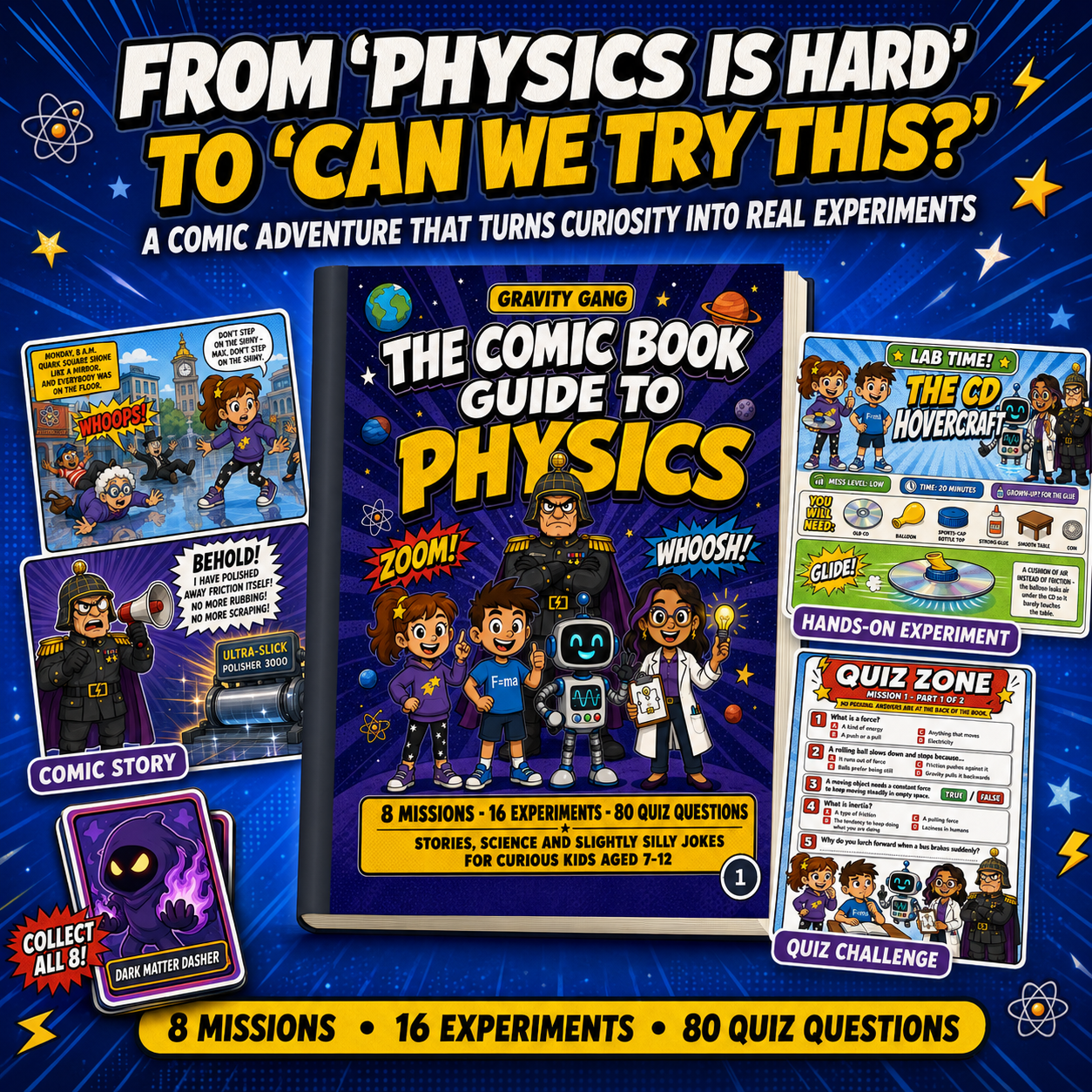
Once the classroom demo is packed away, kids often want more, and that’s where a printed comic beats another worksheet. Fizz Force turns chemistry ideas like dissolving and mixtures into a story kids choose to read, while Gravity Gang does the same for physics concepts.
- Use a chapter as a warm-up hook before introducing a new unit.
- Send a book home as a take-home activity packet that pairs reading with a kitchen experiment.
- Hand it to a reluctant reader who responds better to adventure than to a textbook.
Browse both titles on the Brainie Comics shop page if you want a printed companion that keeps the hands-on learning going after the school bell rings.
Sources
These come from established science education organizations, not general blogs.
- Properties of Mixtures vs. Solutions: Mix It Up! - Lesson - Teach Engineering
- Dissolving is a property — American Chemical Society K–8 resources
- Dissolving and back again — ACS (fifth-grade activity PDF)
- Kitchen powders solubility activity — SERC / Carleton College
FAQ
Can you give examples of mixtures and solutions kids know?
Chocolate milk, lemonade, and saltwater are solutions kids drink regularly, while trail mix, sand and water, and oil and water are mixtures they can see and touch. The difference comes down to whether the parts blend evenly or stay visibly separate, as described in TeachEngineering’s mixtures lesson.
What household items dissolve fastest in water?
Table salt and sugar dissolve readily in warm water, while flour tends to cloud the water without fully dissolving. Comparing them side by side under the same conditions, as recommended in a fair solubility test, shows kids that dissolving depends on the substance.
How do you separate a mixture of sand, salt, and water?
A magnet won’t help here, but a filter catches the sand while letting the saltwater pass through, and evaporating the remaining liquid leaves the salt behind. This sequence, outlined in a model separation lesson, shows students that method choice depends on physical properties.
Is air a mixture or a solution?
Air is a solution because its gases, mainly nitrogen and oxygen, are blended evenly at the molecular level with no visible separation. This makes it a useful example for showing that solutions aren’t only liquids, as noted in TeachEngineering’s overview.
How long does it take to grow salt crystals at home?
A salt-crystal investigation typically shows visible crystals in about 24 hours once the water evaporates from a saturated saltwater solution. The timing can vary slightly with room temperature and humidity, but the crystals reliably reappear.