

Oobleck for Kids: Recipe, Prediction Prompts, and 10 Activities
Oobleck is a two-ingredient cornstarch-and-water mixture that acts solid when you punch it and liquid when you let it sit, and it can be made quickly. Mix cornstarch with water in a ratio around 1 cup cornstarch to slightly less water in a bowl, adjusting with small splashes until it feels thick but pourable. Keep it away from drains when you clean up, and never let toddlers put it in their mouths. Everything else, from exact ratios to classroom activities, is below.
TL;DR:
- Both cornstarch and water should be added gradually during mixing to achieve the desired thick but pourable consistency, especially for younger children.
- Oobleck reacts differently under force; it resists like a solid when punched quickly but flows like a liquid when moved slowly, demonstrating non-Newtonian fluid behavior.
- Draining oobleck is not recommended, as it can clog pipes; instead, let it dry and dispose of it in the trash after it hardens.
- Leftover oobleck can be stored at room temperature in an airtight container for a few days, with a few drops of water added if it dries out.
- The key to a successful science lesson is emphasizing prediction before testing, encouraging children to ask what they expect to happen before each experiment.
Table of Contents
- What You Need for a Kid-Safe Oobleck Recipe
- How Do You Mix Oobleck Without a Mess?
- Is Oobleck Safe for Kids, and How Do You Clean It Up?
- Why Does Oobleck Act Like a Solid and a Liquid?
- Fun Oobleck Activities and Variations to Try
- Can You Store and Reuse Leftover Oobleck?
- How Brainie Comics Turns Oobleck Into a Bigger STEM Lesson
- What Oobleck Actually Teaches, and Where Most Guides Fall Short
- Sources
- FAQ
What You Need for a Kid-Safe Oobleck Recipe
You need exactly two ingredients to make oobleck, plus a bowl and a spoon or your hands. Everything else on this list is optional, but it changes the experience in ways worth knowing about before you start.
- Cornstarch: 1 cup for a small batch, more for group activities
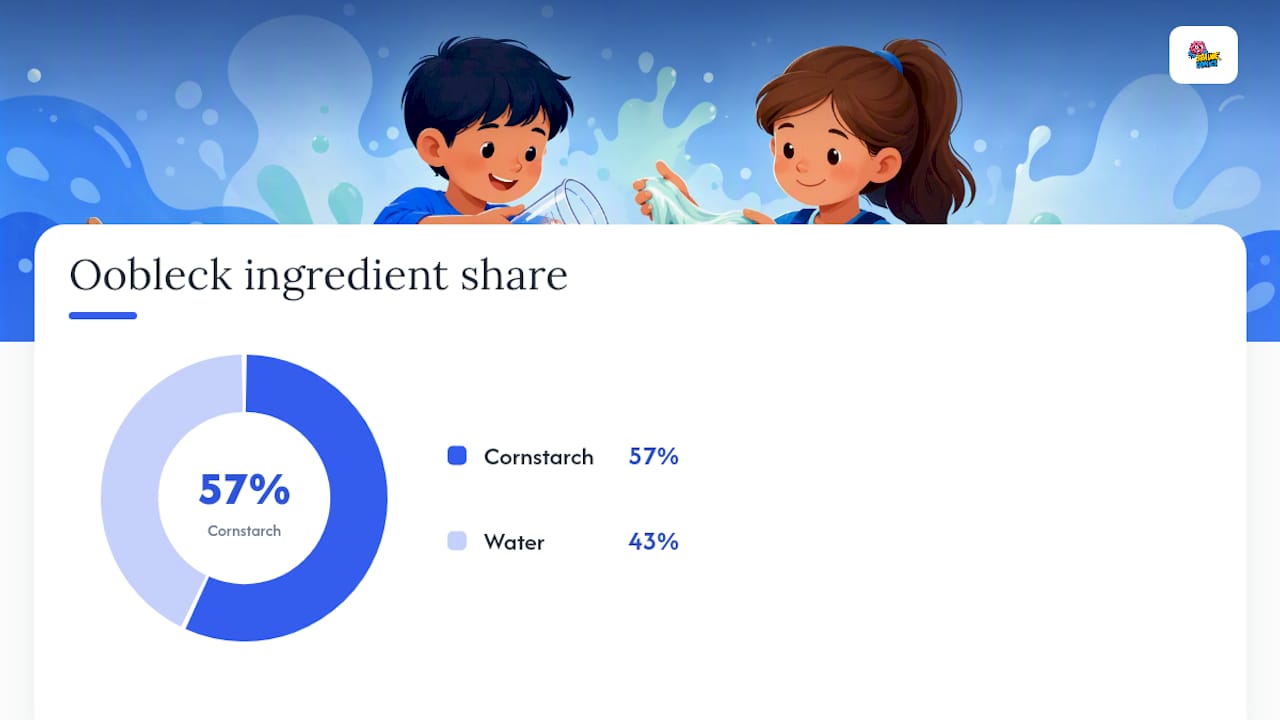
- Water: 3/4 cup as a starting point, added gradually
- Food coloring (optional): a few drops turn plain oobleck into something visually memorable for sensory play
- Mixing bowl and spoon: hands work fine once the mixture thickens
- Tray or tub: contains spills and makes cleanup faster
The classic ratio is about 2 parts cornstarch to 1 part water, though PBS Kids recommends 1 cup of cornstarch to roughly 3/4 cup of water as a reliable starting point for families and classrooms. Both work. The 2:1 version feels stiffer and cracks more dramatically when you strike it; the PBS ratio flows a little more and mixes faster for younger kids with less hand strength.
If you’re out of cornstarch, arrowroot or tapioca starch will substitute, though the texture turns slightly slicker and less chalky. Cornstarch remains the standard because it’s cheap, widely stocked, and gives the clearest solid-to-liquid transition.
How Do You Mix Oobleck Without a Mess?
Getting the texture right takes a few tries, but the process is forgiving. Follow these steps in order:
- Set up your space first. Cover the table with a plastic tablecloth or tray, and put kids in old clothes or a smock. Oobleck washes out of most fabrics, but it dries into a stubborn paste if you skip this step.
- Pour the cornstarch into a bowl. Use the full amount for your batch size before adding any liquid.
- Add water slowly, a little at a time. Stir after each addition rather than dumping it all in at once. Science Buddies suggests adding water dropwise for small samples so kids can watch the texture change in real time and even count drops as a mini-experiment.
- Check the consistency. You want a mixture that flows like syrup when you tilt the bowl but firms up the instant you poke it. Too watery? Add a spoonful of cornstarch. Too stiff to mix? Add water by the teaspoon.
- Test the solid behavior. Have kids punch or slap the surface quickly. It should resist like a solid.
- Test the liquid behavior. Let a hand sink in slowly, or let the mixture drip off a spoon. It should ooze like a thick liquid.
That contrast between steps 5 and 6 is the entire lesson, and it takes seconds to demonstrate.
Is Oobleck Safe for Kids, and How Do You Clean It Up?
Oobleck is nontoxic and generally safe for school-age children with supervision, though it’s not a good fit for babies or toddlers who still mouth objects, since swallowing large amounts can cause digestive discomfort. Keep younger children’s play sessions short and closely watched.
A few ground rules make the activity smoother for everyone:
- Protect surfaces with a tray, tablecloth, or outdoor setup since spills happen.
- Dress kids in clothes you don’t mind staining, or use a smock.
- Wash hands with soap right after play, especially before eating.
- Never pour oobleck down a sink. Cornstarch clumps and settles in pipes, and it can clog drains over time, according to Live Science’s oobleck guide. Let it dry out, then scrape it into the trash.
- Wipe bowls and trays with a dry paper towel before rinsing. This removes most of the residue and keeps your sink clear.
Pro Tip: If oobleck dries on a patio or driveway, hose it off outside instead of scrubbing it into a trash bag. Dried oobleck crumbles easily outdoors, but indoors it’s better to let it fully dry, then toss the solid chunks straight into the garbage.
Why Does Oobleck Act Like a Solid and a Liquid?
Oobleck is what scientists call a non-Newtonian fluid, meaning it doesn’t follow the normal rules of liquids like water or oil. Regular liquids keep the same thickness no matter how you push on them. Oobleck changes thickness depending on how much force you apply, and that’s the whole trick behind the toy.
Here’s the plain-language version: cornstarch is made of tiny hard particles, and when they’re suspended in water, they float around loosely, letting the mixture flow. Hit it hard or squeeze it fast, and those particles jam together and lock in place, resisting the force like a solid. Move slowly, and the water lubricates the particles enough to let them slide past each other again, so it flows like a liquid. Science World explains this tangle-and-release behavior as the defining trait of non-Newtonian fluids, and it’s the same physics behind quicksand.
Worth noting for older kids: no chemical reaction happens here. Cornstarch and water don’t combine into a new substance. It’s a physical mixture, sometimes called a suspension or colloid depending on particle size, and the Science Museum Group uses this exact distinction to teach the difference between physical and chemical changes.
Give kids these prompts to guide their own discovery:
- Squeeze a handful slowly, then release. What happens?
- Punch the surface fast. Does it feel different than squeezing?
- Roll a small ball in your palms. Does it stay a ball if you stop moving?
- Drizzle it off a spoon from a height. Watch how it behaves right before it hits the bowl.
Fun Oobleck Activities and Variations to Try
Oobleck holds up well as a repeatable activity because small changes in ratio, color, or setup create entirely new lessons. Try these:
- Color-mixing trays: split a batch into small cups, add different food coloring to each, and let kids combine them to predict new shades.
- Sieving station: run oobleck through a strainer or colander to feel how it resists and then slips through depending on pressure.
- Texture hunt: compare oobleck to slime, water, and sand, and have kids describe each in their own words.
- Force measurement: have kids drop a small object (a marble, a coin) from different heights and observe how deep it sinks.
- Ratio comparison: mix one bowl at 2:1 cornstarch to water and another at 1.5:1, then compare stiffness side by side.
- Temperature test: chill one batch and leave another at room temperature, then compare how each behaves.
- Individual trays: for classrooms, give each child a small personal tray instead of one shared bowl to cut down on cross-contamination.
- Timed stations: rotate small groups through mixing, testing, and observation stations every five minutes.
- Prediction journals: have kids write down what they expect before each test, then record what actually happened.
- Assessment prompts: ask kids to explain, in their own words, why oobleck feels like a solid one moment and a liquid the next.
Extension resources like MSU Extension’s classroom activities frame oobleck as a launchpad for teaching viscosity and mixture behavior, with trays adaptable for group sizes from two kids to twenty.
Can You Store and Reuse Leftover Oobleck?
Oobleck keeps for a short window if you store it right, but it’s not meant to last indefinitely. Seal leftovers in an airtight container, and in classrooms, give each child their own labeled container to avoid mixing germs between batches.
- Store in an airtight container at room temperature, not the fridge.
- If it dries out slightly, add a few drops of water and stir to bring it back to a workable texture, a fix the Ontario Science Centre recommends for short-term reuse.
- Don’t try to rehydrate a batch that’s grown dusty, moldy, or visibly dirty. Throw it out instead.
- Plan to discard any batch after a few days, sooner if it was handled by multiple kids or left uncovered.
How Brainie Comics Turns Oobleck Into a Bigger STEM Lesson
Oobleck works best as a lesson, not just a mess, and that’s exactly where a story helps, especially when paired with grading tools designed for STEM assignments that support hands-on science experiments. Reading a chapter before mixing gives kids something to predict, and pairing narrative with hands-on chemistry mirrors what PBS Kids has long used to frame Dr. Seuss’s Bartholomew and the Oobleck as a springboard into real science.
Some educational publishers build that same pairing into their books. A simple sequence works well at home or in a classroom:
- Read a chapter from a science comic book covering mixtures or states of matter.
- Ask kids to predict what oobleck will do before mixing it.
- Run the experiment and compare results to their prediction.
- Reflect on what surprised them, out loud or in a journal.
For a physics-focused follow-up on force and motion, Gravity Gang covers concepts that connect directly to how oobleck resists sudden force.
What Oobleck Actually Teaches, and Where Most Guides Fall Short
Most oobleck tutorials treat it as a one-off party trick: mix it, let kids squish it, move on. That undersells what’s actually happening. Oobleck is one of the few kitchen experiments where a child can feel a scientific principle change under their own hands in real time, without any equipment beyond a bowl.
The conventional advice usually stops at the recipe. It rarely pushes kids to predict outcomes before testing them, which is the step that turns squishing into science. A prediction, even a wrong one, gives a child a reason to pay attention to what happens next.
If you take one thing from this guide, prioritize the prediction step over the mixing step. The cornstarch and water matter less than the habit of asking “what do you think will happen” before every test. That single question, repeated across ratios, temperatures, and force tests, is what separates a genuine science lesson from an afternoon of cleanup.
— Brainie Comics
Sources
- Oobleck — Science World
- How to Make Oobleck | PBS KIDS for Parents
- How to Make Oobleck (Science Buddies)
FAQ
How Do You Make Oobleck Easy for Kids?
Mix 1 cup of cornstarch with about 3/4 cup of water in a bowl, stirring gradually until it feels thick but pourable. Let kids test it by punching the surface and letting a hand sink in slowly to feel both behaviors.
How Do You Explain Oobleck to Kids?
Tell them oobleck acts like a solid when they hit it fast because the cornstarch particles jam together, and it acts like a liquid when they move slowly because water lets the particles slide past each other, a behavior Science World calls a non-Newtonian fluid.
How Do You Make Oobleck With Two Ingredients?
Combine cornstarch and water at a ratio of roughly 2 parts cornstarch to 1 part water, or use the PBS Kids measurement of 1 cup cornstarch to 3/4 cup water, adding water slowly until the texture flows but firms up under pressure.
Is Oobleck Safe for Babies?
Oobleck isn’t recommended for babies or toddlers who still mouth objects, since it’s not meant to be eaten and can cause digestive discomfort if swallowed in quantity. It’s better suited to school-age kids who can play with supervision and understand not to put it in their mouths.