

10 STEM Activities Without Screens for Parents: Predict, Test, Revise
Yes, you can run high-quality, screen-free STEM activities at home with ordinary household items. Below are 10 projects you can start today, plus a simple loop that turns any craft into a genuine investigation. They fit ages roughly 4 to 12, cost little beyond what is already in a kitchen drawer, and most take 20 to 45 minutes.
TL;DR:
- For ages 4 to 6, try foil boats or hovercrafts; ages 6 to 8 suit sailboats and catapults, while rovers fit ages 9 to 12.
- Turn crafts into investigations by predicting an outcome, changing one variable across repeated trials, recording results, comparing them, and then revising the design.
- Adults should handle heating, grating, and cutting, supervise stove work, and keep small parts such as candy wheels away from children under age 4.
- The floor maze and straw test take 15 to 20 minutes, while milk to plastic can take an hour, including setup and cooling.
Table of Contents
- 1. Ten Screen-Free STEM Projects You Can Start Today
- 2. Turning a Craft Project into a Real Investigation
- 3. Getting Materials Ready and Keeping Kids Safe
- 4. Matching Activities to Age and Learning Goal
- 5. Building Computational Thinking Without a Screen
- 6. What Makes Screen-Free STEM Actually Work
- 7. How Brainie Comics Approaches Story-Driven STEM
- 8. Keeping Curiosity Alive During Hands-On Play
- 9. Reaching Kids Who Resist Reading
- 10. Connecting Backyard Experiments to Real Science
- 11. A Quick Reference for Running Each Activity
- A Publisher’s Take on Why This Matters
- Try a Ready-Made Screen-Free Activity Bundle
- FAQ
- Sources
1. Ten Screen-Free STEM Projects You Can Start Today
Each of these works with materials most households already have, and each practices a different scientific or engineering skill.
- Cardboard rover: Build a rubber-band-powered rover from a cardboard body, pencil axle, straw, and candy or cardboard wheels, following the size specs from NASA JPL’s cardboard rover project. It takes about a half hour to three quarters of an hour and teaches measurement and engineering iteration as kids test how many rubber-band turns move the rover farthest.
- Toy sailboat: A cork hull, toothpick mast, and foil sail let kids explore buoyancy and center of mass, as outlined in Science Buddies’ toy sailboat activity. Expect around twenty to thirty minutes, with a built-in extension: add a keel or ballast and see how stability changes.
- Popsicle-stick catapult: Craft sticks and rubber bands make a simple launcher that teaches energy transfer in around twenty to thirty minutes; pulling the arm back farther converts more stored energy into launch distance.
- Crayon rock cycle: Grated crayon shavings modeled with pressure or adult-supervised heat demonstrate sedimentary, metamorphic, and igneous processes, per Science Buddies’ rock cycle activity. This runs between twenty and forty minutes.
- Milk-to-plastic chemistry: Heated milk and vinegar form a moldable casein plastic, a kitchen chemistry classic that takes about half an hour to an hour with adult supervision around the stove.
- Long-straw airflow test: Taping straws end to end and blowing through them tests how pressure and airtight seals affect airflow, a short physics challenge.
- Balloon hovercraft: A balloon, bottle cap, and flat cardboard base create a cushion of air that glides across smooth floors, demonstrating friction reduction in less than half an hour.
- Aluminum-foil boat challenge: Fold foil into a boat shape and add pennies or coins one at a time to test buoyancy and stability limits.
- Balloon-powered car: A cardboard chassis with straw axles and a balloon for thrust teaches propulsion and friction in a single afternoon.
- Floor-maze sequencing: Tape a grid on the floor and write step-by-step movement commands to guide a sibling or toy through it, practicing sequencing with no materials beyond tape and paper.
2. Turning a Craft Project into a Real Investigation
A craft becomes an investigation once you add a testing loop: predict, build or model, observe, record, compare, revise, and explain. Each step takes seconds to add but changes what a child learns.
- Predict: Ask what will happen before building anything, for example how far the cardboard rover will travel with three rubber-band turns.
- Build or model: Assemble the rover following NASA JPL’s instructions, substituting materials where needed.
- Observe and record: Run several trials, each time changing only the number of rubber-band turns, and write down the distance traveled.
- Compare: Plot the trials on a simple chart to see which turn count went farthest.
- Revise and explain: Adjust the design or variable, run it again, and ask the child to explain why the result changed.
A recording sheet can be as simple as four columns: trial number, what changed, distance measured, and one observation. Keep every other variable the same (same surface, same wheels) so the one change you are testing is the only explanation for the result.
Pro Tip: Ask open questions like “What makes you think that?” instead of giving the answer, so the child stays in charge of the thinking.
3. Getting Materials Ready and Keeping Kids Safe
Most of these projects pull from the same small pool of supplies: cardboard, corks, rubber bands, foil, straws, crayons, milk, and vinegar, so one shopping trip covers several activities.
- Pre-sort materials into bins by activity so setup takes minutes, not an hour.
- Cover the work surface and keep a damp cloth nearby for spills.
- Reserve heating, grating, and cutting steps for an adult, especially in the crayon rock cycle and milk-to-plastic experiments.
- Keep small parts like buttons or candy wheels away from children under 4.
- Plan for mess: milk-to-plastic and crayon melting are longer, dirtier sessions, while the floor maze and long-straw test stay quick and clean.
Caregivers act as facilitators who use hands-on, inquiry-based tasks rather than lecturing, according to National Academies guidance on out-of-school STEM learning. That framing applies directly to how you supervise: step in for safety, then step back and let the child lead the thinking.
4. Matching Activities to Age and Learning Goal
Picking the right project starts with the child’s age and the skill you want to practice.
- Preschool (ages 4 to 6): aluminum-foil boats and balloon hovercrafts build observation and cause-and-effect thinking through immediate, visible results.
- Early elementary (ages 6 to 8): the toy sailboat, long-straw test, and popsicle-stick catapult introduce measuring and the idea of changing one variable at a time.
- Upper elementary (ages 9 to 12): the cardboard rover, milk-to-plastic chemistry, and crayon rock cycle support iterative engineering and real chemistry concepts.
- Sequencing and logic: the floor maze fits any age once a child can follow multi-step directions, typically around age 5 and up.
5. Building Computational Thinking Without a Screen
Sequencing, algorithms, and debugging do not require a device. A taped floor maze, walked step by step from written commands, teaches a child to plan a sequence and then watch where it breaks down.
- Write out movement steps on paper before testing them on the maze, so the “code” exists separately from the “run.”
- When the sequence fails partway through, ask the child to find which step caused the problem rather than fixing it yourself.
- Encourage a rewrite of just the broken step, then retest, which mirrors how real debugging works.
- A second version, drawing an algorithm for a simple task like “make a sandwich,” practices the same precision in instructions.
These exercises build algorithmic thinking, conditional logic, and testing habits using only tape, paper, and pencils.
6. What Makes Screen-Free STEM Actually Work
Evidence on informal science learning points to a few consistent principles rather than a single best activity.
Informal learning works best when it starts from a child’s own question, uses hands-on inquiry, connects to everyday life, and allows flexible time.
That framing comes from National Academies guidance on prioritizing science and engineering education, which also notes that children spend far more waking hours outside school than in it, making home-based learning time significant. A separate practical framework on screen-free STEM learning describes the same pattern from a different angle: short iteration cycles, test, record, tweak, repeat, mirror real engineering practice and keep activities measurable.
- Ask open questions before giving answers.
- Record results, even informally, so comparison is possible.
- Iterate on one variable at a time.
- Connect the activity back to something the child already knows, like how boats float or why cars need wheels.
Because the materials are inexpensive and the time commitment is flexible, this approach fits households with very different budgets and schedules.
7. How Brainie Comics Approaches Story-Driven STEM
We build narrative comic books that pair an adventure story with kitchen-safe experiments for kids in middle childhood. Each book uses the plot to introduce a real physics or chemistry concept, then hands the child a hands-on task using household materials, which scaffolds the same predict-and-test thinking described above for readers who want the structure already written out.
8. Keeping Curiosity Alive During Hands-On Play
Curiosity tends to fade when an activity feels like a test with one correct answer, so the goal is to keep questions open rather than closed. Instead of asking “did the rover go far,” ask “what do you notice about the wheels that went farther,” which invites observation instead of a yes-or-no reply.
Letting a child choose which variable to change next, rather than assigning it, keeps ownership with them and tends to extend how long they stay engaged. If a rover design fails completely, treat it as data rather than a mistake: ask what the result tells them about the design, then let them propose the fix.

Mixing in a story element helps too. Giving the rover a name and a mission, or imagining the foil boat as a cargo ship that has to survive a storm, turns a repeatable test into a narrative the child wants to continue. This is part of why pairing comics with experiments works: the story gives a reason to keep testing, not just a task to finish.
Rotating who leads also helps. Let an older sibling run one trial while a younger one records results, then switch roles. Finally, resist the urge to fix a flawed build immediately. A design that falls apart on the first trial often produces the most interesting conversation about why, and that conversation is where the actual learning happens.
9. Reaching Kids Who Resist Reading
Reluctant readers often avoid books because reading feels like a separate chore from the things they actually enjoy. Hands-on STEM experiments can close that gap by giving reading an immediate, physical payoff: the instructions lead directly to building something or watching a reaction happen.
Short, numbered steps work better than long paragraphs for this audience, since each step completed is a small win that keeps momentum going. Reading a material list out loud together, then letting the child check off items as they gather them, turns reading into part of the activity rather than a barrier before it.
Story-based formats add another route in. A comic book that embeds an experiment inside a plot, like Gravity Gang does with physics concepts, gives a reluctant reader a reason to get through the page: the next panel reveals what happens when the experiment runs. That structure uses the same curiosity that drives a child to keep turning pages in any adventure story, just aimed at scientific content instead.
Letting a child read instructions aloud to a parent, rather than silently to themselves, also lowers the pressure and makes reading feel collaborative instead of evaluated.
10. Connecting Backyard Experiments to Real Science
A foil boat or cardboard rover means more once a child sees it as a small version of something real. After the toy sailboat activity, point out that cargo ships use the same buoyancy and ballast principles to stay upright in open water, which is also the idea behind the buoyancy experiments that extend this concept with journaling tasks.
The cardboard rover connects directly to actual Mars rovers, since the NASA JPL project it is based on uses the same build-test-revise cycle that engineers use before a real rover ever launches. Naming that connection while testing gives the activity a bigger context than just a craft project.

For families looking for inclusive ways to extend these ideas, the neurodivergent-friendly gravity experiments guide offers low-cost variations on gravity-based STEM play that adapt well across different learning styles.
Asking “where else does this show up” after any activity, whether it is friction in a balloon car or crystal formation in a rock cycle model, builds the habit of looking for science outside the activity itself.
11. A Quick Reference for Running Each Activity
Each project follows roughly the same shape: gather materials, build, test, and record.
- Cardboard rover: cut body and wheels, attach pencil axle and rubber band, wind and release, measure distance, repeat with different turn counts.
- Toy sailboat: insert mast into cork, attach foil sail, float in water, add ballast or a keel, compare stability.
- Popsicle-stick catapult: stack sticks, secure with rubber bands, add a launch cup, pull back and release, measure distance across pull strengths.
- Crayon rock cycle: grate crayon shavings, compress for sedimentary, press and warm gently for metamorphic, melt and cool fully for igneous, with an adult handling heat.
- Milk-to-plastic: heat milk, add vinegar, strain the curds, mold while warm, let dry, with an adult managing the stove.
- Long-straw test: tape straws end to end, blow through, note the point where airflow weakens.
- Floor maze: tape a grid, write movement steps, walk the path, debug any step that fails.
A Publisher’s Take on Why This Matters
Screen-free learning works best when it feels like an adventure instead of an assignment, which is the idea behind pairing comic storytelling with real kitchen experiments. We see children return to a book not because they are told to, but because the next experiment is part of the story. The materials stay cheap, the steps stay safe with basic supervision, and the payoff is a kid who wants to try the next page.
— Brainie Comics
Try a Ready-Made Screen-Free Activity Bundle
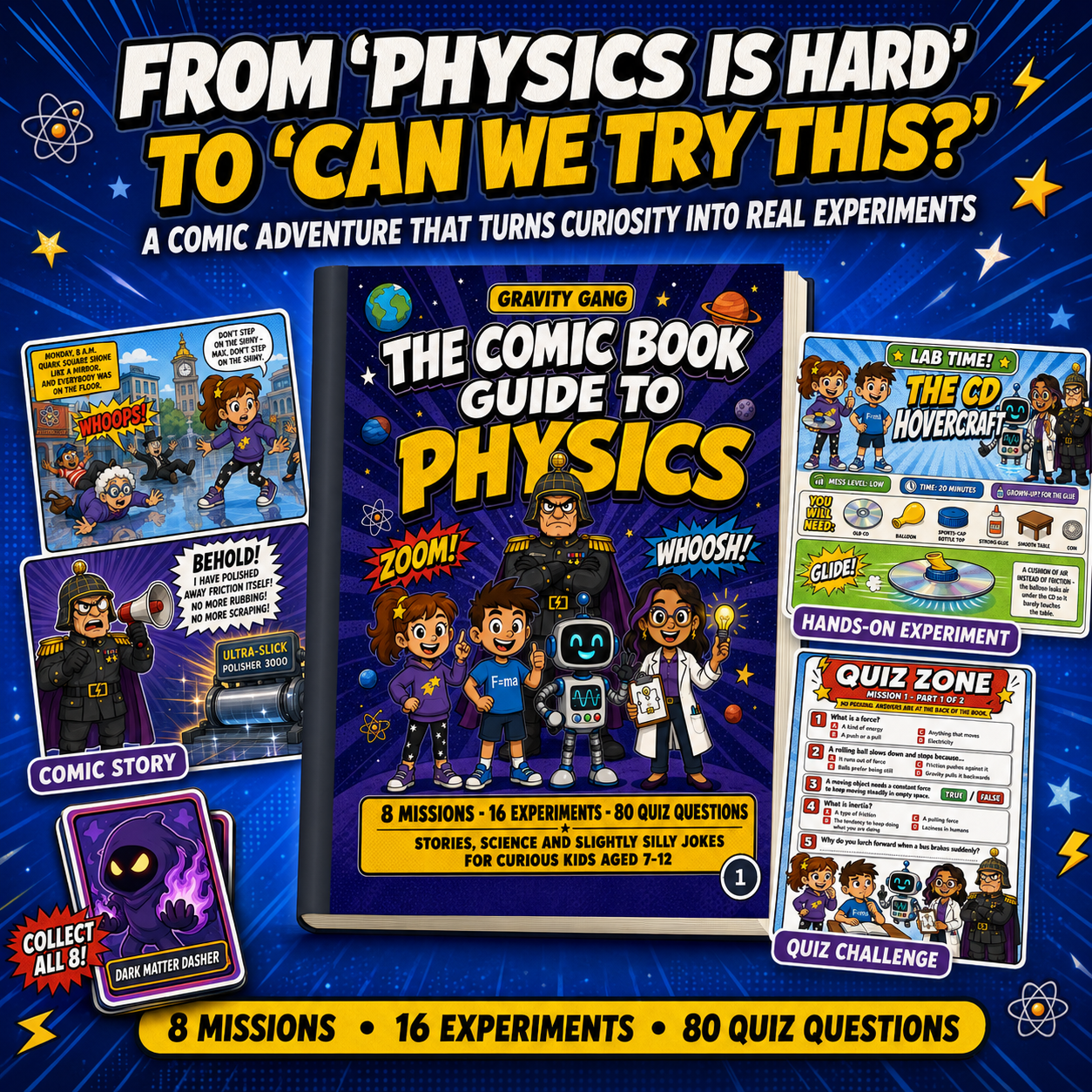
If gathering materials and writing your own steps feels like one task too many, our comic books do that work for you. Fizz Force and Gravity Gang each combine an adventure story with kitchen-safe experiments built from household items, so the reading and the hands-on activity reinforce each other instead of competing for attention.
- Browse both titles on our comic book collection page.
- Check out Gravity Gang for physics-based experiments like rover builds and launch challenges on its product page.
- Explore Fizz Force for chemistry experiments such as kitchen reactions on its product page.
Each book is 59.95 USD and comes with a 30-day money-back guarantee, so you can try the activities with your child before deciding if it’s a fit.
FAQ
What age group do screen-free STEM activities work best for?
Most of the activities in this article suit children roughly ages 4 to 12, with simpler cause-and-effect projects like foil boats fitting younger kids and iterative builds like the cardboard rover suiting ages 9 and up. Adjust supervision level rather than the activity itself for younger siblings joining in.
How much do screen-free STEM activities typically cost?
Nearly all the projects here use materials already found at home, such as cardboard, straws, corks, and crayons, keeping cost close to zero beyond occasional items like vinegar or craft sticks. Comic book bundles like Fizz Force or Gravity Gang cost 59.95 USD each if you want a scripted, ready-made option instead.
How long does each STEM activity usually take?
Quick projects like the long-straw test or floor maze run about 15 to 20 minutes, while builds like the cardboard rover or crayon rock cycle take about a half hour to three quarters of an hour. Chemistry activities involving heat, such as milk-to-plastic, can stretch to an hour with setup and cooling time.
How do I turn a simple craft into a real science investigation?
Add a testing loop: predict what will happen, build the project, run several trials while changing only one variable, and record the results before comparing them. This predict-test-revise cycle, outlined in the NASA JPL rover project, is what separates a one-off craft from an investigation.
Which steps in these activities need adult supervision?
Any step involving heat, grating, or small parts needs direct adult involvement, including the stovetop portion of milk-to-plastic and the heating step in the crayon rock cycle. Cutting cardboard or foil with scissors also warrants supervision for younger children.
Sources
- Make a Cardboard Rover – Engineering Project | NASA JPL Education
- Make a Toy Sailboat | STEM Activity
- Science and engineering education needs to be prioritized through fifth grade, says new report | National Academies