

10 Low Prep Research Backed Safe Science Experiments for Parents
Yes, safe, low-prep science experiments exist, and you can run one today with items already in your kitchen. They work best when you keep quantities small, choose low-toxicity materials, and follow a few basic safety and supervision steps. Pick an experiment below, read its short safety note, and then you are ready to start.
TL;DR:
- Most kitchen science experiments are safe for children when adult supervision, proper protective gear, and correct disposal steps are followed.
- Pretesting experiments helps avoid surprises like overflowing foam or slow reactions and ensures safety before starting with children.
- Using household materials such as baking soda, vinegar, cornstarch, and water, most experiments can be conducted in under 20 minutes with minimal risk.
- Safety measures include supervising children under 8, keeping chemicals in original containers, and never mixing household cleaners like bleach with vinegar or ammonia.
- Employing guidance during experiments, such as asking questions and cleaning promptly, enhances learning and reduces mishaps.
Table of Contents
- 1. Curated kitchen experiments parents can run today
- 2. Safety checklist and poison prevention before you start
- 3. How to run an experiment from setup to cleanup
- 4. Why hands-on experiments help children learn
- 5. How Brainie Comics approaches story-led, safe experiments
- 6. A ready-made bundle for parents who want it done
- FAQ
- Sources
1. Curated kitchen experiments parents can run today
Each of these uses household items, takes under 20 minutes to set up, and comes with a built-in science lesson. Prep time and “wow factor” are noted so you can match the activity to your afternoon.
Baking soda volcano (prep: 5 minutes, wow factor: high)
- What you need: baking soda, vinegar, dish soap, a tray, an empty bottle.
- The science: baking soda (a base) reacts with vinegar (an acid) to release carbon dioxide gas, which foams up through the soap.
- Ages and supervision: ages 4 and up, with an adult present for pouring.
- Place the bottle on a tray to contain the mess.
- Add two tablespoons of baking soda to the bottle.
- Add a squirt of dish soap.
- Pour in a quarter cup of vinegar and step back.
- Rinse the tray and bottle with water when finished.
Oobleck (cornstarch slime) (prep: 5 minutes, wow factor: medium)
- What you need: cornstarch, water, a mixing bowl.
- The science: oobleck is a non-Newtonian fluid that acts solid under pressure and liquid when still, showing kids that not all matter behaves predictably.
- Ages and supervision: ages 3 and up, minimal supervision needed.
- Mix two parts cornstarch with one part water.
- Stir until it thickens.
- Let your child punch it gently, then let a finger sink in slowly.
- Dispose of leftovers in the trash, never down the sink, since cornstarch clogs pipes.
Lava lamp (prep: 3 minutes, wow factor: high)
- What you need: vegetable oil, water, food coloring, a clear bottle, an effervescent tablet.
- The science: oil floats on water because it is less dense, and the tablet’s fizzing carries colored water droplets up through the oil.
- Ages and supervision: ages 5 and up, adult handles the tablet.
- Fill the bottle three-quarters with oil.
- Add water and a few drops of food coloring.
- Break the tablet into small pieces and drop one in at a time.
- Watch the bubbles rise, then cap and store for reuse.
Dancing raisins (prep: 2 minutes, wow factor: medium)
- What you need: raisins, a clear glass, carbonated water or soda.
- The science: carbon dioxide bubbles cling to the raisins’ wrinkled surface, lifting them until the bubbles pop at the top.
- Ages and supervision: ages 3 and up.
Surface tension pepper trick (prep: 2 minutes, wow factor: medium)
- What you need: a shallow dish of water, ground pepper, dish soap.
- The science: soap breaks the water’s surface tension, sending the pepper flakes racing outward.
- Ages and supervision: ages 4 and up.
Density jar (prep: 10 minutes, wow factor: high)
- What you need: honey, dish soap, water, oil, a tall clear jar.
- The science: liquids of different densities stack in layers rather than mixing.
- Ages and supervision: ages 5 and up, with adult help pouring slowly.
Invisible ink with lemon juice (prep: 5 minutes, wow factor: medium)
- What you need: lemon juice, a cotton swab, paper, a lamp or warm light bulb.
- The science: lemon juice weakens paper fibers, so the oxidized area browns faster under heat and reveals the message.
- Ages and supervision: ages 6 and up, adult manages the heat source.
Capillary action celery (prep: 5 minutes active, wow factor: builds over days)
- What you need: celery stalks, water, food coloring, clear cups.
- The science: celery draws colored water up through tiny tubes, the same process plants use to move water from roots to leaves.
- Ages and supervision: ages 4 and up.
Floating and sinking boat build (prep: 10 minutes, wow factor: medium)
- What you need: aluminum foil, small objects like coins or marbles, a basin of water.
- The science: a boat floats when it displaces enough water to support its weight, introducing buoyancy in a hands-on way.
- Ages and supervision: ages 5 and up.
Pro Tip: Run the experiment yourself once before showing your child; a quick pretest catches surprises like overflowing foam or slow reactions.
Safety notes to pair with any of the above:
- Use goggles for anything that fizzes, sprays, or pops.
- Keep all materials in their original containers until the moment of use.
- Never substitute an unlisted chemical “to see what happens.”
2. Safety checklist and poison prevention before you start
Every experiment on this list is low-risk when you follow a short set of rules drawn from established safety guidance. The American Chemical Society’s safety guidance notes that elementary science activities stay safe when adults pretest demos, require goggles and other protective gear, select low-risk materials, and follow proper disposal steps. The National Science Teaching Association adds that a chemical hygiene plan, access to safety data sheets, and regular safety training reduce injury risk during hands-on science.
Before you start, work through this list:
- Supervise directly for children under 8; older children can handle setup steps themselves with an adult nearby.
- Provide goggles for any reaction involving liquids, powders, or heat, and an apron to protect clothing.
- Store all chemicals and materials in original, labeled containers, out of reach of young children when not in use.
- Never mix bleach with ammonia, vinegar, or other cleaners, and never let a child taste an experiment ingredient.
- Keep the Poison Help number (1-800-222-1222 in the US) posted somewhere visible during experiment time.
Most poisonings happen at home, and the Poison Help fact sheet on cleaners and disinfectants warns specifically against combining household cleaning products, since the resulting fumes can cause serious harm in a closed kitchen or bathroom. If a child ingests or inhales something unexpected, call Poison Help immediately and keep the product container on hand to describe its ingredients.
3. How to run an experiment from setup to cleanup
A smooth experiment comes down to preparation, not luck. Use this sequence every time:
- Pretest the demo yourself the day before, so you know timing, quantities, and what the reaction actually looks like.
- Gather and label every material on a tray, and clear food and drinks from the workspace.
- Set up a containment surface, a baking tray, a plastic mat, or newspaper, before anything gets poured.
- Assign roles: one adult leads the reaction, one child assists with pouring or stirring under direct guidance.
- Ask open questions during the activity, such as “What do you think will happen if we add more?” to turn watching into thinking.
- After the reaction, rinse containers, dispose of leftovers appropriately, and have everyone wash hands before touching anything else.
Pro Tip: Keep a damp cloth and a trash bag within arm’s reach before you start; cleanup takes seconds when the tools are already there.
For classrooms, a simple printed checklist works well: materials gathered, goggles on, tray in place, roles assigned, and a clear stop signal everyone knows in advance. Teaching the “ask first, never taste” rule through role play, an approach suggested by lab safety resources for families, helps the habit stick even when you are not in the room.

4. Why hands-on experiments help children learn
Guided experiments do more than entertain. A 2026 quasi-experimental study found that children aged 5 to 6 raised their average science scores from 32.47 to 59.24, an 82.4% increase, after a series of guided hands-on experiments, a gain that points to real cognitive benefit from structured, physical exploration rather than passive instruction. A 2024 policy review from IZA found that high-intensity experiential pedagogy raised standardized test scores by roughly 0.22 to 0.34 standard deviations compared to conventional teaching.
Discovery-based pedagogy and hands-on methods consistently raise engagement and test outcomes when paired with adult scaffolding that prompts explanation and reflection.
The common thread in both findings is guidance: a child who performs an experiment and then explains what happened retains and transfers the concept far better than one who simply watches. That is why each experiment above pairs a physical step with a question, turning a kitchen mess into a learning moment that travels into other subjects.
5. How Brainie Comics approaches story-led, safe experiments
We design our books around age-banded, story-driven experiments that use ordinary household materials, each paired with a clear safety note so parents know what to expect before a page turns into a project. For more age-specific ideas, our household science experiments for ages 4 to 12 and age-banded kitchen science experiments round out the activities in this guide.
— Brainie Comics
6. A ready-made bundle for parents who want it done
If building a materials list every weekend sounds like one more chore, we put the planning into two comic book series instead. Fizz Force: Comic Book Guide to Chemistry and Gravity Gang: Comic Book Guide to Physics are written for kids aged 7 to 12 and built around reluctant readers who respond better to story than to a textbook.
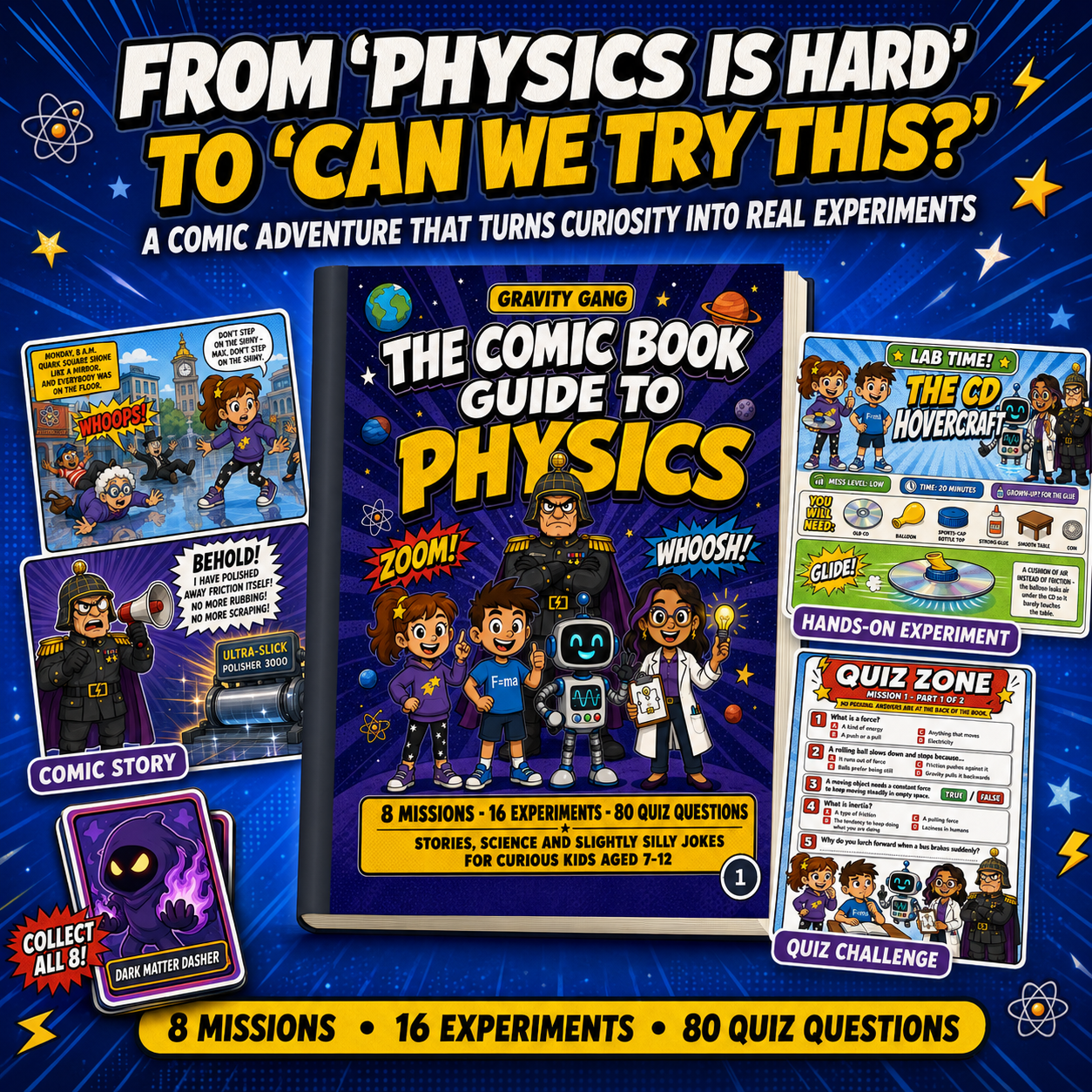
- Each book folds safe, household-item experiments directly into the story, so your child reads a chapter and then runs the related activity.
- Quizzes and a completion certificate close out each book, giving kids a reason to finish what they started.
- No screens required: every experiment runs on paper instructions and kitchen staples you likely already own.
Both titles are available on our full collection page for $59.95 each, backed by a 30-day money-back guarantee if the book is not a fit for your reader.
FAQ
What are 10 easy science experiments for kids?
A strong starter set includes a baking soda volcano, oobleck, a lava lamp, dancing raisins, the surface tension pepper trick, a density jar, invisible ink, capillary action celery, a floating boat build, and a simple water-and-oil mix. Each uses household items and takes under 20 minutes to set up, as outlined in the curated list above.
What are 100 easy science experiments I can do at home?
No single source verifies a specific large list of experiments, so we recommend starting with a smaller, well-tested set like the ten above and expanding gradually as your child’s interest grows. Our kitchen science experiments guide and water science experiments guide offer additional age-banded ideas to build out a larger rotation.
What is the coolest easy science experiment?
The baking soda volcano remains one of the most popular choices because the foaming reaction is immediate and visually dramatic while using only two common ingredients. The elephant toothpaste reaction, using a food-grade hydrogen peroxide dilution under adult supervision, offers a similarly dramatic foaming effect for slightly older kids.
What are the top science fair experiments for kids?
Strong science fair picks combine a clear hypothesis with an observable, measurable result, such as testing which liquid dissolves a sugar cube fastest or comparing plant growth under different light conditions. Density jars and capillary action celery also work well because children can document layers or color change step by step.
What safety gear do I need for home science experiments?
Goggles and an apron cover most kitchen chemistry activities, and gloves are worth adding for anything involving concentrated cleaners or prolonged skin contact. The ACS safety guidance recommends this basic protective setup for any reactive or messy demonstration involving children.
Sources
- Inquiry-based experiment benefits (UNJ 2026 quasi-experimental study)
- Science on the move: how experiential pedagogy shapes human capital (IZA, 2024)
- Safety in the elementary school science classroom (ACS)
- Safety and school science instruction (NSTA)
- Poison help: disinfectants and cleaners safety (HRSA/Poison Help)