

Five Point Rubric: Classroom Ready Science Resources for K–12 Teachers
For K-12 science teachers, the fastest way to classroom-ready, NGSS-aligned lessons and hands-on activities is a small set of trusted hubs: museum educator pages, PhET simulations, government and NSTA-style lesson libraries, and curated activity banks. This article gives you a categorized shortlist organized by classroom need, a five-point rubric to vet any resource in minutes, research-backed guidance on using digital simulations, and low-cost activity sources you can use tomorrow.
TL;DR:
- Resources should explicitly name NGSS Disciplinary Core Ideas, Practices, and Crosscutting Concepts to ensure proper three-dimensional alignment.
- Use a brief five-point evaluation rubric to verify resources’ standards alignment, grade suitability, safety, assessment, and accessibility before adoption.
- Digital simulations like PhET work best when paired with guided prompts that involve prediction, data collection, or evidence-based argument, not free exploration.
- Household-material experiments provide cost-effective, engaging activities that can be scaled for stations, jigsaw groups, or student-designed investigations.
- Building connections through professional development and online communities enhances teachers’ ability to implement resources and innovate beyond material limitations.
Table of Contents
- 1. Vetted science resources organized by classroom need
- 2. A quick rubric to evaluate a science resource fast
- 3. Using digital simulations well: what PhET’s research shows
- 4. Finding NGSS-aligned, lesson-ready activities and downloadable PDFs
- 5. Low-cost, hands-on activities using household materials
- 6. Professional development opportunities and communities for science teachers
- 7. Why narrative-driven, hands-on books help reluctant readers engage with science
- Brainie Comics as a classroom-ready pilot option
- Sources
- FAQ
1. Vetted science resources organized by classroom need
Most teachers do not need more resources. They need the right resource for the moment: a lesson plan when starting a new unit, a simulation when lab equipment is unavailable, a video when a phenomenon can’t fit in the room, and a quick activity bank when time is short.
- NGSS-aligned lesson libraries and district-adoptable programs. Full programs work best when you’re planning a unit from scratch and want a coherent sequence of three-dimensional lessons; single downloadable lessons work better when you need to fill a gap or supplement an existing unit. Look for explicit alignment labels before adopting either.
- Interactive simulations, led by PhET research on interactive simulations. Use simulations when a physical lab is too costly, too dangerous, or too slow to show a concept in real time, but keep physical labs for skills like measurement, materials handling, and observation that a screen cannot teach. PhET’s own research points to strong learning gains when simulations are paired with guided prompts rather than open free play.
- Multimedia and video collections from museums and government agencies. NASA’s educator hub and the Smithsonian’s National Museum of Natural History offer footage, mission data, and short documentaries that introduce a phenomenon before students investigate it themselves. Use these at the start of a lesson to spark a question, not as a passive watch-and-move-on activity.
- Hands-on activity banks with clear materials lists. Explorify provides free, teacher-tested activities for primary grades with straightforward prep. Pull from these when you need a five-to-ten-minute discussion starter or a full investigation with minimal setup.
Pro Tip: Before adopting any resource, check whether it names a specific performance expectation. If it only names a topic, you’ll need to build the three-dimensional connections yourself.
2. A quick rubric to evaluate a science resource fast
You don’t need a committee to decide whether a lesson belongs in your plans. A five-point scan, done in under two minutes, catches most problems before they reach your students.
- Standards alignment: does the resource name specific Disciplinary Core Ideas, Science and Engineering Practices, and Crosscutting Concepts, or only a general topic?
- Grade fit: are learning objectives and success criteria stated plainly enough that you could write a quick assessment from them alone?
- Materials and safety: is there a full materials list, an estimated prep time, and any safety warnings for the specific steps involved?
- Assessment: does the resource include a formative check or a performance task, or does it leave assessment entirely up to you?
- Accessibility: are there multilingual supports, accessibility notes, or scaffolded versions for students who need them?
Pro Tip: A resource missing one or two of these isn’t automatically a reject. Scaffold the gap yourself rather than discarding a lesson that’s otherwise strong.
3. Using digital simulations well: what PhET’s research shows
The research behind PhET simulations is specific on one point: sims work best when paired with guided prompts, not unstructured clicking. Open conceptual questions before students touch the simulation, then let them test their own predictions against what they observe.
- Demo plus immediate prediction: show the simulation briefly, ask students to predict an outcome, then let them run it themselves.
- Guided exploration with data collection: give students a data table and a specific variable to manipulate, so exploration produces evidence rather than just observation.
- Investigation challenge with an evidence-based claim: ask students to use simulation data to argue for or against a claim, mirroring how scientists build arguments from evidence.
The PhET teacher guide for Acid-Base Solutions is a good model: it includes stepwise activities, sample prompts, and accessibility notes, plus a caution that the simulation simplifies certain chemistry, such as auto-ionization, that a real lab or a short direct explanation should fill in.
PhET’s own research documents extensive student interview studies showing strong learning gains when simulations are used with guided prompts, which is the reason for pairing sims with structured questions rather than leaving them as free play.
4. Finding NGSS-aligned, lesson-ready activities and downloadable PDFs
The distinction that saves the most planning time is program versus single lesson. A full-adoptable program gives you a coherent multi-week sequence built around a small number of performance expectations. A single downloadable lesson fills a specific gap, like a missing phenomenon introduction or a formative assessment you don’t already have.
- Filter search results by grade band, named performance expectation, and required materials before opening a resource, so you’re not sorting through mismatches later.
- Use program-evaluation frameworks like PEEC’s criteria to check whether a full curriculum actually supports three-dimensional learning, not just topical coverage.
- To convert a single activity into a mini-sequence, add a short sense-making task that links the practice students used (an SEP) to the core idea and a crosscutting concept, even if the original resource didn’t include one.
5. Low-cost, hands-on activities using household materials
When budget or lab access is the constraint, household-material experiments close the gap without sacrificing rigor. Our own posts on kitchen science experiments and salt science demos are built around materials most classrooms already have.
- Stations: rotate small groups through three or four short experiments running simultaneously.
- Jigsaw investigations: assign each group a different variable, then have them teach their findings to the class.
- Demo to student redesign: run a teacher demo once, then ask students to redesign it to test a new variable.
Keep a simple safety check before each activity and a tiered version ready for students who need more scaffolding.
6. Professional development opportunities and communities for science teachers
Vetted resources solve the material problem. They don’t solve the isolation problem that many science teachers, especially those teaching outside their subject certification, run into every year. Building a habit of connecting with other teachers pays off in ways a lesson bank never can.
Local and regional science teacher associations run workshops on topics like phenomena-based instruction and three-dimensional assessment design, often at a lower cost than national conferences. National organizations, including NSTA, run annual conferences plus year-round webinars that cover both content updates and pedagogy. Many state education departments also run free or low-cost PD tied directly to their own standards implementation, which is worth checking before paying for a general workshop.
Online communities, from subject-specific social media groups to district-run collaborative planning teams, offer a faster feedback loop than formal PD: posting a lesson plan or a tricky misconception question often gets a useful answer within a day. University science education departments sometimes open summer institutes to K-12 teachers as well, particularly around new simulation tools or updated core content. The through-line across all of these is that PD including hands-on practice with a tool or lesson, not just a lecture about it, tends to be the PD teachers actually use again.

7. Why narrative-driven, hands-on books help reluctant readers engage with science
Stories lower the barrier that dense textbooks raise. When a student follows a character through a chemistry mystery, the science becomes a reason to keep reading rather than an assignment to finish. Embedded experiments then give that curiosity something to do with its hands. A simple classroom use: open the week with a short comic episode as a warm-up, then run the matching kitchen experiment as a station later that period.
— Brainie Comics
Brainie Comics as a classroom-ready pilot option
Museum sites and simulations cover the science content well, but they don’t always solve the reluctant-reader problem in your room. Gravity Gang introduces physics concepts through story, and Fizz Force does the same for chemistry, both aimed at readers ages 7 to 12 who need a reason to stay engaged before the science lands.
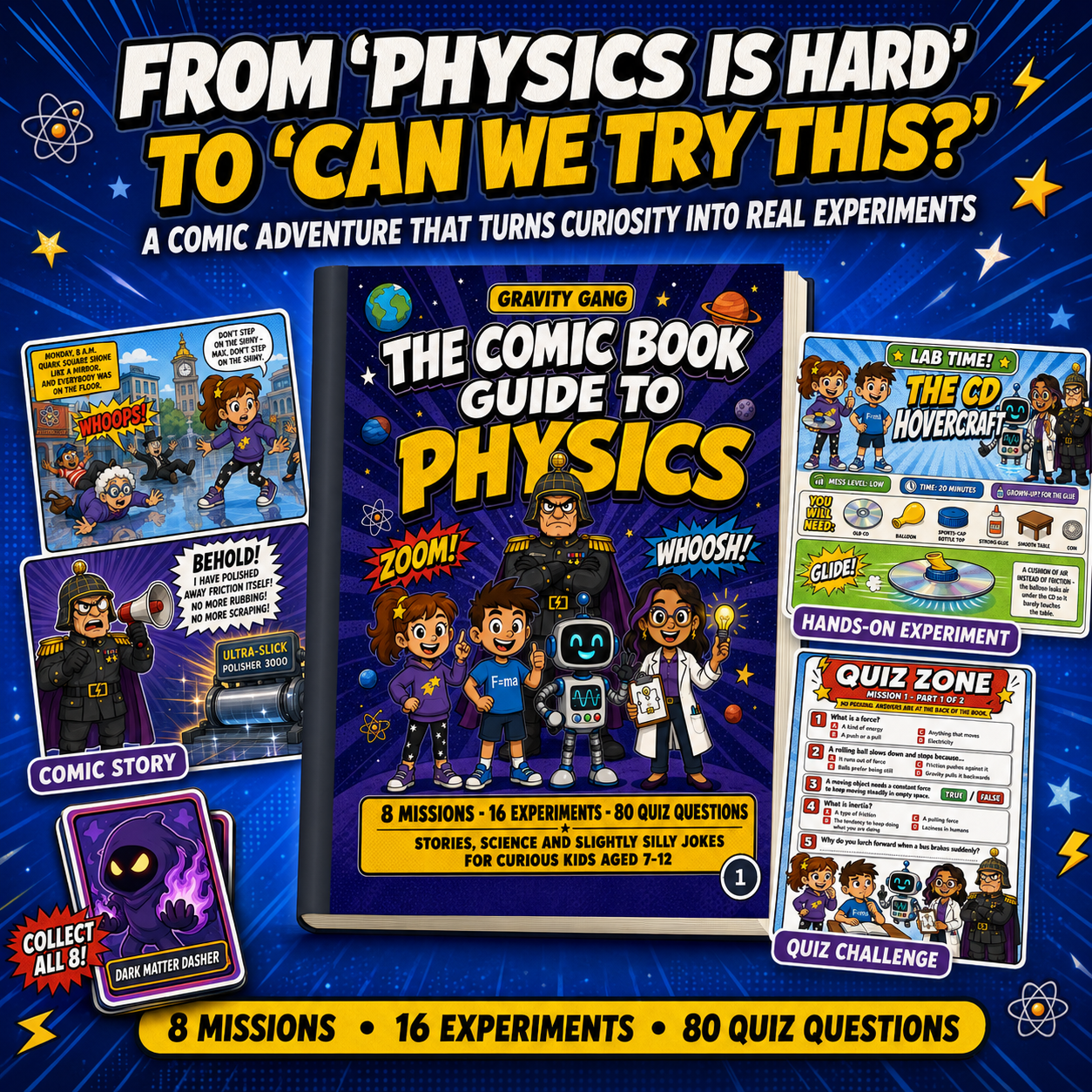
A low-risk way to test either book is a three-day mini-unit built around a single episode, or a take-home family lab sent along with the book itself.
| Product | Subject focus | Best classroom use |
|---|---|---|
| Gravity Gang | Physics | Three-day unit or take-home family lab |
| Fizz Force | Chemistry | Three-day unit or take-home family lab |
Both are available on the Brainie Comics product collection; current prices are on the pricing page.
Sources
FAQ
How do I know if a lesson is NGSS-aligned?
Check whether the resource explicitly names a Disciplinary Core Idea, a Science and Engineering Practice, and a Crosscutting Concept rather than just a general topic. If it only lists a topic, you will likely need to add the three-dimensional connections yourself before using it.
When should I use a PhET simulation instead of a physical lab?
Use a simulation when the real experiment would be too costly, too dangerous, or too slow to observe in class, and pair it with guided conceptual questions rather than unstructured exploration. Physical labs remain better for teaching measurement and hands-on material skills that a screen cannot replicate.
Are there low-cost hands-on science activities for the classroom?
Yes, household-material experiments using items like salt, water, and kitchen supplies can cover many core concepts without a lab budget. Resources like kitchen science experiments organize these by age and topic for quick classroom use.
What age group are Brainie Comics books designed for?
Gravity Gang and Fizz Force are designed for children ages 7 to 12, blending story with kitchen-safe experiments. They work well as a classroom supplement or a take-home family activity alongside standard curriculum resources.