

Under 30 Minutes a Day: Build Science Literacy at Home, Busy Parents
Small, repeated inquiry activities using household items, paired with prediction, recording, and reflection, build a child’s science literacy faster than lectures or worksheets ever will. Success looks like more unprompted questions, explanations backed by evidence instead of guesses, and longer stretches of focused tinkering. The National Academies and a longitudinal study in Frontiers in Psychology both back this up, and story-driven tools like Brainiecomics fit neatly into the routine.
TL;DR:
- Repetition and reflection over time, rather than a single activity, significantly improve a child’s scientific literacy scores at home.
- Simple household items can be used to run effective experiments that introduce key scientific concepts through prediction, testing, and explanation.
- A six-step routine—observe, question, predict, test, record, explain—encourages genuine inquiry and helps children develop critical thinking skills.
- Pairing storytelling or comic books with hands-on experiments boosts engagement and memory, especially for reluctant readers.
- Spending less time with activities and more on meaningful conversations about observations and predictions yields better learning outcomes.
Table of Contents
- What Science Literacy at Home Actually Means
- A One-Week Starter Checklist for Home Science Education
- Age-Banded Science Skills for Kids, 4 to 12
- How to Teach Science at Home Using a Six-Step Routine
- Pairing Books With Hands-On Science Talk
- Teaching Kids to Spot a Shaky Science Claim
- Reflection Templates and Why Home Exposure Compounds Over Time
- A Caregiver’s Honest Take on Making This Stick
- Bring the Routine Into Your Living Room With Brainie Comics
- Sources
- FAQ
What Science Literacy at Home Actually Means
Science literacy at home is not memorizing facts about volcanoes or the water cycle. It’s a set of practices: noticing something odd, asking a testable question, making a prediction, gathering evidence, and revising your thinking when the evidence surprises you. The National Academies’ consensus report on PreK to grade 5 science calls these “sensemaking practices,” and it explicitly recommends that families extend them beyond the classroom, not just leave them to teachers.
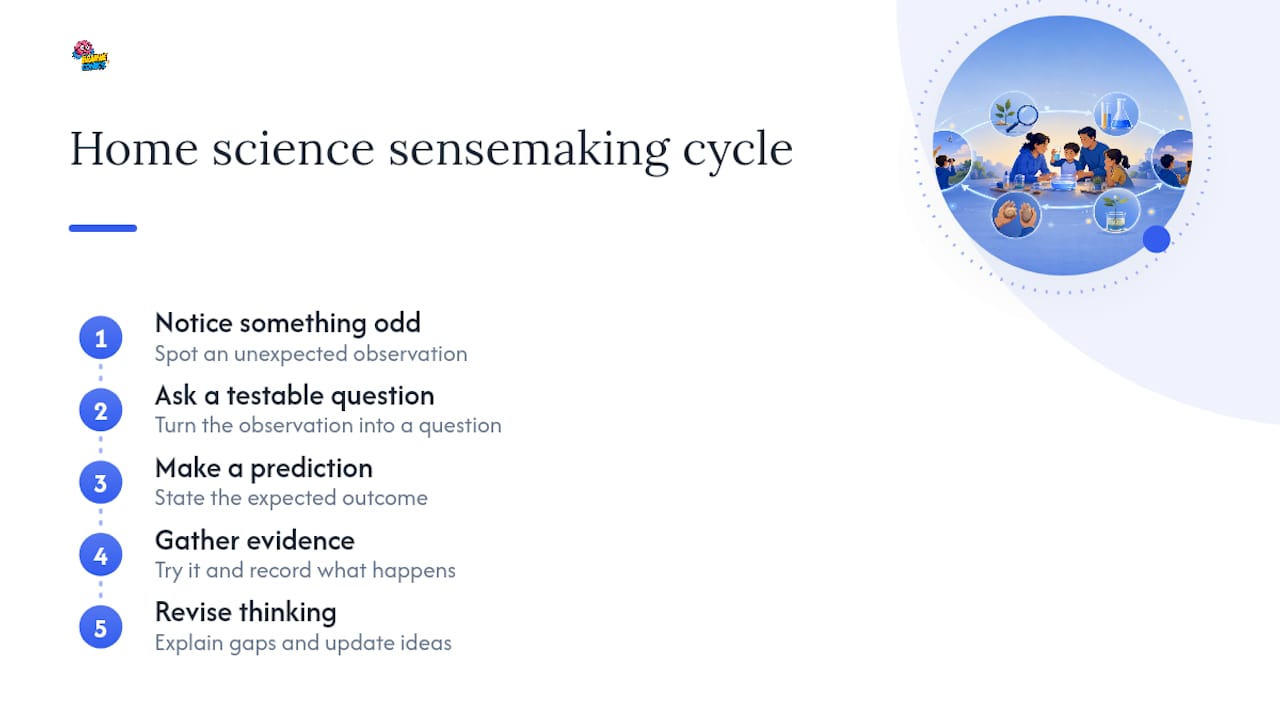
That distinction matters for how you spend your time. A parent chasing “science literacy activities” often ends up buying a kit with a checklist and a right answer printed on the box. That’s a craft project with extra steps. Real inquiry requires uncertainty. Your child predicts the vinegar and baking soda will “explode,” records what actually happens, and then has to explain the gap between the guess and the result. That gap, and the explaining, is where the literacy actually gets built.
Parents worried they need a chemistry background can relax. The Frontiers longitudinal study found that a richer home science environment, meaning more frequent exposure to science-related activities and conversation starting before kindergarten, predicted higher scientific literacy scores across the following four years. Frequency and consistency mattered more than expertise.
A One-Week Starter Checklist for Home Science Education
You don’t need a shopping trip to start. Most of what you need for a week of home science education is already in your kitchen, junk drawer, or recycling bin.
Ready-now materials to gather tonight:
- Baking soda, vinegar, dish soap, and food coloring
- A handful of coins, paper clips, or small toys for sorting and weighing
- A flashlight, a mirror, and a few clear cups or jars
- Paper towels, a magnifying glass if you have one, and a notebook or a few index cards
Safety sanity-check: anything that heats, involves a flame, or uses more than a teaspoon of a cleaning product needs an adult doing the pouring. Everything else on this list is safe for a child to handle directly.
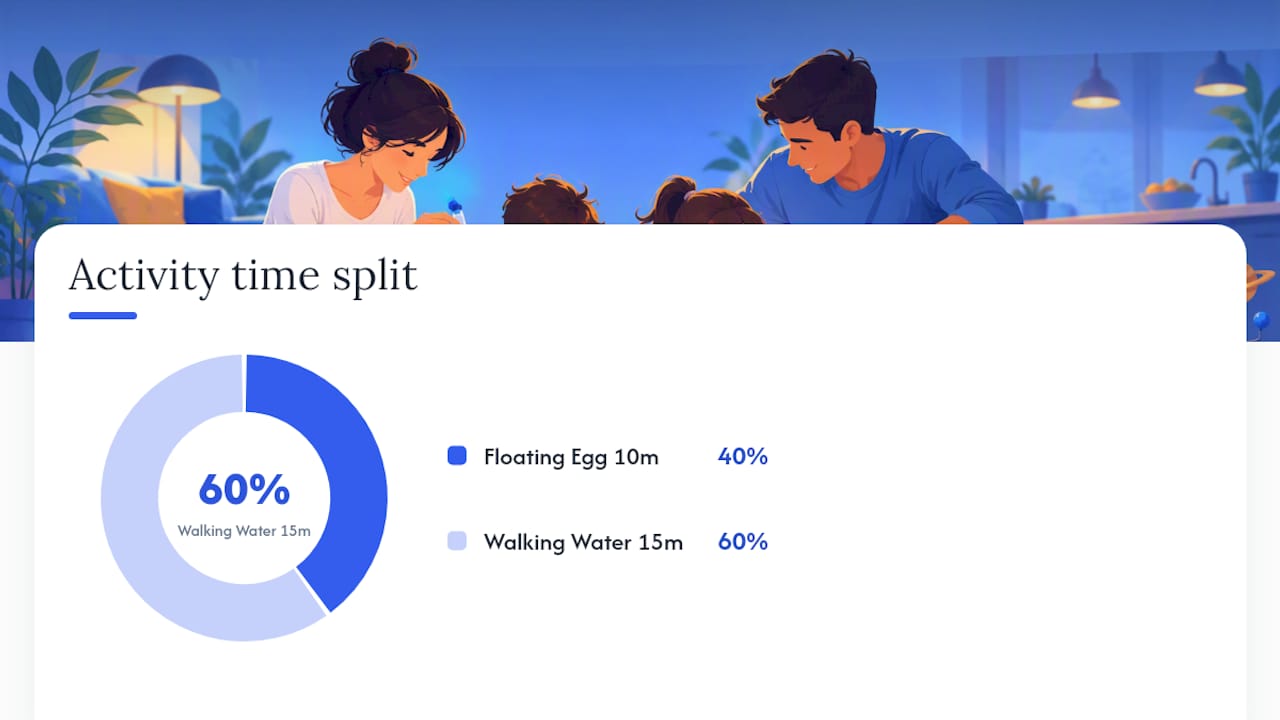
Activity 1: The Floating Egg (10 minutes) Goal: test how salt changes water density. Materials: two glasses of water, an egg, salt. Steps: 1) Ask your child to predict what happens if you drop an egg in plain water. 2) Drop it in, it sinks, then stir several tablespoons of salt into a second glass and try again. 3) Compare the two results side by side. Reflection prompt: “What was different about the water that made the egg act differently?”
Activity 2: Walking Water (15 minutes) Goal: observe capillary action with paper towels and colored water. Materials: three cups, paper towel strips, food coloring. Steps: 1) Fill the outer two cups with colored water, leave the middle empty. 2) Fold paper towel strips as bridges between cups and let them sit. 3) Check back in 20 to 30 minutes to see the color travel. Reflection prompt: “Why do you think the water climbed up the paper instead of just sitting still?”
Three phrases do more for science literacy than any workbook: “What do you notice?”, “What do you wonder?”, and “What do you predict will happen?” Say them out loud, in that order, before nearly any activity, structured or not. A pile of laundry, a puddle in the driveway, or a bubbling pot of pasta water all work as prompts.
Pro Tip: Skip elaborate setups. Snap a phone photo or record a 15-second voice note of your child’s prediction before the activity, then another right after. Replaying the “before” prediction next to the “after” result does more to build explanatory thinking than any worksheet, and it takes zero extra planning time.
Age-Banded Science Skills for Kids, 4 to 12
Science skills for kids look different at four than they do at eleven, and matching the activity to the developmental stage keeps frustration low and curiosity high.
Ages 3 to 5: sensory exploration and single-question tests
Preschoolers learn science through their hands and mouths (literally), so the goal at this age is exposure and simple cause-and-effect, not measurement.
- Sink or Float Sort — Learning aim: build early prediction habits. Materials: a bin of water and 8 to 10 small household objects (a cork, a spoon, a crayon, a rubber duck). Steps: sort objects into “will float” and “will sink” piles before testing, then test one at a time and move them to a results pile. Reflection prompt: “Which one surprised you the most?” Time budget: 15 minutes.
- Color Mixing in a Bag — Learning aim: observe change over time. Materials: a zip-top bag, water, red and blue food coloring. Steps: squeeze in separate drops of red and blue, seal the bag, and let your child squish it. Reflection prompt: “What new color did you make, and what two colors made it?” Time budget: 10 minutes.
Ages 6 to 8: controlled mini-experiments with one changed factor
By early elementary, kids can hold the idea of a “fair test,” changing only one thing at a time while keeping everything else the same.
- Ramp Racing — Learning aim: introduce controlled variables. Materials: a board or stiff cardboard, books to prop it up, two or three toy cars of different weights. Steps: race the same car down ramps of different steepness, then swap in a different car on the same ramp. Reflection prompt: “What changed the distance, the ramp or the car?” Time budget: 20 minutes.
- Melting Ice Race — Learning aim: simple measurement and timing. Materials: three ice cubes, salt, a sunny windowsill, a shaded spot. Steps: place one cube in salt, one in the sun, one in shade, then check every 5 minutes and note which melts first. Reflection prompt: “Why did the salted cube behave differently?” Time budget: 20 minutes.
Ages 9 to 12: short investigations with planning and data
Older elementary kids are ready for genuine mini-investigations, where they help design the test, collect a few data points, and revise an explanation when the data doesn’t match their hunch.
- Bridge Strength Test — Learning aim: plan a test and collect comparative data. Materials: index cards, tape, weights (coins or washers), two stacks of books as supports. Steps: build three bridge designs (flat, folded, rolled into a tube), predict which holds the most weight, then load coins onto each until it collapses and record the count. Reflection prompt: “Which design held the most, and does that match your original guess about why shapes matter?” Time budget: 20 minutes.
- Homemade Battery Test — Learning aim: record and compare quantitative results. Materials: lemons or potatoes, galvanized nails, copper coins or wire, a small LED or multimeter. Steps: build a simple circuit, test voltage or brightness across two or three different fruits or vegetables, and log results in a small table. Reflection prompt: “What pattern shows up in your data, and what would you test next?” Time budget: 25 minutes.
For a wider menu once these become routine, a curated set of household science experiments for ages 4 to 12 and age-banded kitchen science experiments can keep the rotation fresh without you having to invent a new activity every weekend.
How to Teach Science at Home Using a Six-Step Routine
The gap between a “fun activity” and an actual investigation is a specific sequence of moves. Learning how to teach science at home really comes down to running the same six steps often enough that your child starts doing them without prompting.
- Observe. Notice something specific: condensation on a cold glass, a shadow that changed length, a smell coming from the fridge. Naming the observation out loud trains attention, which the National Academies report identifies as a foundational sensemaking skill.
- Question. Turn the observation into something testable: “Why did the shadow get shorter?” not “Tell me about shadows.”
- Predict. Get a specific guess on record, out loud or written down. A vague “I don’t know” is fine as a starting point, but push gently toward a guess, even a wrong one.
- Test one variable. Change a single thing at a time. This is the step most home activities skip, and it’s the one that separates an investigation from a craft project, according to guidance from BEETLES’ “What Scientists Do”.
- Record. A quick sketch, a tally mark, or a one-line note works. The point is having something concrete to compare against the original prediction.
- Explain. Ask your child to account for the gap, if there is one, between what they predicted and what happened. This step is the one most often skipped at home, and it’s also the one doing the most work for literacy.
Worked example, start to finish: Fill three cups with water at different temperatures (cold, room temperature, warm). Ask, “Which one will dissolve a sugar cube fastest?” Get a prediction from your child before dropping in the cubes. Time each cup with a phone timer, jot the seconds on an index card, then ask, “What was it about the warm water that changed things?” Total time: about 12 minutes.
Let wrong predictions stand without correcting them immediately. The Kansas Children’s Discovery Center frames “I don’t know, let’s find out” as the most useful sentence a parent can say, because it models curiosity instead of handing over the answer. A test that fails to match the prediction isn’t a bad outcome. It’s the moment that forces your child to revise their thinking, which is the entire point of the exercise.
Pro Tip: Scale complexity by adding one more variable per month, not per week. A child who has mastered “does temperature change dissolving speed?” is ready for “does stirring change it too?” Adding both at once too early just produces confused results and a frustrated kid.
Pairing Books With Hands-On Science Talk
Reading time and science time don’t have to compete for the same 20 minutes. A story with a clear cause-and-effect problem, paired with a short hands-on check, does double duty, and it’s especially effective for reluctant readers who tune out at the word “experiment.”
Three prompts work well mid-story, right before a key event:
- “What do you think happens next, and why?”
- “Has anything like this happened to you or in a different book?”
- “If you were the character, what would you try first?”
And three quick extensions work well right after finishing a chapter or story:
- Reenact the character’s test with real materials, even a rough version.
- Ask your child to draw the moment where the character was wrong about something.
- Pick one fact from the story and ask, “How would we check if that’s actually true?”
A 2023 study on family tinkering found that adding narrative prompts, giving objects and activities a story and a mission, changed how families talked during hands-on play and improved children’s memory of the experience weeks later. The story wasn’t decoration. It was the thing that made the science stick.
Mini-lesson example: Read a chapter where a character has to figure out why a homemade rocket won’t launch. Pause before the reveal and ask your child to predict the fix. Then run a real 10-minute test: build a baking-soda-and-vinegar rocket from a film canister or small bottle, and see if your child’s fix idea (more baking soda, a tighter cap, more vinegar) actually works. Close with a two-minute conversation: “Was the character’s problem like our rocket’s problem?”
This is also the exact structure behind Brainiecomics’ comic-and-experiment format, where a chapter’s mission resolves through a real kitchen test rather than an explanation dropped into a text box. Reading Rockets makes a similar case for pairing STEM books with hands-on activities rather than treating reading and doing science as separate subjects competing for the same slot on a bookshelf.
Teaching Kids to Spot a Shaky Science Claim
Science literacy at home also means teaching kids that not everything that sounds scientific is true, and this matters more with every year a child spends online. UNESCO’s media and information literacy framework recommends checking a source, finding independent coverage, and tracing a claim back to its original evidence. A child-sized version of that fits into four steps.
The family verification checklist:
- Stop. Before believing or sharing a claim, pause instead of reacting immediately.
- Who said it? Is this a scientist, a brand trying to sell something, or a random account?
- Find another source. Does a second, unrelated source say the same thing?
- Trace the evidence. Where did this claim actually come from, a study, an experiment, or just someone’s guess?
Practice run: pick a viral science-sounding claim, “goldfish only have a 3-second memory” is a classic and false one, and walk through the four steps together in 10 to 15 minutes. Search for a second source, note that most say goldfish memory lasts weeks or months, and ask your child what made the original claim sound convincing anyway. Usually the answer is “it was surprising,” which is itself a useful lesson about why false claims spread.
Why This Matters: A single verification habit, checking for a second independent source, is one of the most transferable science literacy skills a child can build, because it applies equally to a homework fact, a social media post, and a headline they’ll read as an adult.
Media literacy and science literacy reinforce each other. A child who can explain why an experiment result surprised them is halfway to being able to explain why a suspicious claim doesn’t add up. Both skills demand the same thing: evidence before belief.
Reflection Templates and Why Home Exposure Compounds Over Time
The Frontiers longitudinal study tracked children from preschool entry and found that a richer home science environment predicted meaningfully higher scientific literacy scores across the following four years. The effect wasn’t from one impressive activity. It came from repetition, the same kind of small, consistent exposure this article has been describing all along.
Reflection is the stepfamilies skip most often, and it’s also the one doing the most for retention. BEETLES’ guidance for field instructors recommends explicit reflection scaffolds, drawings, short voice notes, or a handful of set questions, so children recognize they were doing actual science practices rather than just playing.
Template 1: The Observation Sketch Have your child draw what they saw in three boxes: “Before,” “During,” and “After.” Underneath, one line: “The thing that surprised me most was ___.” That’s it. No grading, no right answer.
Template 2: The 3-Question Reflection Sheet
- What did I predict would happen?
- What actually happened?
- What would I test differently next time?
Copy these three lines onto an index card and keep a stack by your activity supplies. Reusing the same three questions after every activity, rather than inventing new reflection prompts each time, is what turns a one-off experiment into a repeatable habit.
Pro Tip: Keep a single running notebook instead of loose pages. A child flipping back through four months of predictions and results sees their own thinking improve, and that visible progress is often more motivating than any sticker chart.
This is where story-based, hands-on products earn their place rather than just their marketing copy. Brainiecomics builds its Gravity Gang and Fizz Force comics around exactly this loop: a story problem, a kitchen-safe experiment tied to the plot, and a prompt to record what happened. The books don’t replace the reflection habit described above; they give it a built-in structure for families who want the routine without designing it themselves. For more on making experiments memorable rather than one-and-done, see homeschool science experiments kids actually remember.
A Caregiver’s Honest Take on Making This Stick
Nobody running a household with two jobs, three activities, and a dishwasher that needs unloading has time for a “science curriculum.” That’s not a criticism of parents, it’s just math. A 2024 study on virtual family engagement programs found that time, not interest or ability, is the barrier parents report most often when it comes to doing STEM activities at home. So the honest advice is to plan for less than you think you need.
A realistic week looks like this: five weekday micro-routines of 5 to 10 minutes each (a prediction question at breakfast, a two-minute observation before bed), and one weekend “double play,” a slightly longer 20-minute activity paired with a related book chapter. That’s under 30 minutes of total daily time, some days closer to five.
The single biggest lever isn’t the activity you choose. It’s whether you follow up with a real conversation, even a 90-second one, about what your child noticed and predicted. A rushed activity with a genuine two-minute conversation afterward beats an elaborate one with silence at the end.
— Brainie Comics
Bring the Routine Into Your Living Room With Brainie Comics
Some educational comic books turn the six-step investigation routine into a story format designed to engage children, using screen-free, kitchen-based experiments. Certain comic books address physics and chemistry topics and include kitchen-safe experiments integrated with their plot, incorporating prediction, testing, and explanation steps as part of the story adventure.
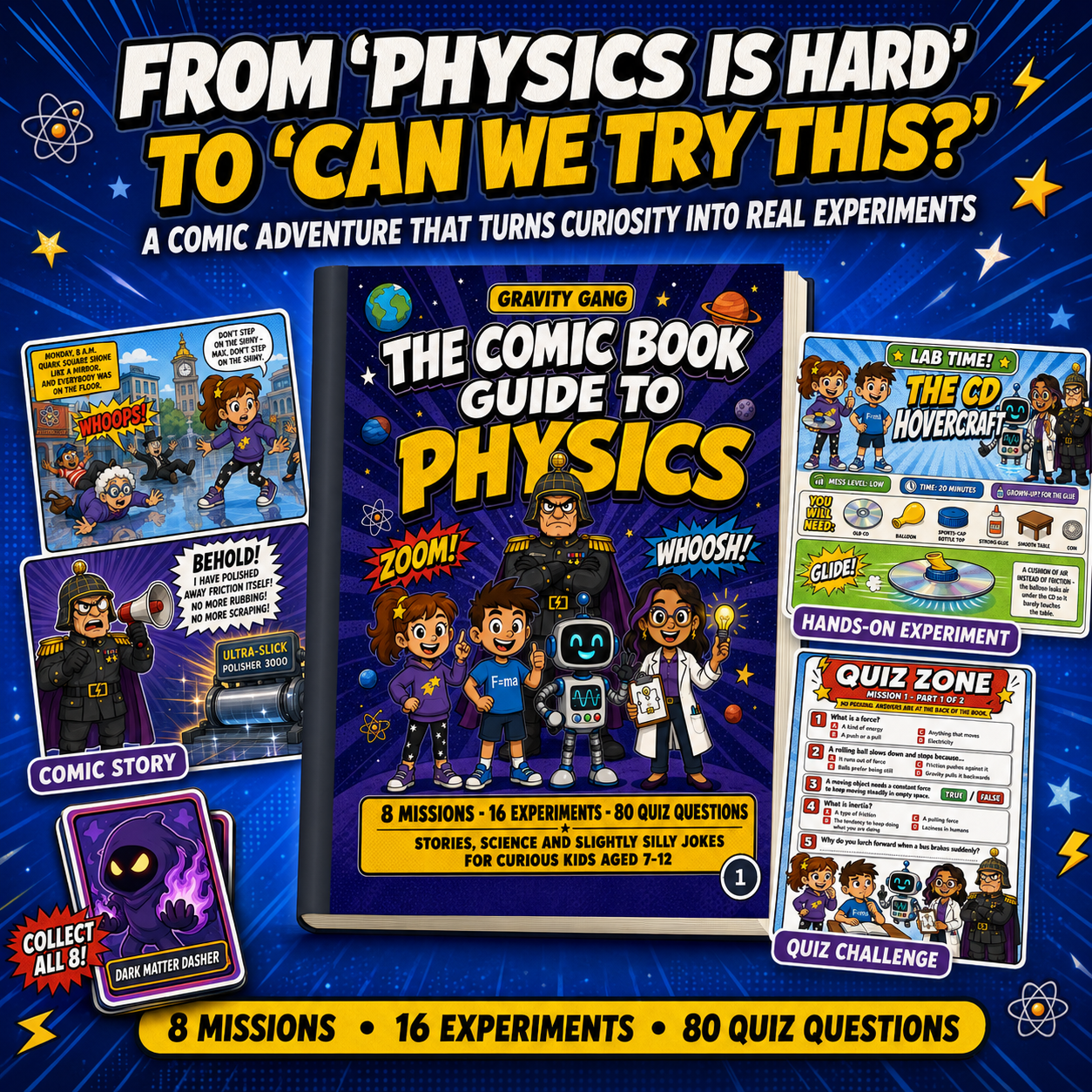
Some story-based educational books include story missions that frame the prediction, household-materials experiments for testing, and quizzes encouraging explanation, supporting reflection habits described earlier. If you’re not sure which one fits your child better, browse the full comic collection and start with whichever mission grabs their attention first, physics rockets and gravity stunts in Gravity Gang, or fizzing kitchen reactions in Fizz Force. Both are $59.95 each, backed by a 30-day money-back guarantee, so testing the routine with your own kid carries no real risk. Order one today and run your first six-step investigation by the weekend.
Sources
- National Academies consensus report (PreK–5 guidance)
- Predicting grade school scientific literacy from aspects of the early home science environment
- Study on storytelling effects during family tinkering (2023)
- BEETLES — What Scientists Do
FAQ
What are some easy science experiments I can do at home?
Sink-or-float sorting, walking water with paper towels, ramp racing with toy cars, and homemade fruit batteries all use household items and take 10 to 25 minutes. The age-banded activities section above groups similar experiments by developmental stage, from preschool sensory play to elementary-level data collection.
Can you give examples of scientific literacy in action?
Scientific literacy shows up when a child predicts an outcome, tests it, and explains a result that didn’t match their guess, rather than just naming facts. The National Academies frames this as “sensemaking,” which includes planning an investigation, analyzing evidence, and revising an explanation.
What are easy science experiments kids can do without much setup?
Melting ice races, color mixing in a sealed bag, and dissolving sugar in water at different temperatures all take under 20 minutes and use items already in most kitchens. The one-week starter checklist above lists two ready-to-run activities with step-by-step instructions.
How do I know if my child’s science understanding is improving?
Watch for three signs: they ask follow-up questions unprompted, they explain results using evidence instead of guessing, and they stay engaged with an activity longer than they used to. Keeping a simple observation notebook, as described in the reflection templates section, makes that progress visible over weeks and months.
Are comic books like Brainiecomics actually useful for teaching science at home?
Story-based formats that pair a narrative with a real hands-on experiment can improve memory and engagement, according to a 2023 study on family tinkering. Brainiecomics’ Gravity Gang and Fizz Force build kitchen-safe experiments directly into their stories, giving reluctant readers a reason to finish the chapter and try the test.