

For Parents: Kitchen Science for Kids: Age Banded Experiments + Comics
Kitchen science for kids is a set of safe, low-prep experiments using items you already have, built to teach observation, measurement, and the scientific method. You can run a meaningful hands-on experiment in 10 to 30 minutes with pantry staples like milk, vinegar, and baking soda. Below you’ll find age-banded ideas, safety notes, and inquiry prompts. Start tonight with magic milk, then write down what your child noticed.
TL;DR:
- Most experiments, like the baking soda volcano or magic milk, require only minimal supervision and can be completed within 10 to 30 minutes using pantry staples.
- Activities are tailored to different age groups, with younger children focusing on sensory play and older kids designing independent experiments and recording results.
- Safety precautions include checking for allergies, avoiding hot surfaces, and using age-appropriate tools and cutting techniques to prevent injuries.
- Turning experiments into scientific inquiries involves asking questions, predicting outcomes, testing one variable at a time, and recording observations systematically.
- Incorporating comics like Fizz Force and Gravity Gang helps reluctant readers understand concepts through story and step-by-step experiments, reinforcing learning and engagement.
Table of Contents
- 1. Easy experiments to run with pantry items
- 2. Which experiments fit each age group?
- 3. Safety and prep steps before you start
- 4. Turning a kitchen trick into real science
- 5. Why comics make the science stick
- Why mess matters more than tidy results
- Bring the story home with Fizz Force and Gravity Gang
- FAQ
- Sources
1. Easy experiments to run with pantry items
Each of these works with a few dollars of supplies and a kitchen counter. Supervision levels vary, so check the notes before you start.
- Magic milk: milk, dish soap, food coloring, and cotton swabs show how soap breaks surface tension and reacts with milk fats, sending color swirling across the surface. Takes 5 to 10 minutes with low supervision. The Oregon State Extension milk lesson explains how soap disrupts fat and protein structures to create the visible movement.
- Baking soda volcano: baking soda and vinegar in a container produce an acid-base reaction with foam and fizz. Takes 10 to 20 minutes, medium supervision for pouring and cleanup.
- Oobleck (cornstarch slime): cornstarch and water make a non-Newtonian fluid that acts solid under pressure and liquid at rest. Takes 10 to 15 minutes, low supervision.
- Floating or sinking egg: salt dissolved into water raises the water’s density until a raw egg floats. Takes 10 to 20 minutes, low supervision.
- Ice cream in a bag: cream, salt, and ice demonstrate freezing point depression as salt lowers the temperature needed for the mixture to freeze. Takes 20 to 30 minutes, medium supervision for ice handling.
- Gummy bear osmosis: soaking gummy bears in plain water versus salt water shows diffusion and osmosis as the candy swells or shrinks overnight. Low supervision, best left overnight.
- Color diffusion or galaxy jars: food coloring dropped into water and oil layers reveals how density and diffusion separate liquids. Takes 10 to 15 minutes, low supervision.
- Bouncy egg: soaking a raw egg in vinegar for 24 to 48 hours dissolves the shell and leaves a rubbery membrane you can bounce gently. Medium supervision for handling.
Pantry chemistry is more rigorous than it looks: the reaction behind the baking soda volcano, measuring, and record-keeping steps map directly onto practices recommended for teaching the scientific method in the kitchen, where practicing with non-food materials first helps kids master tools before working with real ingredients.
For a deeper set of options organized by complexity, our household science experiments for ages 4 to 12 collection covers variations on most of these.

2. Which experiments fit each age group?
Motor skills and attention span, not interest, usually decide which experiment works.
- Ages 2 to 3: stirring, shaking closed containers, and sensory play suit this age best. Let them mix oobleck once it’s prepared, or drop color into water while an adult controls the dropper.
- Ages 4 to 5: measuring cups and spoons, pouring, and no-heat mixing become possible. Magic milk, sink-and-float tests, and simple density columns work well, matching the measuring and pouring tasks described in New York State’s cooking-with-children guidance for 4- and 5-year-olds.
- Ages 6 to 8: basic measuring, timed observation, and supervised heat or simple tools open up more options. The baking soda volcano, ice cream in a bag with an adult handling ice, and vinegar de-shelling of eggs all fit, as long as an adult manages any heat source.
- Ages 9 to 12: kids can design one-variable experiments, record measurements independently, and run fair tests. Diffusion timing with a stopwatch, osmosis trials comparing liquids, and variations on the baking soda reaction (more vinegar, less soda, different temperatures) give them room to test their own questions.
Concrete adjustments help at every age: give younger children pre-measured ingredients in small cups, use closed containers to limit spills, and swap in plastic or child-safe serrated knives for any cutting tasks. For more on building measurement skills specifically, see our guide on measuring in the kitchen.
3. Safety and prep steps before you start
A few minutes of setup prevents most problems.
- Check for food allergies or sensitivities before anyone tastes anything, and keep a first-aid kit and paper towels within reach.
- Follow CDC food-safety guidance for children under 5: strict handwashing, avoiding unpasteurized dairy and other high-risk raw foods, and supervising any tasting closely, since younger children have developing immune systems.
- Prevent choking by cutting grapes lengthwise, skipping popcorn and hard candy for children under 4, and using plastic serrated knives for soft foods, following the age-based precautions in New York State’s guidance.
- Keep kids at a safe distance from hot surfaces. Only adults should touch stovetops, boiling water, or hot pans, and each child should have a clear, non-heat role.
- Plan for cleanup before you start: have a compost bin or trash ready, and reuse containers like jars and bowls across experiments.
Pro Tip: Lay out every tool and ingredient before you call the kids to the counter. Rushed setup is the biggest cause of kitchen-science chaos.
4. Turning a kitchen trick into real science
A fun reaction becomes a learning experience once kids ask a question and test it themselves.
- Ask: what do you think will happen?
- Predict: write or say a guess before starting.
- Test: run the experiment, changing only one thing at a time.
- Observe: watch closely and describe what’s happening out loud.
- Record: write, draw, or photograph the result.
- Explain: say in one sentence why it happened.
For gummy bear osmosis, kids can test one variable, salt water versus plain water, and measure the bear’s length or weight before and after. A simple journal page with “I think,” “I saw,” and “I think this happened because” works for any age.
- Group kids into teams of 3 or 4 with assigned roles: recorder, measurer, and timer, as described in this resource on role play routines for kids.
- Run each test at least twice to check whether the result holds.
- Score engagement informally with a 1 to 5 observation scale or a single photo per step.
5. Why comics make the science stick
Brainie Comics builds its Fizz Force and Gravity Gang books around exactly this gap: kids who enjoy a story but stall out on a textbook. Each book pairs a chemistry or physics story with step-by-step experiments using everyday materials, so the narrative carries the reader through concepts that might otherwise feel dry. The comic format lowers the effort needed to follow multi-step instructions, which helps reluctant readers in particular. A practical classroom routine: read a short strip to introduce an idea, run the matching experiment, then use the comic’s reflection prompts for journaling.

Why mess matters more than tidy results
A messy experiment that sparks three new questions beats a clean one nobody discusses afterward. Match your pacing to the goal: a 10 to 15 minute demo works for pure engagement, while measurement practice needs multi-day setups like gummy bear osmosis. Judge success by how many hypotheses a child generates, whether they can explain the result in their own words, and whether they want to try again.
— Brainie Comics
Bring the story home with Fizz Force and Gravity Gang
Fizz Force and Gravity Gang are comic books that combine chemistry and physics concepts with stories, using household materials and no screen time.
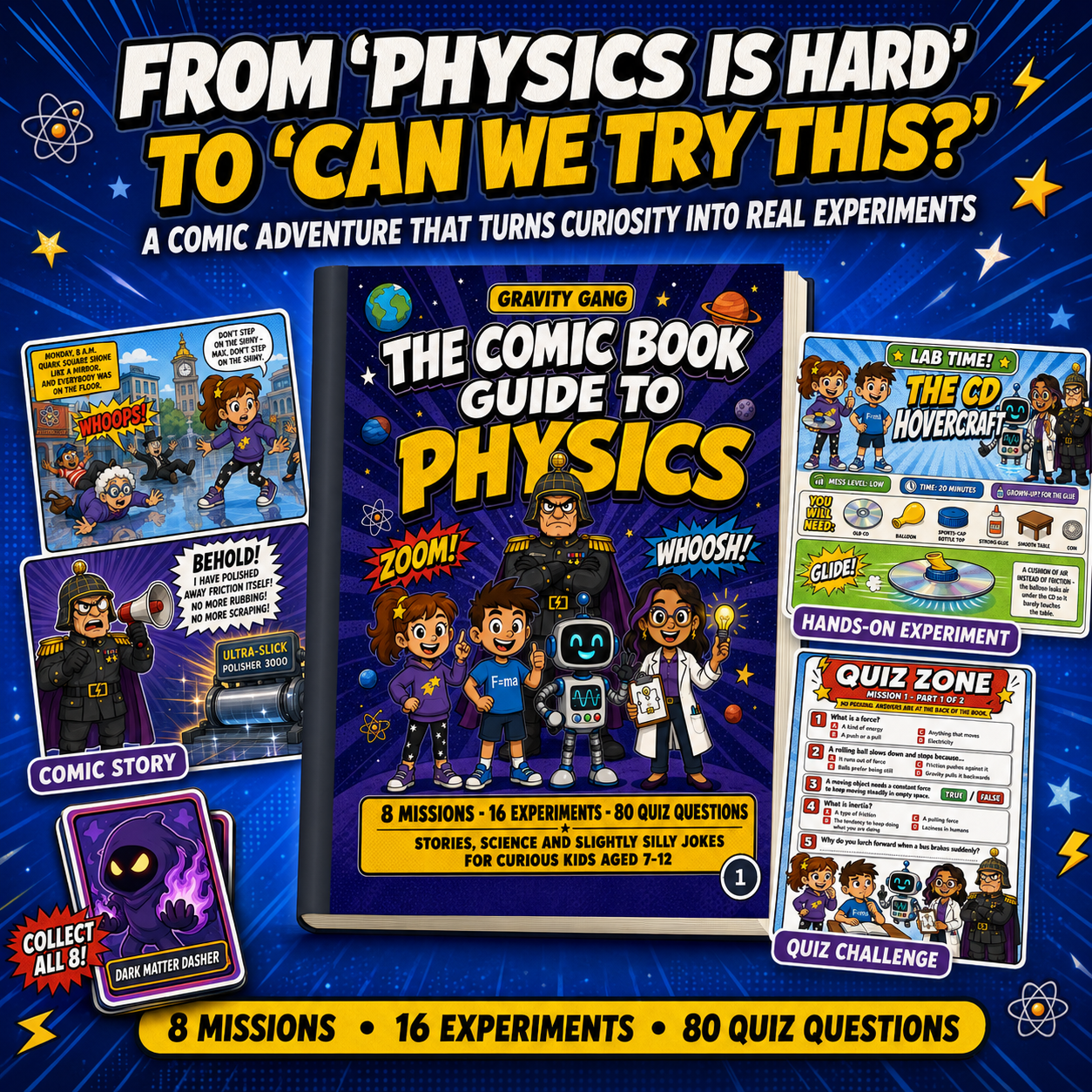
Try one experiment from this list tonight, then let the matching comic turn it into a multi-step adventure with built-in worksheets and prompts. Browse both titles on the Brainie Comics collection page to find the right starting point for your child.
FAQ
What are some fun kitchen science experiments for a 10-year-old?
A 10-year-old can handle experiments with real measurement and one-variable testing, like gummy bear osmosis comparing liquids, timed color diffusion, or variations on the baking soda and vinegar reaction. These let them design their own fair test and record results in a journal.
What is magic milk?
Magic milk is an experiment where dish soap added to milk with food coloring makes the colors swirl and spread. The soap breaks the milk’s surface tension and interacts with its fats, as described in the Oregon State Extension lesson on the science of milk.
How is science used in the kitchen?
Cooking relies on chemistry (reactions like baking soda and vinegar, or heat changing proteins) and physics (density, freezing points, surface tension). Everyday tasks like measuring, mixing, and heating are small science experiments already happening in daily cooking.
How is cooking related to science for kids?
Cooking gives kids a hands-on way to practice the scientific method: asking questions, predicting outcomes, measuring ingredients, and observing changes. Pacing a kitchen-science routine over several weeks, as recommended by Yale Teachers Institute’s curriculum, helps kids build measuring and safety skills before tackling more complex experiments.
How do I keep kitchen science safe for young kids?
Wash hands before and after, check for allergies, and keep children away from hot surfaces and sharp knives. Follow age-based task guidance, such as the New York State cooking guidance, to match each task to a child’s skill level.
Sources
- Food safety for children under 5 | CDC
- Cooking with preschool-age children | New York State Department of Health
- Cooking up the scientific method | Yale Teachers Institute
- The science of milk lesson (Oregon State Extension)