

Six Elementary Science Experiments Age Banded for Teachers
Six household experiments are all you need to get kids ages 5 to 11 genuinely excited about science: a baking soda volcano, Skittles diffusion, oobleck, a balloon rocket, a lemon battery, and a density tower. Most take under 60 minutes, use items already in your kitchen, and come with a clear learning goal so the activity isn’t just messy fun.
TL;DR:
- Most experiments use common household items and can be completed in under 60 minutes, making them accessible and easy to fit into busy schedules.
- Safety precautions include wearing goggles for vinegar splashes, controlling ratios for reactions, and supervising sharp tool use in the lemon battery.
- Adjustments for different ages enhance learning, with young children focusing on predictions and vocabulary, while older students test hypotheses and measure outcomes.
- Setting up multiple stations and pre-measuring supplies reduces wait times and streamlines the activity for larger groups and classroom management.
- Troubleshooting involves simple fixes like checking ratios, ensuring good electrical contact, or modifying variables to prevent repeated failures and reinforce learning.
Table of Contents
- Six Elementary Science Experiments Using Household Items
- Getting Materials and Space Ready Before You Start
- Adjusting Experiments by Age and Grade
- Running These as Classroom Stations or Take-Home Kits
- Safety Rules and What to Do When an Experiment Flops
- Why Story-Driven Experiments Work for Reluctant Readers
- A Note on Letting Kids Fail Forward
- Turn These Experiments Into a Full Story-Based Science Habit
- Where to Find More Tested Experiments
- Sources
- FAQ
Six Elementary Science Experiments Using Household Items
These six show up again and again on educator-curated lists because they’re cheap, fast, and reliably produce a reaction kids remember, which is exactly why WeAreTeachers keeps them near the top of every classroom roundup.
-
Baking Soda Volcano. Materials: baking soda, vinegar, dish soap, red food coloring, a small bottle, a tray. Time: 20 minutes. Steps: build a clay or paper “mountain” around the bottle, add baking soda and a squirt of dish soap, pour in vinegar mixed with food coloring, watch it erupt, then discuss the acid-base reaction that made the gas. Learning goal: acids and bases produce carbon dioxide gas. Safety note: keep it away from eyes and do it on a tray. Extension: try different vinegar-to-soda ratios and time each eruption.
-
Skittles Rainbow Diffusion. Materials: Skittles, a white plate, warm water. Time: 15 minutes. Steps: arrange candy in a circle on the plate, slowly pour warm water in the center, predict what will happen, then watch silently for 30 to 45 seconds without touching the plate. Learning goal: diffusion moves color molecules from high to low concentration. Safety note: no ingredients here are dangerous, but discourage tasting once dye has dissolved. Extension: test cold versus hot water and compare diffusion speed.
-
Oobleck (Non-Newtonian Fluid). Materials: cornstarch, water, a bowl, food coloring (optional). Time: 15 minutes. Steps: mix two parts cornstarch to one part water, add color, then let kids punch it fast and stir it slowly, and ask them to explain why it behaves both like a solid and a liquid. Learning goal: some materials don’t follow ordinary rules for solids and liquids. Safety note: never pour it down a sink, it clogs pipes. Extension: measure how the ratio changes stiffness.
-
Balloon Rocket. Materials: a balloon, string, a straw, tape. Time: 20 minutes. Steps: thread string through a straw, tape the straw to an inflated balloon, stretch the string across a room, and release the balloon to watch it “rocket” along the line. Learning goal: escaping air creates thrust, an example of Newton’s third law. Safety note: keep the flight path clear of faces. Extension: change balloon size or straw length and measure distance traveled.
-
Lemon Battery. Materials: a lemon, a copper coin, a galvanized (zinc) nail, wires, a small LED or multimeter. Time: 25 minutes. Steps: roll the lemon to release juice, insert the coin and nail a few inches apart, attach wires to each, and connect to the LED or multimeter to detect a tiny electrical current. Learning goal: chemical reactions between two different metals in an acidic solution generate electricity. Safety note: adults handle any sharp nail insertion. Extension: chain multiple lemons together to boost voltage.
-
Density Layering Lava Lamp. Materials: vegetable oil, water, food coloring, salt, a clear jar. Time: 15 minutes. Steps: pour water then oil into the jar, add drops of colored water, sprinkle salt on top, and watch colored droplets sink then rise as the salt dissolves. Learning goal: liquids of different densities separate into visible layers. Safety note: use a sturdy, capped container if kids will shake it. Extension: test other liquids like honey or dish soap to build a full density stack.
These six line up closely with what Science Buddies flags as ideal for elementary attention spans: quick payoff, minimal setup, room for a short observation window before moving on.
Getting Materials and Space Ready Before You Start
Most of these experiments run on items already sitting in a pantry, and a few smart substitutions save a trip to the store.
- Swap distilled vinegar for lemon juice in the volcano if you’re already using lemons for the battery experiment.
- Keep a roll of paper towels and a plastic tray at every station to catch spills before they hit the floor.
- Stock basic safety goggles for anything involving vinegar splashes or hot water, and keep an adult within arm’s reach for the lemon battery’s wiring step.
- If you’re rotating multiple kids through stations, prep separate trays in advance so one group’s mess doesn’t stall the next.
- Separate prep time (mixing, measuring, setting out materials) from hands-on time when you plan a session. Prep might take 10 minutes; the actual experiment often takes half that.
Pro Tip: Set up two identical stations for popular experiments like oobleck or the volcano. Kids wait less, and you get twice the observation data to compare.
Adjusting Experiments by Age and Grade
The same experiment can teach very different skills depending on how you frame the questions.
- Grades K to 2: Focus on simple predictions (“Will it float?”) and basic vocabulary like “mix,” “dissolve,” or “reaction.” Keep instructions to one step at a time.
- Grades 3 to 5: Add measurement. Have kids time the balloon rocket’s flight or count how many drops of vinegar trigger a reaction, then repeat the trial and record results.
- Higher-achieving students: Push toward hypothesis testing. Ask them to predict how changing one variable, like water temperature in the Skittles experiment, will change the outcome, then graph the results.
- Every adaptation ties back to core classroom skills: observation, measurement, and controlling variables, which the American Chemical Society identifies as the backbone of meaningful elementary science work.
Running These as Classroom Stations or Take-Home Kits
Turning a single demo into a rotating station setup or a family activity doesn’t take much extra planning.
- Set station rotations at 12 to 15 minutes each, with one adult or older student per station managing materials and safety.
- Add a one-page prediction sheet before each experiment starts, then a simple data table afterward, turning a demo into a real investigation.
- For take-home versions, bag pre-measured dry ingredients (cornstarch, baking soda) with a printed instruction card so parents only need water, vinegar, or a lemon from the fridge.
- In classrooms with limited supplies, group three or four students per lemon or per oobleck batch instead of giving each child a full setup.
Safety Rules and What to Do When an Experiment Flops
A failed reaction is usually a ratio problem, not a lost lesson.
- Require eye protection for anything involving vinegar sprays, and keep hands away from mouths during every experiment, no exceptions.
- If the volcano fizzles instead of erupting, check the baking soda-to-vinegar ratio first; old baking soda loses potency over months.
- If the lemon battery shows no current, check that the nail and coin aren’t touching and that wires are making firm contact.
- Turn a flop into a lesson: ask “what would you change next time?” and let kids form a new hypothesis rather than just handing them the fix.
- For most spills, a damp paper towel and a rinse under cool water handles cleanup; vinegar and oobleck both wash out with plain water.
Pro Tip: Keep a “why didn’t it work?” question on hand for every experiment. Kids remember troubleshooting longer than they remember a perfect result.
Why Story-Driven Experiments Work for Reluctant Readers
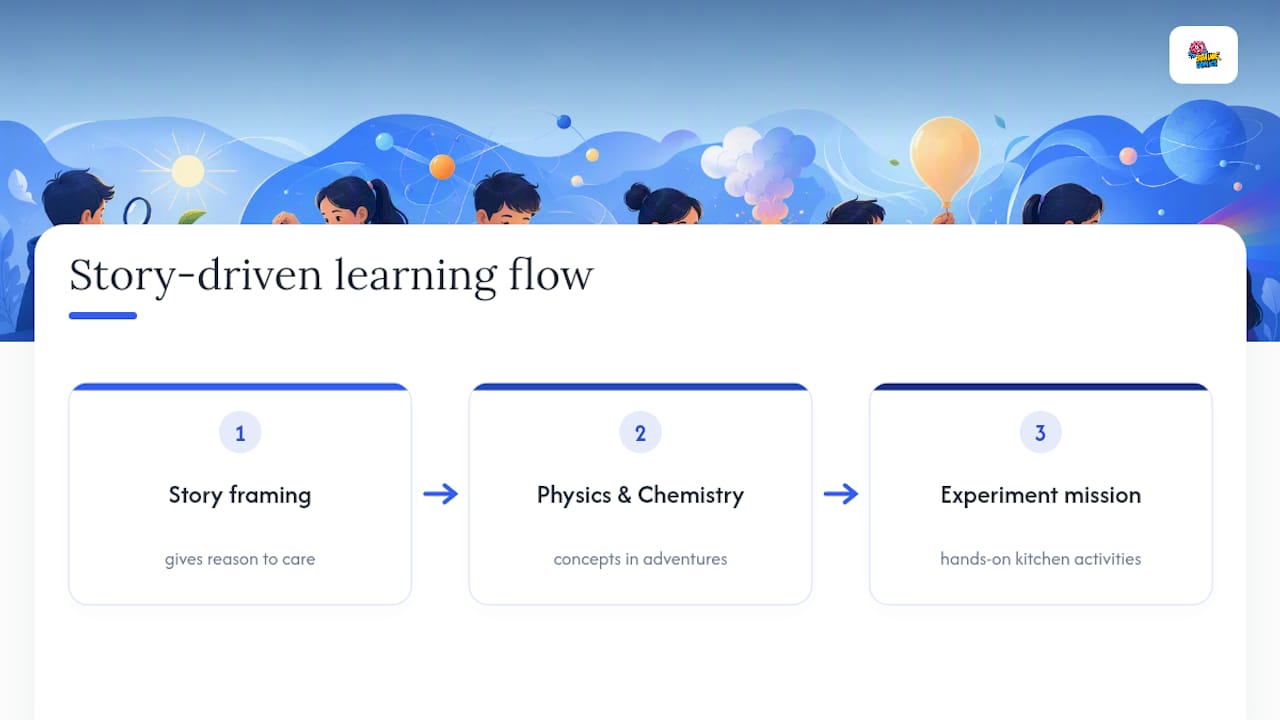
Framing an experiment around a story, not just a set of steps, gives kids a reason to care about the outcome, and research on storytelling in science education backs that up directly. Brainie Comics builds on this with Gravity Gang and Fizz Force, comic books that wrap physics and chemistry concepts into adventure plots, then hand kids the same kitchen experiments as story missions. For more free experiment ideas in this style, browse the baking soda and vinegar guide or the household experiments roundup on the Brainie Comics blog.
A Note on Letting Kids Fail Forward
The best sessions we’ve seen described in classroom guidance aren’t the ones where every experiment works perfectly. They’re the ones where a kid predicts wrong, watches it happen anyway, and asks why. Let your child or student plan the next trial, and let them help with cleanup too. Ownership of the mess is part of the science.
— Brainie Comics
Turn These Experiments Into a Full Story-Based Science Habit
Running six solid experiments is a great start, but keeping kids engaged past the first “wow” moment usually takes more than a materials list. That’s the specific gap Brainie Comics is built to fill: instead of handing a child a worksheet, Gravity Gang and Fizz Force wrap the same kitchen-safe experiments into comic adventures where the science has a reason to happen, with zero screen time required.
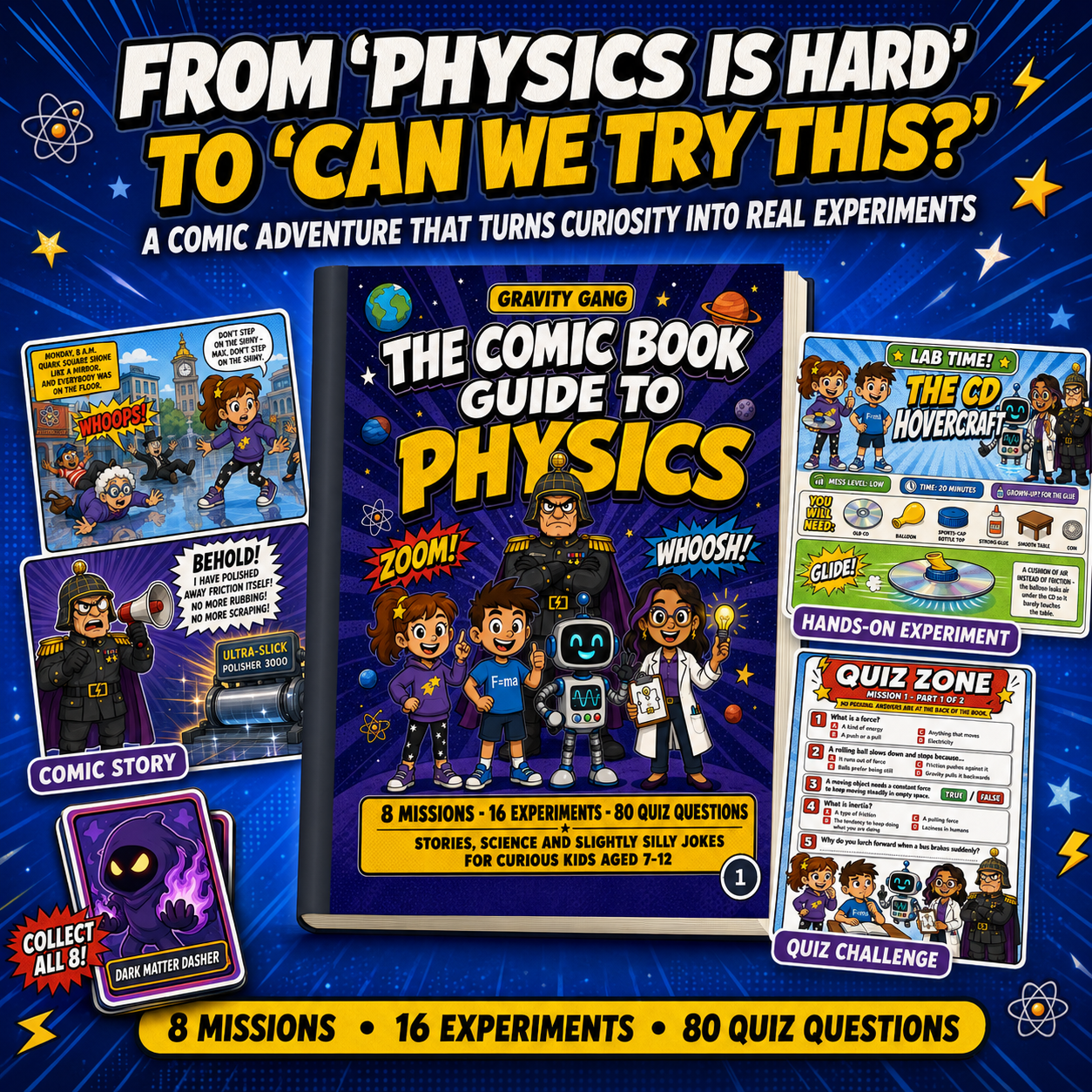
Both books work as a home library addition or a teacher’s back-pocket resource for slow afternoons. If you’d rather start with baking, these tips on baking with kids from Missy Lala’s pair nicely with the food-based chemistry angle in Fizz Force. Browse the full comic book collection, or go straight to Gravity Gang for physics fans or Fizz Force for chemistry lovers to see which story fits your reader.
Where to Find More Tested Experiments
- Science Buddies offers grade-level filters and scientist-tested project guides.
- The American Chemical Society frames activities around safety and the scientific process.
- PBS KIDS and WeAreTeachers list dozens more easy, low-cost ideas for home and classroom use.
Sources
- STEM Activities for Kids
- Science Activities for the Classroom — American Chemical Society
- 70+ Easy Science Experiments Using Materials You Already Have
- Simple activities for kids — PBS KIDS
FAQ
What are 10 easy science experiments for kids?
Beyond the six covered above (volcano, Skittles diffusion, oobleck, balloon rocket, lemon battery, density tower), other reliable picks include a leakproof bag test, a walking water experiment, homemade bubbles, and an egg-in-vinegar bouncy egg. All use household items and fit within a single school session.
What are some fun science experiments for kids?
The most consistently popular options are ones with a visible, fast payoff: the baking soda volcano and the oobleck experiment both deliver an immediate reaction that keeps kids engaged. Story-driven versions, like the ones in Brainie Comics’ Gravity Gang and Fizz Force, tend to hold attention longer because the experiment has a narrative reason behind it.
What are some simple science experiments I can do in grade 5?
Fifth graders do well with experiments that add measurement and repeat trials, such as timing balloon rocket flights across different straw lengths or testing lemon battery voltage with multiple lemons chained together. These activities build directly on the observation and variable-control skills emphasized by the American Chemical Society.
What are some quick science experiments?
Skittles diffusion and the density layering demo both run in 15 minutes with almost no prep, making them ideal for a quick classroom block or a rainy afternoon at home. Most household-material experiments fit within an hour, which keeps them realistic for short attention spans.
Does Brainie Comics include experiments in its books?
Yes. Both Gravity Gang and Fizz Force pair comic book storytelling with kitchen-safe experiments tied to each chapter’s plot, using everyday household materials. Current pricing is listed on the Brainie Comics collection page.