

Screen vs. Print Learning for Parents and Teachers: When Print Wins
For most deep reading and long expository tasks, print tends to produce slightly better comprehension and retention than reading on screens. The size of that gap depends heavily on scrolling versus paging, device type, the learner’s age, and whether an adult guides the digital session. Screens can match or even beat print for short texts or well-designed digital materials. The sections below walk through the evidence and what it means for choosing materials at home or in class.
TL;DR:
- For long assignments, choose paginated tablet layouts over continuous scrolling; fixed page structure better supports locating details and following arguments.
- Short passages, fact checks, and quick reference tasks show little measurable difference between formats, so screens remain practical for brief reading.
- For young children, digital storybooks can support vocabulary when an adult reads alongside them, but independent screen reading tends to produce weaker comprehension.
- Across 119 studies of K through 5 students, reading effect sizes fell from 0.23 overall to 0.14 on standardized tests.
Table of Contents
- What research reviews reveal about print versus digital reading
- How screen size and scrolling change comprehension and memory
- When age and task type change the print versus screen answer
- Practical strategies for parents and teachers using both formats
- What this means for classroom device choices and curriculum design
- How engagement differs between print and screen reading
- How screen time affects attention span and readiness to learn
- Why the physical qualities of print support memory
- Why multisensory input matters for print and screen learning
- Pairing hands-on tasks with screen-based reading
- Comparing print and digital comics for learning outcomes
- Our take on screen-free, hands-on learning for reluctant readers
- Printed science comics built for reluctant readers
- FAQ
- Sources
What research reviews reveal about print versus digital reading
Large-scale reviews converge on a consistent, modest pattern: print reading supports somewhat stronger comprehension than screen reading, especially for longer, expository material. A systematic literature review of digital versus paper reading found that paper led to better comprehension outcomes across many studies, though the size of the advantage shifted depending on the device and how the text was presented. A separate network meta-analysis reinforced this pattern while adding nuance about format.
That nuance matters. The comprehension gap tends to shrink or disappear under certain conditions:
- Short texts show little to no measurable difference between print and screen comprehension.
- Paged digital formats, where readers tap or swipe rather than scroll, narrow the gap considerably.
- Well-designed e-readers and tablets with page-like presentation often perform close to print.
- Continuous scrolling on computers or phones tends to widen the gap the most.
Digital formats are not uniformly worse. A two-decade meta-analysis on storybook reading found that digital storybooks can slightly improve story comprehension and produce a stronger boost in vocabulary learning, but only when the digital material is carefully chosen and an adult reads alongside the child. Independent reading without that support tends to favor print for young children’s comprehension, a pattern also noted in research hosted at Eprints.
Reviewers are candid about the limits of this evidence base. A 2025 scoping review of online versus traditional education points out that studies vary widely in age ranges, device types, and even in how they define “online learning,” which makes clean comparisons harder than headlines suggest. Differences in study quality, sample size, and measurement tools (standardized tests versus researcher-built quizzes) all shape the reported outcomes.
That measurement distinction turns out to matter a lot in practice.
A 2025 meta-analysis of 119 K through 5 studies found an average effect size of 0.23 for reading comprehension overall, which dropped to 0.14 when only standardized tests were used. The gap between those two numbers is a reminder that how comprehension is measured changes how large an edtech benefit looks, and it is one reason broad claims about digital tools “working” or “not working” deserve a second look.
Taken together, the research consensus is not “print always wins.” It is closer to: print has a durable, modest edge for long, complex reading, digital tools can help in specific, well-supported circumstances, and the details of implementation often matter more than the medium itself.
How screen size and scrolling change comprehension and memory
Not all screens behave the same way, and the research is specific about why. A network meta-analysis that ranked reading effectiveness by device placed paper at the top for comprehension, followed by tablets, then e-readers, then computers, then smartphones. Scrolling increased the paper advantage, while pagination narrowed the differences considerably.
The mechanism behind this ranking comes down to how the brain builds a map of a text. Cognitive research on spatial landmarks in reading shows that printed pages give readers fixed visual cues: a passage sits at the top of a right-hand page, a key fact appears near a particular paragraph break. Those landmarks help readers build a mental map they can later use to relocate information and reconstruct the flow of an argument. Scrolling disrupts that map. There is no fixed “place” for anything, which adds a small but real cognitive cost every time a reader tries to recall where something was.
Pagination, whether on a tablet, an e-reader, or a paginated PDF, restores some of that spatial structure. It will not fully match the physical landmarks of a printed page, but it comes closer than infinite scroll ever does.
- Paper ranks highest for comprehension across the reviewed studies.
- Tablets and e-readers using paged layouts come close behind when scrolling is avoided.
- Computers and smartphones, especially with continuous scrolling, show the largest comprehension gap from print.
Ergonomics play a supporting role too. Smaller screens force more frequent scrolling or zooming, which fragments attention and adds friction to tracking an argument across paragraphs.
Pro Tip: For any reading assignment longer than a page or two, choose a paginated view over a scrolling one, even if the content stays digital.
When age and task type change the print versus screen answer
Who is reading, and what they are trying to accomplish, shapes the right medium as much as the research consensus itself.
For young children, digital storybooks with a parent or teacher narrating alongside them can boost vocabulary and sometimes story comprehension, according to the two-decade storybook meta-analysis. Strip away that adult mediation, though, and independent reading on a screen tends to produce weaker comprehension in preschool and early elementary readers than the same book in print. The medium is not the deciding factor so much as whether a more experienced reader is present to guide attention and ask questions.
For older students, the picture shifts with text length and purpose:
- Long, integrative expository texts, the kind that require holding several ideas together, tend to favor print for building a coherent overall understanding.
- Short passages, quick reference lookups, and fact-checking tasks show little to no measurable difference between formats.
- Deep comprehension and synthesis work suffers most on scrolling digital formats, a pattern confirmed across the device-ranking research on digital versus paper reading.
A good rule of thumb: the more a task asks a reader to connect ideas across pages, the more print’s spatial cues help. The more a task asks a reader to find one specific fact, the less the medium matters.
Practical strategies for parents and teachers using both formats
Translating this research into daily habits does not require abandoning screens, and it does not require buying stacks of textbooks either. It requires matching the medium to the task and adding a few deliberate habits.
For digital reading:
- Choose paged formats over scrolling ones whenever a choice exists.
- Walk new readers through how to navigate and backtrack in an e-book or PDF before assigning independent reading.
- Add a short discussion prompt after digital reading sessions, since adult engagement remains one of the strongest moderators of comprehension noted in research on adult mediation.
- Turn off multimedia features that are not directly tied to the story, since distracting add-ons tend to reduce rather than improve comprehension.
For print reading:
- Ask spatial-location questions during review, such as “where in the chapter did that happen?” to reinforce the mental map print naturally provides.
- Build in short, active recall exercises after reading rather than passive rereading alone.
Some tasks genuinely suit one medium better than the other, and that distinction is where digital tools can add real value rather than just convenience. Shorter, well-structured content such as video lessons or guided text modules can work well for self-directed skill building, a point addressed directly in evidence-based guidance on video versus text learning for self-learners weighing which format fits a given goal.
A workable weekly rhythm: schedule device-free print reading blocks for longer books, use short digital sessions for vocabulary drills or adaptive practice, and close out both with a few minutes of recall questions rather than simply moving to the next task.
Pro Tip: Teach kids to predict how well they understood something before checking, since readers often overestimate how much they absorbed from a screen compared with print.
What this means for classroom device choices and curriculum design
Schools do not need to choose a single medium for everything. The evidence instead points toward matching the device to the task: print for long comprehension work that benefits from spatial cues, digital tools for adaptive practice, accessibility features, or short-form drills.
Implementation quality matters more than which device sits on the desk. A UNESCO analysis of ed-tech deployment during widespread remote learning found that technology-first approaches, used as a substitute for in-person instruction rather than a complement to it, often produced weak engagement and poor outcomes.
- Train teachers specifically in mediation strategies rather than assuming a new app will teach itself.
- Choose e-texts and platforms that avoid unnecessary scrolling and minimize distracting, non-essential features.
- Treat device access as a starting point, not a guarantee of learning gains, since availability alone does not close comprehension gaps.
How engagement differs between print and screen reading
Comprehension scores tell part of the story, but engagement shapes how willing a child is to read in the first place. Printed books and comics offer a tactile, linear experience: a reader holds the weight of the pages, flips back easily, and sees progress accumulate physically. That sense of forward motion can sustain attention longer during a single sitting.
Screens introduce more competing stimuli. Notifications, autoplay features, and the general habit of switching tabs train readers to expect frequent breaks, which can work against sustained focus during longer passages. Emotional engagement also shows up differently: a printed comic or storybook tends to feel like a dedicated object for reading, while a screen is associated with many other activities at once, which can dilute the sense of immersion. None of this makes digital reading inherently unengaging. Short, well-designed digital content can hold attention just as well for brief sessions. The difference tends to surface during longer, uninterrupted reading, where print’s single-purpose nature gives it a practical edge in sustained focus.
How screen time affects attention span and readiness to learn
Extended screen exposure before a learning task can affect how ready a child is to focus once reading begins. Rapid, stimulating content such as short-form video trains faster shifts in attention, which can make slower, sustained reading feel more effortful by comparison. This does not mean every screen interaction harms attention. The concern centers on the pattern and pacing of use, not the device itself.
Building in a short transition, closing devices a few minutes before reading time, tends to help children settle into a slower pace. Pairing that transition with a physical object, like a printed comic or book, gives an additional cue that this is a different kind of activity than scrolling or gaming. For families and classrooms juggling multiple screen uses throughout the day, protecting a dedicated print reading window remains one of the more straightforward ways to support readiness for deeper, sustained learning tasks.
Why the physical qualities of print support memory
The physical properties of a printed book contribute directly to how well readers remember what they read. Turning pages, feeling how far through a book a reader has progressed, and seeing a fact positioned near the top or bottom of a specific page all create cues that help encode information spatially. Research on spatial landmarks in reading ties this directly to memory: readers build an internal map of the text using these physical reference points, and that map helps them relocate information later.
This tactile dimension also supports a slower, more deliberate reading pace. Flipping a page takes a small amount of physical effort that a scroll or swipe does not require, and that slight friction can encourage readers to linger rather than skim. For younger readers especially, the physical act of holding a book and turning its pages adds a layer of concrete, sensory engagement that purely digital formats cannot replicate in the same way.
Why multisensory input matters for print and screen learning
Learning sticks better when it engages more than one sense at a time. Print naturally offers tactile feedback: the texture of paper, the heft of a book, the physical act of turning a page. Combined with visual processing, this creates a richer sensory record that can aid recall later.
Screens can add their own multisensory layer through sound, animation, and touch-based interaction, and these features sometimes help, particularly for vocabulary learning in young children when they are story-congruent rather than purely decorative. The research on digital storybook reading draws a clear line here: multisensory digital features that connect directly to the story content can help, while unrelated animations or sound effects tend to distract rather than reinforce. Print’s multisensory input is simpler but more consistent, which may explain why it holds a steadier advantage across age groups and reading tasks.
Pairing hands-on tasks with screen-based reading
Interactive, hands-on tasks, like a simple kitchen experiment tied to a reading passage, give digital or print reading a physical anchor it would not otherwise have. When a child reads about a chemical reaction and then mixes two household ingredients to watch it happen, the concept moves from abstract text to a concrete, repeatable experience.

A few considerations make this pairing work well regardless of whether the reading itself happens on paper or on a screen. The hands-on task should connect directly to the content just read, not sit as an unrelated add-on. Instructions for the activity benefit from being simple enough that a child can follow them with minimal adult supervision, which keeps the focus on the science rather than the logistics. Timing also matters: doing the activity immediately after reading, rather than much later, reinforces the connection between the explanation and the demonstration. This kind of integration gives any reading format, screen or print, a stronger shot at producing lasting understanding rather than passive content consumption.
Comparing print and digital comics for learning outcomes
Comic and graphic formats offer a useful lens for the print versus screen question because they combine text, image, and sequence in a way few other formats do. A printed comic lets a reader flip back a page to check a detail, flip forward to see what happens, and physically track where a given scene sits in the story, drawing on the same spatial landmark cues described in research on reading and memory. A digital comic on a scrolling platform loses some of that spatial structure, even though the art and story content stay identical.
For reluctant readers specifically, the format itself tends to matter less than whether the content is engaging. A well-written comic can turn around interest in a way dense text rarely does, as discussed in broader research on the benefits of graphic novels for younger readers. What shifts between print and digital versions of the same comic is less the story and more the behavior around it: how easily a reader can flip back, annotate, or combine the reading with an offline activity. A printed comic paired with a hands-on experiment, for instance, keeps the reading experience entirely screen-free from start to finish.
Our take on screen-free, hands-on learning for reluctant readers
We make printed science comics for young readers, built around the idea that reluctant readers need a reason to turn the page and a reason to put the book down and do something with their hands. Our titles pair comic storytelling with kitchen-safe experiments that use everyday materials, offering a physical, screen-free follow-up.
That design lines up with what the research keeps showing: print supports deeper comprehension on longer material, and hands-on tasks add a sensory anchor that pure reading, in any format, cannot provide on its own.
— Brainie Comics
Printed science comics built for reluctant readers
If you are looking for a way to get a reluctant reader excited about science without adding more screen time to their day, our product lines take a direct approach. Fizz Force, our comic book guide to chemistry, and Gravity Gang, our comic book guide to physics, each cost $59.95 as a one-off purchase.
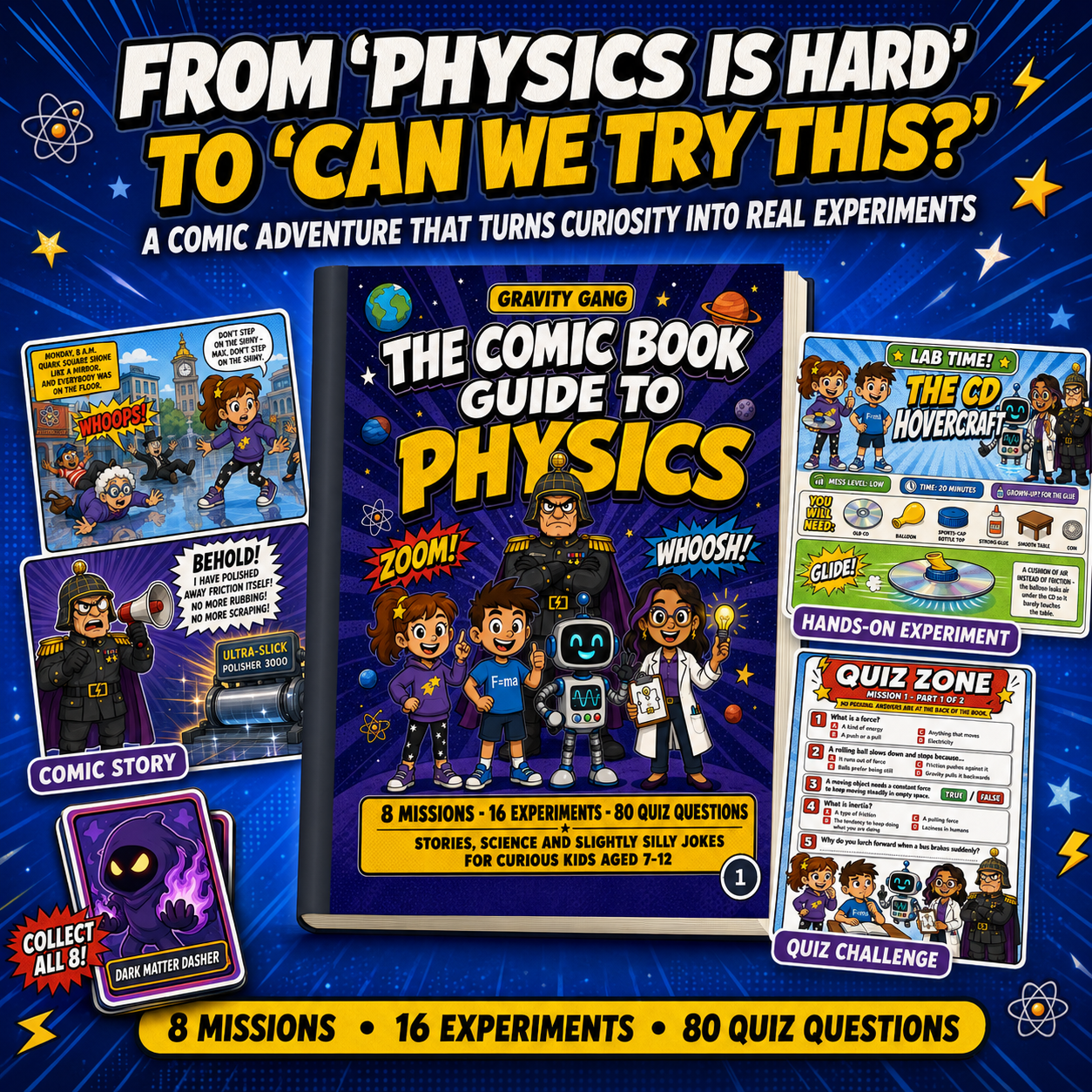
Every book combines an adventure story with real physics or chemistry concepts, interactive experiments using household items, quizzes, and a completion certificate for finishing the book. Parents tell us their kids show more interest in science and improved reading skills after working through the stories and experiments together.
- Check the product pages for applicable return terms.
- Experiments use everyday materials.
- Each book is designed for young readers who find traditional textbooks hard to stick with.
Browse the full collection of printed titles to find the right fit, or explore our curated picks for reluctant readers for more ideas on pairing comics with hands-on activities.
FAQ
Is it better to learn from books or screens?
For long or complex material, printed books tend to support slightly better comprehension and retention than screens, particularly when the digital version involves scrolling. Short texts and quick reference tasks show little difference between the two, and well-mediated digital reading can work well for young children’s vocabulary growth.
What is the 5 finger rule for books?
The 5 finger rule is a simple way for young readers to check if a book matches their current reading level: they read one page and raise a finger for every word they do not know. Five or more unfamiliar words on that page suggests the book may be too difficult for independent reading right now.
What does Elon Musk say about reading?
This question does not point to a documented, sourced claim relevant to the print versus screen research covered here, so we cannot offer a reliable answer within the scope of this article.
Do screens in schools actually help kids learn?
Results are mixed and depend heavily on implementation. A large meta-analysis of K through 5 edtech studies found an average effect size of 0.23 for reading comprehension overall, dropping to 0.14 when measured with standardized tests, suggesting real but modest benefits that shrink under stricter measurement.