What Are the Real Benefits of Graphic Novels for Kids?
Graphic novels genuinely improve reading comprehension, motivation, and higher-order thinking while giving struggling readers, English learners, and diverse learners a way in that traditional prose often can’t. A 2018 study by Meuer found that readers who worked with graphic novels scored higher on comprehension and memory recall than those reading text-only passages, with researchers pointing to reduced cognitive load from visual context as the driver. A literature review on pedagogical advantages identifies five consistent benefits across studies: stronger comprehension, greater motivation, sharper critical thinking, vocabulary growth, and improved English-speaking proficiency.
The top benefits, backed by research:
- Comprehension and memory: Combining text with images reduces cognitive load and improves recall.
- Motivation and reading identity: Graphic novels pull reluctant readers in and help them see themselves as readers.
- Critical thinking: Integrating visual and verbal cues requires active inference, not passive reading.
Key Takeaways
Graphic novels build real literacy skills when taught with explicit instruction in visual conventions, inference, and written response.
| Point | Details |
|---|---|
| Dual-coding boosts comprehension | Text plus image reduces cognitive load and improves memory recall, as Meuer (2018) found. |
| Reluctant readers re-engage | Graphic novels build reading identity by giving hesitant readers an interest-driven entry point. |
| Explicit instruction is required | Without teaching panel conventions, students over-rely on images and miss textual meaning. |
| English learners gain access | Multimodal features reduce the double burden of new language and new content simultaneously. |
| Creativity and analysis both develop | Creating panels forces students to decide what matters, a high-order comprehension and artistic task. |
Table of Contents
- What are the benefits of graphic novels for reading and comprehension?
- Why do graphic novels work so well for reluctant readers?
- How do graphic novels build critical thinking?
- What visual literacy skills do graphic novels teach?
- How do graphic novels support English learners and diverse students?
- Practical strategies for using graphic novels at home and in class
- What does the research actually show about graphic novels?
- How graphic novels spark creativity and artistic expression
- Why graphic novels work for different learning styles and abilities
- The historical and cultural weight graphic novels carry
- What graphic novels taught us about reaching every reader
- Sources
What are the benefits of graphic novels for reading and comprehension?
The cognitive case for graphic novels rests on dual-coding theory: when the brain processes information through two channels simultaneously, verbal and visual, it encodes that information more deeply than through text alone. That’s not a hypothesis; it’s the mechanism researchers point to when explaining why graphic novel readers tend to outperform text-only readers on comprehension checks.
The Meuer (2018) study found exactly that pattern with language learners, though the sample size and classroom setting mean the results are best treated as a strong signal rather than a universal law. Still, the direction of the finding is consistent with what teachers report: students who struggle to track a dense paragraph often follow the same information with ease when a panel sequence carries part of the meaning.
Vocabulary is another area where graphic novels outperform their reputation. The text in panels is curated and compressed, which means every word earns its place. A single page of a well-crafted graphic novel can expose a reader to more precise, contextually rich language than several pages of simpler prose. One classroom application: a teacher assigns a panel sequence from a science-themed graphic novel, asks students to identify every word they couldn’t define without the image, and then tests whether the visual context helped them infer the meaning correctly. It usually does.
Why do graphic novels work so well for reluctant readers?
Reluctant readers rarely struggle because they lack ability. More often, they lack a reason to start. Education researchers and commentators consistently find that graphic novels function as an engagement hook, giving hesitant readers an entry point that feels manageable and genuinely interesting, and that repeated positive reading experiences build the reading identity that sustains long-term literacy growth.

Librarians who have run targeted graphic novel displays and events report increased participation from students who otherwise avoid the library entirely. AASL’s Knowledge Quest documents program examples where visibility alone, putting graphic novels at eye level and featuring them in events, raised circulation among the students most likely to fall behind.
Pro Tip: Pair a graphic novel with one follow-up activity that requires writing, not just reading. A three-sentence panel summary or a quick “what would happen next?” prompt keeps the engagement benefit while adding the text-production practice that deepens comprehension.
Quick strategies for converting interest into sustained reading:
- Let students choose their own graphic novel title from a curated list.
- Pair graphic novel reading with a brief oral retell to a partner.
- Use social reading: two students read the same title and compare what they noticed in the images versus the text.
- Follow a graphic novel unit with a related prose excerpt on the same topic to scaffold the transition.
How do graphic novels build critical thinking?
Reading a graphic novel is an active, analytical task. The reader must decide what happened in the space between panels, what a character’s expression means relative to what they’re saying, and whether the visual framing supports or contradicts the narration. Stanford reporting links this integration of visual and textual meaning directly to accelerated critical thinking, particularly when the subject matter is historical or morally complex.
Genres that consistently prompt higher-order analysis include historical nonfiction, memoir, and investigative graphic journalism. These formats ask readers to evaluate perspective, notice what is shown versus what is left out, and weigh the reliability of a narrator who is also a visual character.
Three discussion prompts that push analysis beyond plot:
- Why did the artist choose this panel angle? What would change if the reader saw the scene from a different character’s viewpoint?
- What information is missing from this page? What might the author have chosen not to show, and why?
- Does the image support or contradict what the text says? What does that tension tell you about the narrator’s reliability?
These questions work across grade levels and genres. They also transfer directly to media literacy, which is increasingly a core skill.
What visual literacy skills do graphic novels teach?
Visual literacy, the ability to interpret and create meaning from images, is a skill most curricula assume but rarely teach explicitly. Graphic novels make it teachable because the visual grammar is consistent and learnable: panels sequence events, gutters hold implied action, splash pages signal importance, and facial expressions carry emotional subtext that the text may not state directly.
Core visual literacy skills graphic novels develop:
- Inferencing from facial expression and body language
- Sequencing panels to reconstruct narrative order
- Decoding graphic conventions (gutters, splash pages, thought bubbles, motion lines)
- Reading color and shading as emotional or thematic signals
- Analyzing layout choices as authorial decisions
A single-panel annotation activity (step by step):
- Select one panel with a character, a background, and at least one speech or thought element.
- Ask students to circle every visual detail that gives information the text does not state.
- Have them write one sentence per circled detail explaining what it adds.
- Discuss as a class: which details were most important? Which were ambiguous?
This activity takes about fifteen minutes and produces written evidence of inference, which makes it easy to assess. The skills it builds, reading images for implied meaning, transfer directly to evaluating photographs, data visualizations, advertisements, and social media content. That transfer matters because EdWeek’s 2025 analysis of graphic novel instruction emphasizes that multimodal literacy skills developed through comics carry over into the digital and media contexts students navigate every day.
How do graphic novels support English learners and diverse students?
For English learners, reading a grade-level text in a second language is a double burden: they’re processing new language and new content simultaneously. Research from Grand Valley State University shows that graphic novels reduce that burden by combining linguistic and nonlinguistic modes, giving English learners access to grade-level content while supporting language development at the same time. The visual context doesn’t replace the language; it scaffolds it.
Students with dyslexia, attention differences, or processing challenges benefit from the same multimodal structure. Shorter text blocks, clear visual anchors, and predictable panel layouts reduce the working memory demands that make long prose passages exhausting for some learners.
Scaffolding strategies that work in practice:
- Pre-teach five to eight key vocabulary words before reading, using images from the graphic novel itself.
- Use paired reading: one student reads the text aloud while the other describes the images, then they switch.
- Assign visual annotation: students mark panels where the image changed their understanding of the text.
- Follow reading with a multimodal composition task, such as creating a three-panel sequence that summarizes a key event.
Statistic callout: The Grand Valley/LAJM research specifically identifies graphic novels as an equity tool, not just an engagement tool, because they increase access to grade-level content for students who would otherwise be locked out by language barriers alone.
Practical strategies for using graphic novels at home and in class
Selecting the right graphic novel matters as much as using it well. A title that’s visually compelling but thematically thin won’t sustain the kind of analysis that builds literacy. Look for:
- Text complexity: Does the vocabulary and sentence structure stretch the reader without overwhelming them?
- Cultural relevance: Does the story reflect experiences the reader recognizes or is genuinely curious about?
- Genre fit: Is the format (memoir, nonfiction, adventure) appropriate for the curricular goal?
- Curricular alignment: Can the content connect to a science, history, or social studies unit already in the plan?
Three ready-to-use lesson ideas:
Panel sequencing lesson: Cut apart a page of panels and ask students to reassemble them in order, then explain their reasoning in writing. This teaches sequencing and inference simultaneously.
Compare/contrast adaptation activity: Pair a graphic novel adaptation of a prose text with the original. Ask students to identify three moments where the visual version adds meaning and three where it loses something. This builds analytical writing and close reading.
Multimodal composition project: Students create a three-to-five panel graphic sequence summarizing a chapter, a science concept, or a historical event. Drawing forces them to decide what is most important, which is a high-order comprehension task.
| Use case | Classroom task | Quick assessment |
|---|---|---|
| Motivation hook | Free-choice reading with brief oral retell | Retell rubric (beginning, middle, end) |
| Content scaffold | Paired graphic novel + prose on same topic | Annotation check on prose passage |
| Writing mentor text | Multimodal composition project | Panel-by-panel written explanation |
Pro Tip: When transitioning students from graphic novels to longer prose, use the same topic or character across both formats. Familiarity with the content frees up cognitive bandwidth for the harder work of processing dense text.
What does the research actually show about graphic novels?
The body of evidence most consistently supports three outcomes: comprehension gains (especially for language learners and struggling readers), increased motivation and reading volume, and improved access to grade-level content for English learners. The evidence for critical thinking gains is strong in theory and supported by practitioner observation, but fewer controlled studies have isolated it as a measurable outcome.
| Study / Source | Population / Setting | Main finding |
|---|---|---|
| Meuer (2018) | Language learners, classroom setting | Higher comprehension and memory recall vs. text-only reading |
| Literature review (Semantic Scholar) | Broad review across studies | Five pedagogical advantages: comprehension, motivation, critical thinking, vocabulary, English proficiency |
| Stanford News (2022) | University reporting / educator context | Graphic formats accelerate critical thinking and capture historical nuance |
| Grand Valley / LAJM | English learners, K–12 | Multimodal features increase access to grade-level content and support language development |
| EdWeek (2025) | Practitioner synthesis | Explicit instruction in panel reading is required for visual supports to transfer to deeper literacy |
Two research gaps are worth naming. First, most studies are small-scale or conducted in specific classroom settings, which limits how confidently findings generalize. Second, the benefits depend heavily on how graphic novels are taught. EdWeek’s practitioner synthesis is direct on this point: without explicit instruction in how to read panels, students tend to over-rely on images and skip the textual meaning, which undermines the comprehension gains the format can otherwise produce.
How graphic novels spark creativity and artistic expression
Reading graphic novels exposes students to deliberate artistic choices: how a panel is cropped, why a color palette shifts mid-chapter, what a single line of motion conveys about speed or emotion. That exposure is a form of visual arts education that rarely gets named as such.
When students create their own panels, even rough sketches, they make the same decisions artists make: what to show, what to leave out, how to use space. That process builds creative confidence and teaches economy of expression, the understanding that every element on a page should earn its place. Teachers who assign multimodal composition projects consistently report that students who struggle with traditional essays often produce their most sophisticated thinking in panel form, because the visual constraint forces clarity.
Why graphic novels work for different learning styles and abilities
Not every student learns best through dense prose, and that’s not a deficit. Graphic novels offer a legitimate alternative pathway to the same comprehension and analytical skills, not a shortcut around them. Visual learners process the image-text relationship naturally. Auditory learners benefit from reading aloud while a partner tracks the panels. Kinesthetic learners engage through annotation, cutting, and reassembling sequences.
For students with reading disabilities, the visual scaffolding reduces the decoding burden enough to let comprehension skills develop. For gifted readers, the compressed, layered text in a well-crafted graphic novel offers genuine challenge. The format scales in both directions, which is rare in a single instructional resource.
Colorín Colorado’s guidance for multilingual learners reinforces this: graphic novels work as companion resources alongside grade-level texts, not replacements for them, which keeps expectations high while lowering the access barrier.
The historical and cultural weight graphic novels carry
Graphic novels have documented wars, civil rights movements, immigration experiences, and personal trauma in ways that prose alone sometimes can’t reach. The format’s ability to show rather than only tell gives it particular power for historical and cultural storytelling, because a reader who sees a character’s face during a moment of injustice processes that moment differently than a reader who only reads a description of it.
This matters in the classroom because cultural representation in graphic novels is broader and more current than in many traditional curricula. Students who rarely see their own experiences in school texts often find them in graphic novels, and that recognition is not a small thing. It’s one of the mechanisms through which reading identity forms.
What graphic novels taught us about reaching every reader
The most persistent misconception about graphic novels in education is that they’re a stepping stone, something to use until a student is “ready” for real books. That framing misses what the research actually shows. Graphic novels are not easier than prose; they’re differently complex. Readers decode text, interpret images, track non-linear layouts, and make inferences from visual cues simultaneously. The Conversation’s analysis makes this point clearly: the cognitive work involved is substantial, and it should inform how teachers pace lessons and design assessments.
The practical takeaway from years of classroom evidence is this: graphic novels work best when they’re treated as a full literary format with their own conventions, not as a remedial tool or a reward. Students who are taught to read panels analytically, who are asked to write about what they see and infer, and who are given choice in what they read develop stronger literacy skills than students who are handed a graphic novel and left to browse.
Where the research and practitioner observation align most clearly is on scaffolding. The visual supports in graphic novels are powerful, but they require explicit instruction to translate into deeper literacy gains. Teach the conventions. Model the inference. Require the writing. The format will do the rest.
Sources
- Reading Comprehension through Graphic Novels (Meuer, 2018)
- Graphic Novels pedagogical advantages (literature review)
- Graphic Novels for Multimodal Learning: Equity for English Learners (Grand Valley ScholarWorks)
- Graphic novels can accelerate critical thinking, capture nuance and complexity (Stanford News)
- Don’t underestimate the power of graphic novels for the classroom (EdWeek opinion, 2025)
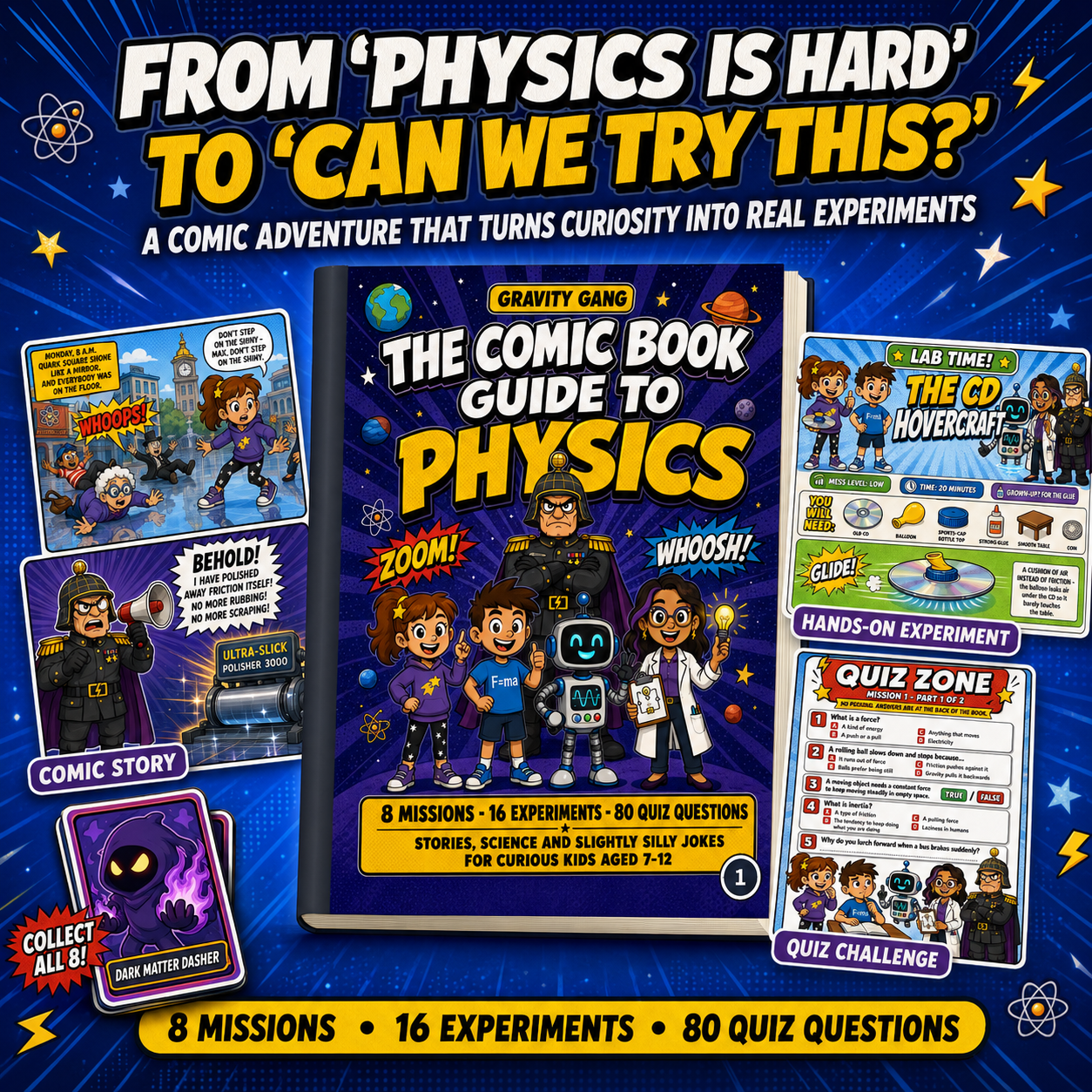
Looking for a graphic novel that teaches real science while building all of these skills? Brainiecomics publishes Gravity Gang and Fizz Force, comic books for ages 7–12 that pair physics and chemistry concepts with hands-on kitchen experiments, quizzes, and completion certificates. They’re designed to do exactly what the research recommends: combine compelling narrative with content knowledge, and give reluctant readers a reason to turn the page.