

Research Backed Comics for Reluctant Readers: Picks & Activities
Yes, comics and graphic novels reliably engage many reluctant readers by lowering the barrier to entry and giving them a quick sense of progress. The single best first move is to pick one interest-matched title, whether it’s about dinosaurs, superheroes, or kitchen science, and pair it with a short guided activity like a read-aloud or a five-minute panel discussion.
TL;DR:
- Comics’ visual and textual combination significantly boosts comprehension for children with decoding challenges by providing visual anchors and reducing cognitive load.
- Explicit instruction on comic grammar, panel order, and inference questions further enhances understanding and inference skills in reluctant readers.
- Age-appropriate comics with clear panels, relatable stories, and visual humor improve engagement without overwhelming, especially when paired with short, guided activities.
- Digital comics can motivate screen-loving kids, but print formats are better for focused, screen-free reading sessions, with sample evaluation crucial before selecting titles.
- Starting with interest-matched comics, short activities, and consistent caregiver involvement creates a supportive environment that encourages sustained literacy development.
Table of Contents
- Why comics work for reluctant readers: the evidence behind the pictures
- Curated comic and graphic novel picks by age and interest
- How to choose the right comic for your reluctant reader
- Ten-minute activities that build comics literacy and stamina
- How Brainie Comics designs science comics for reluctant readers
- Comics as a tool for empathy and social skills
- Do digital comics and apps help reluctant readers?
- Getting parents and caregivers on board
- Bringing comics into an existing literacy curriculum
- Comics for dyslexia and other learning differences
- Why comics deserve more credit than they get
- Ready to try a science comic at home or in class
- Sources
- FAQ
Why comics work for reluctant readers: the evidence behind the pictures
Comics do something plain text can’t: they carry meaning in two channels at once, images and words, so a child who stumbles on a sentence still has a visual anchor to keep the story moving. That redundancy matters most for kids who decode slowly or lose confidence mid-page.
The research backs this up. A 2025 study of vocational EFL students found average reading-comprehension scores climbed significantly after a targeted graphic-novel intervention with a group of 30 students. The gain was statistically significant, and it points to something simple: when text is scaffolded by images, comprehension often follows.
48.6% comprehension increase after a graphic-novel intervention, according to a 2025 EFL study. That’s a meaningful jump for a format many adults still dismiss as “not real reading.”
But pictures alone aren’t the whole mechanism. A visual-literacy intervention study from Sheffield Hallam University found that comprehension and inference improved most when children received explicit instruction in reading comics, not just exposure to them. Comics have their own grammar: panel order, emanata (those lightbulbs and motion lines that signal thought or speed), and speech versus thought bubbles. A child who doesn’t know how to read a panel transition can get lost just as easily in a graphic novel as in a dense paragraph.
That’s why a few minutes of guidance changes outcomes:
- Point out the reading order and how panels connect a scene.
- Show the difference between a speech bubble and a thought bubble.
- Ask one inference question before turning the page.
- Celebrate finishing a chapter, not just the whole book.
Spending even one or two minutes on these visual cues before a child dives in tends to multiply the benefit of the comic itself. It’s a small investment for a format that already does most of the motivational work.
Curated comic and graphic novel picks by age and interest
The right comic depends less on reading level charts and more on fit: does the story match what the child already likes, and does the art carry enough of the plot that a slow reader doesn’t stall out? These picks are grouped loosely by age band, with a quick note on what makes each one work for a reluctant reader and a simple first activity.
Ages 6 to 8
- Simple, high-frequency animal or friendship stories work well here because the panels are large, the dialogue is short, and the humor is visual as much as verbal. Start with a shared read-aloud where the adult reads the words and the child narrates what’s happening in the pictures.
- Early chapter-style comics with recurring characters give young readers a reason to come back, since they already know the cast. Try a “guess what happens next” pause before the final panel of a chapter.
Ages 8 to 10
- Adventure and humor series with clear panel layouts hold attention because the plot moves fast and the jokes land visually. A good starter activity is a panel-sequence game: mix up a few panels from a page and have the child put them back in order.
- School-life or slice-of-life graphic novels appeal to kids who want stories that feel familiar. Pair one with a short discussion about which character’s problem felt most relatable.
Ages 10 to 12
- Longer graphic novels with denser plots but still-clear art suit readers who are building stamina but aren’t ready for text-only novels. Try a “spot the clue” hunt: ask the child to find one visual detail on each page that hints at what happens next.
- Science, history, or fact-based comics work especially well for kids who like nonfiction but resist long paragraphs. A strong first activity is picking one fact from the story and testing it out loud: is it true, and how do they know?
Across every age band, the pattern holds: shorter isn’t always better, but clarity is. A book with clean panel layouts and legible text beats a visually cluttered one, even if the cluttered one has a “cooler” cover.
How to choose the right comic for your reluctant reader
Matching a book to a child takes more guesswork out of it than most parents expect. Before buying or borrowing, run through this checklist.
- Interest first. Does the topic, genre, or character match something the child already likes?
- Page density. Are there large, clear panels, or is the page crowded with small boxes and tiny text?
- Vocabulary level. Does the dialogue match the child’s spoken vocabulary, with a few stretch words rather than many?
- Panel clarity. Can a child tell which panel to read next without confusion?
- Length. Is the book short enough to finish in a few sittings without feeling like a marathon?
- Theme appropriateness. Does the content match the child’s emotional maturity, not just their age on the cover?
- Representation. Do the characters or settings reflect something the child can see themselves in?
A quick test: skim one page together in the store or library and ask, “What do you think is happening here?” If the child can answer from the pictures alone, the book is probably a good fit. Watch for red flags too: panels crammed with tiny text, mature themes buried in what looks like a kids’ cover, or dialogue that reads more like a textbook than a conversation.
Pro Tip: Ask the child to read just the first page out loud. If they stumble on more than a couple of words per panel, the book is likely too advanced for independent reading right now, though it can still work as a read-aloud.
Ten-minute activities that build comics literacy and stamina
Short, repeatable activities do more for reluctant readers than long study sessions. A few that work in both classrooms and living rooms:
- Guided page walk: before reading, walk through one page together, pointing out panel order and symbols.
- Panel sequence cards: cut up a page’s panels and have the child reassemble the story in order.
- Spot the clue: ask the child to find one visual detail per page that hints at what’s coming.
- Paired reading prompts: stop every few pages and ask, “What do you think this character is feeling, and how do you know?”
The scaffolding matters as much as the activity. Model your own thinking out loud (“I notice the character’s eyes are wide, so I think she’s surprised”), let the child choose which book or activity to try first, and keep sessions to 10 or 15 minutes so reading stays a want, not a chore. For children with developmental language differences or decoding gaps, lean harder on the visual cues and shorten the text-reading portions, since research on graphic novels and children with DLD suggests visual context can level the comprehension playing field. For strategies specific to attention differences, see this two-week trial of ADHD reading strategies.
How Brainie Comics designs science comics for reluctant readers
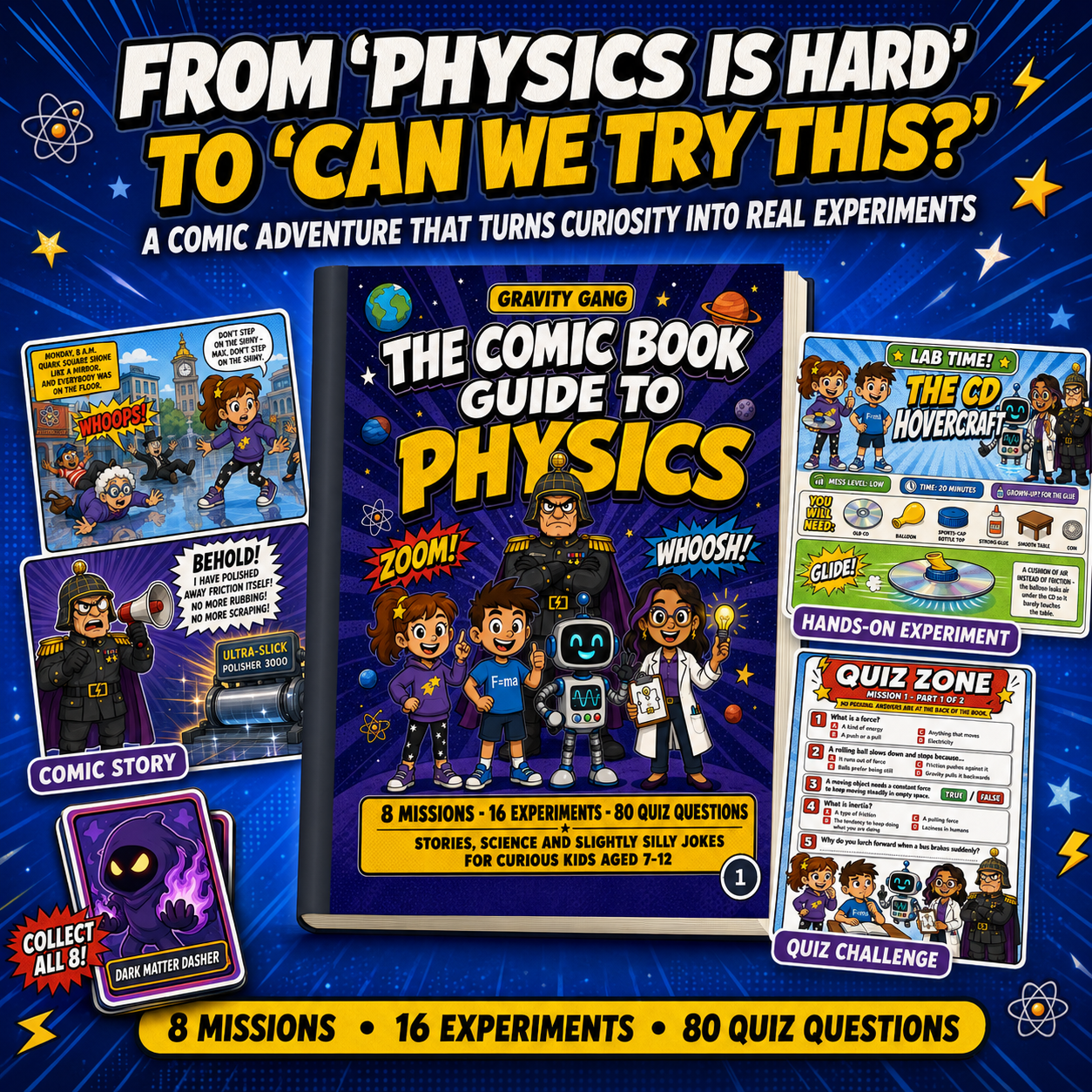
Brainie Comics builds its titles, including Fizz Force and Gravity Gang, around the same principle the research points to: pair a strong visual story with a hands-on task the reader controls. Each book, aimed at ages 7 to 12, pairs a comic-book adventure with kitchen-safe experiments using household items, so a 20-minute reading session can extend naturally into a short science activity. The approach lines up with what Reading Rockets and the NEA describe as effective: picture-text support paired with an active, motivating task.
Comics as a tool for empathy and social skills
Comics put emotion on the page in a way plain text sometimes buries in description. A character’s clenched fists, a tear drawn mid-panel, or a speech bubble that trails off all give reluctant readers an immediate, visible cue to a feeling, without requiring them to infer it from adjectives alone. That visibility makes it easier to talk about what a character is going through and why.

Reading a friendship conflict or a story about fitting in becomes a chance to ask, “Why do you think she reacted that way?” or “What would you have done?” Because the art already shows the emotional stakes, even a reluctant reader who struggles with the text can follow the social dynamics and take part in that conversation.
This works especially well with stories that put two characters at odds and resolve the conflict panel by panel, since the resolution is visible, not just described. Parents and teachers can use that visual pacing to slow down and talk through a character’s choices before moving to the next page, turning a comic into a low-pressure way to practice perspective-taking.
Do digital comics and apps help reluctant readers?
Digital comics and reading apps can work as a motivational on-ramp, especially for kids who already associate screens with fun rather than schoolwork. Features like tap-to-reveal panels, adjustable text size, and built-in audio narration can reduce the friction of decoding while keeping the story’s pacing intact.
The tradeoff is attention. A screen that offers a comic also offers everything else on that device, so digital formats work best as a supplement, not a replacement, for dedicated reading time. Printed comics remove that competition entirely and keep the experience screen-free, which is part of why Brainie Comics builds its books as physical, screen-free products from the start.
For families weighing both, a reasonable approach is to use digital comics for discovery, sampling series and genres, and print for the sustained reading sessions where focus matters most.
Getting parents and caregivers on board
The adult’s attitude toward comics often matters as much as the child’s. A parent who treats a graphic novel as “not a real book” signals that to the child, even unintentionally, while one who reads alongside the child and asks genuine questions about the story sends the opposite message.
Small habits go a long way: keeping comics visible on a shelf at the child’s eye level, letting the child choose the next title rather than assigning one, and asking about the story the way you’d ask about a movie, “What happened? Who was your favorite character?” These invite conversation without turning reading into a quiz.
Caregivers who want a slightly more structured option can try a short weekly routine: one comic, one activity, one conversation. The 20-minute inquiry-based learning routine built around Brainie Comics titles is one example of how that routine can look in practice, pairing a chapter with a related hands-on task.

Bringing comics into an existing literacy curriculum
Comics don’t have to replace a reading program to be useful inside one. The Harvard Graduate School of Education describes graphic novels as a bridge, a way to build the analytical skills students need for denser texts using material that’s easier to access first.
A practical way to integrate them: use a graphic novel adaptation of a classic text as a pre-reading step before the prose version, so students already understand plot and character before wrestling with harder vocabulary. Alternatively, pairing comics with explicit mini-lessons on reading panels and symbols can slot into an existing literacy block as a five-minute warm-up before independent reading time.
Teachers don’t need a separate unit. A single comic used once a week as a change of pace, with the same comprehension questions asked of any text, keeps it connected to curriculum goals rather than treating it as a break from real reading.
Comics for dyslexia and other learning differences
For many children with dyslexia or decoding difficulties, the visual support in comics reduces the load that a page of unbroken text places on working memory. Shorter text blocks, clear panel breaks, and images that carry part of the story all mean less has to be decoded before the meaning lands.
The 2022 Frontiers in Psychology study on children with developmental language disorders found they performed similarly to typically developing readers when working with graphic novels, suggesting the visual context helps bypass some of the barriers text-only formats create. That doesn’t mean every comic is automatically dyslexia-friendly. Look for dyslexia-friendly fonts where available, generous line spacing, and panels that aren’t overcrowded with small text, since a cluttered page can undo the format’s natural advantages.
Why comics deserve more credit than they get
The most persistent myth about comics is that they’re a consolation prize, something you let a struggling reader have until they’re ready for “real” books. That framing gets it backward. Comics teach a distinct kind of literacy, reading sequence, inferring emotion from art, tracking multiple information channels at once, and that literacy has value on its own, not just as a stepping stone.
The bigger risk isn’t that kids will read too many comics. It’s that adults hand them over without any guidance and assume the pictures will do all the work, then conclude the format failed when a child still struggles. Comics work best as a taught skill, not a passive rescue.
Start with one title and one short activity this week. If it clicks, keep going. If it doesn’t, try a different genre before giving up on the format entirely, and let us know what worked.
— Brainie Comics
Ready to try a science comic at home or in class
If you’re ready to put this into practice, Some science comics give reluctant readers a story-driven reason to keep turning pages, then back it up with kitchen-safe experiments that use materials you may already have at home. No screens required, just a comic, a few household items, and a kid curious enough to try the next chapter.
- Browse the full Brainie Comics collection to compare titles.
- Start with Fizz Force for a chemistry-driven adventure.
- Or try Gravity Gang for a physics-focused story.
Pick one book and try one experiment this week, and see whether the science sticks the way the story does.
Sources
- Using Graphic Novels to Improve Reading Comprehension (2025)
- Graphic novels and reading comprehension in children with DLD (2022)
- Teaching people to read comics: The impact of a visual literacy intervention (Verrier et al.)
- Graphic Novels for Kids: Classroom ideas, booklists, and more (Reading Rockets)
- Teaching with comics (NEA)
FAQ
What is the best book for a reluctant reader?
There’s no single best book, since fit depends on the child’s interests and reading stamina, but the strongest options share large, clear panels, short dialogue, and a topic the child already likes. A graphic novel that matches a child’s existing interest, whether that’s animals, humor, or science, tends to outperform any title chosen by reading level alone.
What are some good graphic novels for reluctant readers?
Good picks vary by age, but series with clean panel layouts, recurring characters, and fast-moving plots work well across the board. Nonfiction and science-based comics, adventure series, and slice-of-life stories all give reluctant readers a reason to keep going without overwhelming them with text.
What is the 5 finger rule for reading?
The five-finger rule is a quick way to check if a book matches a child’s reading level: the child reads one page and holds up a finger for each word they don’t know. Five or more unknown words on one page usually signals the book is too hard for independent reading right now, though it can still work well as a read-aloud.
How can I encourage a reluctant reader?
Start with a high-interest, visually clear comic rather than pushing a specific reading level, and pair it with a short activity like a page walk or a panel-sequence game. Letting the child choose the book, reading alongside them, and keeping early sessions short all help build the confidence that turns reluctant readers into willing ones.
Can comics really improve reading comprehension?
Yes. A 2025 study of vocational EFL students found comprehension scores rose from 49.00 to 72.83, a 48.6% increase, after a graphic-novel intervention, and other research on visual-literacy instruction shows similar gains when panel-reading skills are explicitly taught.