

Teens Nearly 5× More Likely to Read More: Science Comics for Teachers
Yes, research shows well-designed science comics increase engagement and can produce measurable learning gains, especially for reluctant readers. Peer-reviewed studies and classroom pilots point to real effects on interest, willingness to keep reading, and conceptual understanding. This guide walks through that evidence, the design principles behind comics that actually teach, ready-to-run classroom activities, and where to find or commission strong science comics.
TL;DR:
- A 2023 study found Newton’s Laws misconceptions fell from 57.01% to 20.24% after students used a comic module, a statistically meaningful gain.
- After reading comics, teenagers were almost five times likelier than essay readers to pursue science further, especially those with low science identity.
- Use comics to introduce abstract processes or review familiar vocabulary, but retain traditional texts for dense technical language and extended written arguments.
- Choose comics with a specific learning goal woven into the plot, and check visual metaphors with a science expert before classroom testing.
- Pair a short comic reading with a hands on experiment or ask students to explain a panel, since follow up reveals misconceptions.
Table of Contents
- What does the research say about comics and science learning?
- Why do comics work as a teaching tool?
- How do you design a science comic that actually teaches?
- What classroom and at-home activities pair well with science comics?
- How do you find and evaluate good science comics?
- How do you create or commission a classroom-ready science comic?
- How do comics trigger situational interest in reluctant readers?
- Which science concepts work especially well in comic form?
- How can parents and educators get the most out of science comics?
- How does learning from comics compare to learning from traditional text?
- How do humor and visual storytelling reinforce science concepts?
- What accessibility considerations matter for science comics?
- Our approach to teaching science through story and experiments
- Ready to bring science through comics into your classroom or home?
- FAQ
- Sources
What does the research say about comics and science learning?
The strongest evidence for comics as a teaching tool comes from studies that measure what happens before and after students read one, not just whether they liked it. A widely cited study by Spiegel et al. (2013) gave teenagers either a comic or a standard essay about viruses, then measured their interest in reading more on the topic. Teenagers who read the comic were almost five times more likely than essay readers to want to continue engaging with the material, and the effect was strongest among students who started out with low science identity, meaning kids who did not already see themselves as “science people.”
That last detail matters for educators and parents. Comics do not just appeal to kids who already like science. They seem to open a door for the kids who usually tune out.
A separate line of research looks at whether comics change what students actually understand, not just whether they want to keep reading. A 2023 study on physics misconceptions tested an e-module comic designed to correct common misunderstandings of Newton’s Laws. The result was reported as statistically significant.
Students using the comic-based e-module cut their rate of Newton’s Laws misconceptions from 57.01% to 20.24%, with researchers reporting the gain as statistically meaningful. That is a concrete signal that a well-built comic can do more than entertain. It can correct specific, nameable misunderstandings.
A third study, Fin-tastic Fish Science, compared students who read a science comic against students who read a standard journal article on the same topic. The comic readers showed learning gains comparable to the journal-article readers, and they reported higher willingness to engage further with the science content. In other words, comics did not sacrifice learning for engagement. They delivered both.
A few patterns show up across these studies that matter for anyone trying to apply the findings in a classroom or at home:
- Most studies use a pre/post design: researchers measure what students know or believe before reading, then measure again afterward, which isolates the effect of the material itself.
- Several studies include a control group reading traditional text, which lets researchers compare comics against the format they are meant to supplement or replace.
- Effects tend to be largest for students who are reluctant readers or who do not already identify strongly with science, based on the subgroup patterns in the Spiegel et al. findings.
- Learning gains are often reported using standardized measures like N-gain scores, which let researchers compare improvement across different starting points.
The design detail that separates these results from a casual “kids like comics” observation is intentionality. Each of these interventions was built with a specific misconception or content goal in mind, tested, and measured. That distinction becomes important in the next section, because it shapes how a comic should actually be built.
Why do comics work as a teaching tool?
Comics teach differently than plain text because they ask the brain to process two information streams at once: words and images. Researchers call this multimodal encoding, and it matters because abstract science concepts, like force, pressure, or chemical bonding, often resist a purely verbal explanation. A panel sequence can show a ball accelerating down a ramp step by step, with each frame functioning like a freeze-frame of a process that would otherwise happen too fast to observe directly.

Visual metaphors do similar work. A chemical reaction drawn as a dance between characters, or an atom’s electron shell drawn as a set of orbiting rings, gives students a mental anchor they can return to later, even after the specific vocabulary fades. This is different from decoration. A metaphor that is wrong or misleading can plant a misconception as easily as it can prevent one, which is part of why careful design matters more than illustration quality alone.
Narrative structure adds a second mechanism: it lets students practice reasoning the way scientists actually have to, by weighing competing information and taking different perspectives. When a science comic follows a character who has to decide whether a claim is true, readers are pulled into what researchers describe as socio-scientific reasoning, drawing on several types of knowledge at once (scientific, social, ethical) to work through a problem. That kind of reasoning is harder to teach through a textbook chapter, because a textbook rarely asks the reader to take a side.
Comics are not equally useful at every stage of a lesson. A few practical distinctions help:
- Use a comic as a conceptual introduction when a topic is abstract or counterintuitive, since the visual sequencing can make an invisible process visible.
- Use a comic as a review tool when students already have the vocabulary but need a memorable anchor to retain it.
- Use a comic as an engagement hook at the start of a unit, especially for a class with several reluctant readers, since the format lowers the barrier to starting.
Pro Tip: Save the most text-dense comic panels for review sessions, not first exposure. Reluctant readers respond best when the first encounter with new material is light on text and heavy on sequential visuals.
None of this replaces direct instruction or hands-on experimentation. It works best as a complement, a way to build the kind of mental scaffolding that makes the rest of a science unit easier to absorb.
How do you design a science comic that actually teaches?
A comic that teaches well does not bolt a lesson onto a story. It treats the science as part of the plot, so a reader cannot follow the narrative without absorbing the content. That single design choice separates comics that produce measurable learning gains from ones that are simply fun to read.
A practical checklist for evaluating or building an educational comic:
- Integrate the science into the plot itself: a character should need to understand density, or pressure, or a chemical reaction, to solve the story’s actual problem, not just mention it in passing.
- Sequence panels to mirror real processes: a causal chain, like a reaction building toward a result, reads more clearly across several small panels than in one dense illustration.
- Label key visuals directly on the page: a diagram embedded in the art, with a clear label, teaches faster than a caption buried in a sidebar.
- Embed short tasks or reflection prompts between story beats: a one-line prediction question keeps a reader thinking rather than passively flipping pages.
- Bring in a subject-matter expert during the review stage: a scientist or science teacher can catch an inaccurate metaphor before it reaches print, a step reviews of the science-art collaboration process consistently recommend.
- Prototype with an actual classroom before finalizing: a small pilot with real students surfaces confusing transitions or unclear panels that no adult editor will catch alone.
That fifth step deserves more attention than it usually gets. The handoff between a written script and finished artwork is where unintended meaning often creeps in, a process researchers call transduction. A scientifically accurate script can still produce a misleading metaphor once an illustrator interprets it visually, simply because written language and visual language carry information differently. The fix is not perfection on the first draft. It is a review loop: script, rough art, expert check, revision.
Pro Tip: When reviewing a science comic for classroom use, ask a student to explain one panel back to you in their own words. If their explanation introduces a misconception you didn’t expect, the art is likely doing more teaching than the text, for better or worse.
Collaborative design, where a writer, illustrator, and subject-matter expert work together from the start rather than in sequence, consistently produces stronger results than a model where a scientist hands off a finished script to an illustrator with no further input. Design-Based Research approaches treat narrative choices and didactic choices as a single integrated decision, not two separate jobs, which keeps the story and the science pulling in the same direction instead of competing for page space.
What classroom and at-home activities pair well with science comics?
A comic works best as the starting point of an activity, not the entire lesson. Pairing a short reading with a hands-on task converts passive interest into something a student can test, touch, or get wrong and fix. The following templates work for ages 7 to 12 and need only common household materials.
- Prediction before reading (5 minutes, no materials): before opening the comic, students write one sentence predicting what will happen to the character based on the cover or title, then compare it to the actual plot afterward.
- Kitchen experiment tie-in (15 to 20 minutes, household items like baking soda, vinegar, food coloring): after reading a chemistry-focused chapter, students run a simple reaction experiment that mirrors what the characters did on the page, a format paired chemistry comic strips and quick experiments use effectively.
- Panel sequencing cut-up (10 minutes, printed panels, scissors): shuffle photocopied panels from a chapter and have students put them back in the correct causal order, reinforcing sequence comprehension.
- Misconception hunt (10 minutes, no materials): give students a short list of common misconceptions about the chapter’s topic and ask them to find the panel that corrects each one.
- Character science journal (ongoing, notebook): students keep a journal written from a character’s point of view, logging what that character learned in each chapter in their own words.
- Quick formative check (5 minutes, exit ticket): a single multiple-choice or short-answer question tied to the chapter’s core concept, collected as students leave.
- Newton’s Laws experiment chain (20 minutes, household balls, ramps, books): students test a prediction about motion drawn directly from a physics comic chapter, a format detailed in simple Newton’s Laws experiments.
- Remote or asynchronous variant (flexible, video or photo submission): students record a short video narrating their experiment results and submit it instead of an in-person demonstration, useful for distance learning.
For objective-setting, a useful frame borrows from Next Generation Science Standards language: a chemistry activity might target “matter and its interactions,” while a physics activity might target “motion and stability: forces and interactions.” Assessment does not need to be elaborate. A short exit ticket, a one-sentence journal entry, or a simple “explain it to a partner” check usually captures whether the concept landed.
A few practical notes for running these at scale or at home:
- Low-prep variants work by swapping any experiment for a discussion-only version, where students describe what they would expect to happen instead of testing it physically.
- Materials stay simple on purpose: baking soda, vinegar, water, balls, ramps, and basic kitchen items cover most introductory chemistry and physics demonstrations.
- Parents running these at home can shorten any 20-minute activity to 10 minutes by skipping the written prediction step and going straight to the hands-on portion.
How do you find and evaluate good science comics?
Library catalogs are more useful for this search than general bookstore browsing, because academic and public library systems let you combine subject tags. A search combining “subject:chemistry” with “subject:comic books” (or the equivalent dropdown filters) narrows results fast, a tactic detailed in library research guides for science comics. Searching by grade band or reading level alongside the subject tag narrows things further.
Once you have a shortlist, a quick evaluation checklist helps separate comics that teach from ones that merely look educational:
- Accuracy: does the science hold up, and was it reviewed by someone with subject-matter expertise rather than only an editor?
- Reading level: does the vocabulary match the target age range without talking down to it?
- Scaffolded activities: does the comic include built-in tasks, questions, or experiments, rather than leaving all follow-up work to the teacher?
- Representation: do the characters and scenarios reflect a range of backgrounds, so more readers can see themselves in the story?
- Length and pacing: is the page count appropriate for a single sitting or a short unit, rather than requiring a multi-week commitment?
- Teacher or parent notes: does the comic include a guide or notes section that explains how to extend the material beyond the page?
Curated resources help narrow the search further. A rubric for classroom-ready science resources gives K-12 teachers a structured way to vet material quickly, while reviews of research-backed picks for reluctant readers collect titles that have already shown results with similar audiences. Checking whether a resource has been piloted in an actual classroom, not just reviewed by adults, is one of the strongest signals of real classroom fit.
How do you create or commission a classroom-ready science comic?
Building a science comic from scratch, or commissioning one, follows a predictable sequence that minimizes rework if you follow it in order rather than skipping ahead to art.
- Define the learning objective first: name the specific misconception or concept the comic needs to address before any writing starts, since a vague goal like “teach chemistry” produces an unfocused script.
- Write a science-aligned script: draft dialogue and scene descriptions that embed the concept into the plot itself, not as a lecture a character delivers.
- Produce thumbnails: rough, small-scale sketches of each page let you test pacing and panel sequencing cheaply before committing to full art.
- Review with a subject-matter expert: a scientist or science teacher checks the thumbnails for accuracy, catching problems while they are still easy to fix.
- Prototype in an actual classroom: a single-lesson pilot with real students surfaces confusing panels or pacing issues no adult reviewer will catch.
- Revise based on pilot feedback: adjust dialogue, panel order, or visual metaphors based on what students actually understood, then finalize.
The most common failure point sits between steps two and four: the transduction from written script to visual art. A line like “the reaction speeds up” can be drawn a dozen different ways, and an illustrator without subject-matter guidance might choose one that implies the wrong mechanism. Research on the science-art interface consistently flags this handoff as the highest-risk stage, and recommends catching it through thumbnailing and expert checkpoints rather than waiting until final art is complete.
Pro Tip: Run your classroom pilot with the roughest version of the art you can tolerate showing students. Polished art makes reviewers hesitant to suggest changes, while rough sketches invite honest feedback before the budget is spent.
On scope and budgeting, a few high-level guidelines help keep a project realistic: a single-concept comic usually runs somewhere between 8 and 16 pages, teacher or parent notes typically add one to two pages per chapter, and an experiment insert (a hands-on activity tied to the story) adds meaningfully more development time than the comic pages themselves, since it needs its own safety and materials check. Planning for that extra review time upfront avoids a rushed final pass.
How do comics trigger situational interest in reluctant readers?
Reluctant readers often avoid science texts not because the content is uninteresting, but because the format itself feels like a wall. A page of dense paragraphs demands sustained decoding before any payoff arrives. A comic page offers a visual entry point first: a character’s expression, an action panel, a splash of color, that pulls a reader in before they have decoded a single word.
Researchers call this situational interest: a temporary spike in attention triggered by the environment or material itself, rather than a stable, pre-existing interest in the subject. The Spiegel et al. study found this effect was strongest precisely among teenagers with low science identity, the students least likely to pick up a science essay voluntarily. That is a meaningful distinction: comics are not just entertaining extras for kids who already love science. They appear to work hardest for the kids who need the extra push.
Completion rates reinforce the same pattern. Research comparing reluctant readers’ completion habits across formats reports that comics get finished more often than equivalent prose, which matters because a text a student abandons halfway through teaches nothing. Situational interest, triggered early, buys enough attention to get a reluctant reader to the end of the material, where the actual science content lives.
Which science concepts work especially well in comic form?
Some concepts translate into sequential art more naturally than others, usually because they involve a process, a transformation, or something invisible to the naked eye. Newton’s Laws of motion are a strong example: a ball rolling down a ramp, a push, a collision, these are inherently visual events that panel sequencing can break into clear causal steps. The 2023 e-module study on Newton’s Laws demonstrated measurable misconception reduction using exactly this kind of visual breakdown.
Chemical reactions work similarly well, since a reaction involves a before-and-after state that is otherwise hard to observe directly. Drawing a reaction as a sequence, molecules rearranging, bubbles forming, a color change, gives students something concrete to track, which a verbal description alone often fails to convey.
Concepts involving scale, like the size of a virus relative to a cell, or density differences between materials, also lend themselves to visual metaphor. A comic can show a virus as impossibly tiny next to a human character, conveying scale instantly in a way that a number on a page rarely does on its own. The virus-focused comic in the Spiegel et al. research used this kind of visual contrast to build both understanding and interest at the same time.
Abstract forces like gravity, pressure, and energy transfer tend to benefit most from comics specifically because they cannot be touched or directly seen, making a visual metaphor one of the few available tools for building intuition before formal vocabulary arrives.

How can parents and educators get the most out of science comics?
A science comic works harder when it is paired with a follow-up conversation or task rather than handed over and left alone. Asking a child to explain one panel back in their own words, right after reading, surfaces whether the science landed or whether a fun story was the only takeaway.
Pairing the reading with a related hands-on activity converts interest into retained learning, since a student who only reads about a reaction forgets it faster than one who also mixes the ingredients. Simple kitchen-based experiments using household items, matched to a chapter’s content, give the concept a second, physical encoding to stick to.
For educators planning a unit, sequencing matters: using a comic as an opening hook works well for topics students usually find intimidating, while saving a comic for a review session works better when the goal is reinforcing vocabulary students already encountered elsewhere. Mixing both uses across a unit, rather than relying on one approach exclusively, matches how the research describes comics working best, as a complement to direct instruction rather than a replacement for it.
Parents extending a comic at home can borrow the same principle on a smaller scale: a single follow-up question over dinner, tied to that day’s reading, does more for retention than simply providing access to more books.
How does learning from comics compare to learning from traditional text?
The comparative research suggests comics are not simply inferior to text as a learning tool, as long as the comic is designed with the content integrated into the narrative rather than treated as decoration. The Fin-tastic Fish Science study found students who read a science comic achieved learning gains comparable to students who read a journal article on the same topic, while also reporting higher willingness to engage further with the subject.
That second finding matters as much as the first. A text that produces equal learning but lower motivation to continue exploring a topic has a weaker long-term payoff than one that produces equal learning and higher motivation, since science education depends heavily on students choosing to keep engaging after a single lesson ends.
Traditional text still carries advantages for certain goals, particularly when a topic demands dense, precise technical vocabulary or extended written argumentation, skills that comics do not specifically train. The research supports treating comics as a strong complement to traditional text rather than a wholesale replacement, matched to the specific learning goal at hand: engagement and conceptual grounding from comics, depth and technical vocabulary from traditional prose.
How do humor and visual storytelling reinforce science concepts?
Humor does more in a science comic than keep a reader entertained between concepts. A joke that depends on correctly understanding a scientific principle forces a reader to process that principle in order to find the moment funny, which creates a small built-in comprehension check embedded directly in the story.
Visual storytelling techniques, exaggerated expressions, visual sound effects, dramatic panel framing, serve a similar function to humor by making the emotional stakes of a scene clear without extra text. A character’s shocked expression after an unexpected chemical reaction communicates the surprising nature of that reaction faster than a paragraph explaining why it was unexpected.
These techniques also support memory. A character readers find funny or memorable becomes an anchor point students can mentally return to when recalling a concept later, long after specific wording has faded. This lines up with the broader finding that narrative structure supports retention: students remember what happened to a character more easily than they remember an isolated fact, and when the science is what happened to the character, the two become difficult to separate in memory.
What accessibility considerations matter for science comics?
A comic that teaches well for one student can create barriers for another if accessibility was not part of the design process from the start. Text size and font choice matter more in comics than in prose, since dialogue often sits inside smaller speech bubbles that can be harder to read than a standard paragraph, particularly for students with visual processing differences.
Color choices need attention too, since panels that rely heavily on color-coded information (a reaction shown only through a color change, for instance) can lose meaning for a student with color vision deficiency unless a secondary visual cue, like a label or pattern, reinforces the same information.
Reading level and vocabulary density should be checked against the target age band deliberately, rather than assumed from the art style alone, since a visually simple comic can still contain dense or technical dialogue that outpaces a reluctant reader’s comfort zone. Representation also plays an accessibility role in a broader sense: characters who reflect a range of backgrounds and abilities make it more likely that a wider range of students see themselves in the story, which supports the situational interest effect the research describes.
Built-in supports, like teacher or parent notes that explain key vocabulary, or activities with low-prep alternatives for students with sensory sensitivities, extend the comic’s usefulness without requiring a separate accessible version to be created from scratch.
Our approach to teaching science through story and experiments
We build comics for kids aged 7 to 12 around a simple premise: a story only works if the science is load-bearing, not decorative. We offer comic books that follow characters who have to understand scientific concepts to solve the plot’s actual problem, which keeps young readers turning pages for the story while absorbing the content along the way.
Every chapter pairs with a hands-on kitchen experiment using household items, so the reading moment and the hands-on moment reinforce each other rather than competing for a child’s attention. No screens are involved at any point, which matters to us as much as it matters to the parents who tell us their kids read more and ask more science questions after finishing a book.
We built these specifically for reluctant readers and hands-on learners, the audience the research consistently shows benefits most from this format. For educators exploring classroom use, our interactive approach to science books gives a closer look at how story and experiment fit together across a full book.
— Brainie Comics
Ready to bring science through comics into your classroom or home?
Fizz Force and Gravity Gang are both available now, each priced at $59.95 as a one-time purchase, with no subscription or recurring cost. 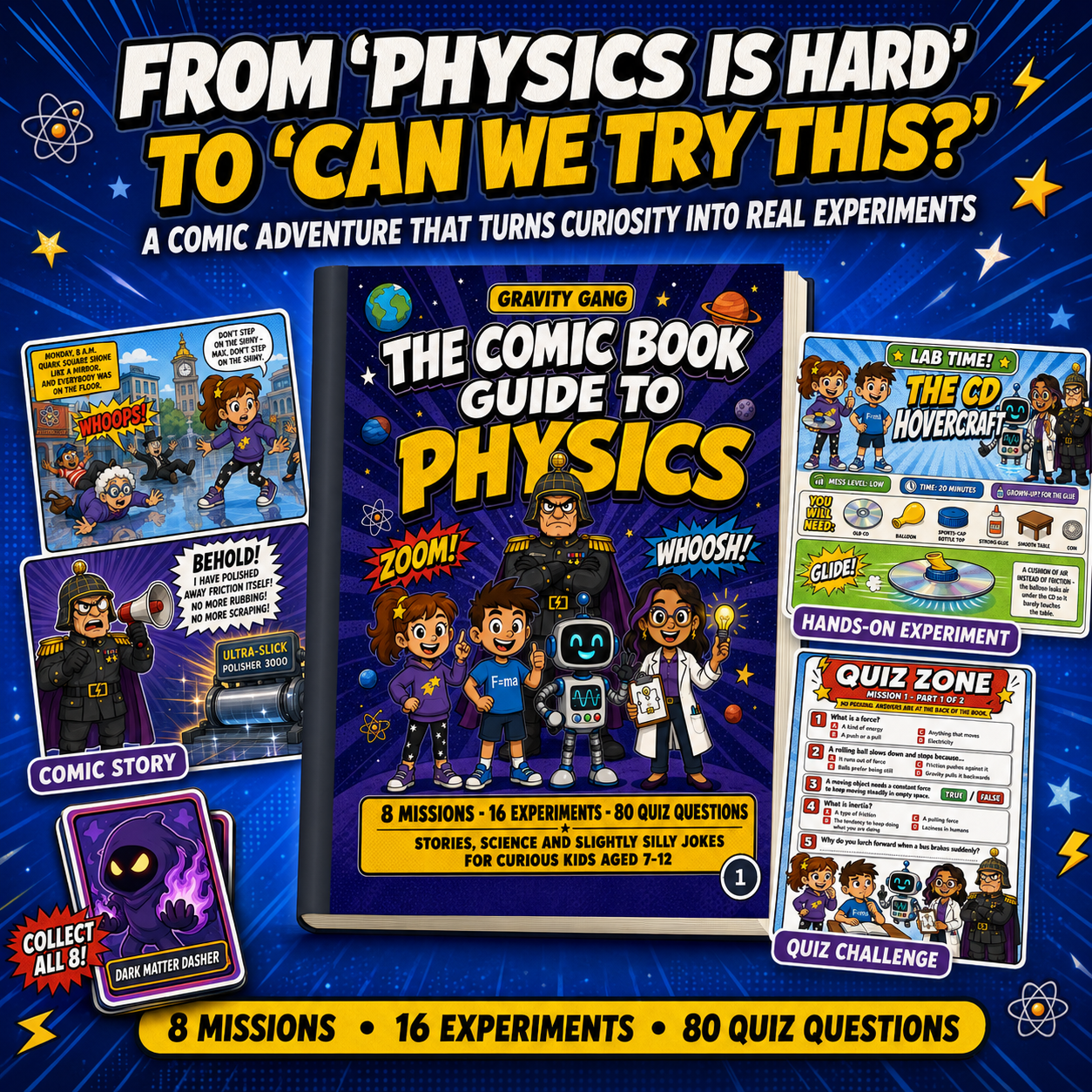
Fizz Force walks young readers through real chemistry concepts, paired with kitchen-safe experiments that use ingredients most households already have on hand, while Gravity Gang covers physics fundamentals through the same story-plus-experiment structure, including activities that map directly onto motion and force concepts like the ones explored in our Newton’s Laws experiments. Both books include quizzes and a completion certificate, giving kids a clear sense of progress once they finish.
We offer a money-back guarantee to ensure parental confidence when trying our comics. If you are weighing comics against other hands-on science resources for younger siblings, screen-free activity ideas for toddlers make a useful complement for the under-7 crowd while older kids work through a full comic.
For a closer look at the chemistry title specifically, visit the Fizz Force product page, and for the physics title, visit the Gravity Gang product page. Both are available now through our full collection.
FAQ
Is there research evidence that comics improve science learning?
Yes, multiple peer-reviewed studies report measurable effects, including a 2023 study showing a comic-based module cut physics misconceptions from 57.01% to 20.24%. A separate study found teenagers reading science comics were almost five times more likely to want to keep reading about the topic compared to those reading standard essays.
Do science comics work better for reluctant readers?
Research suggests comics are especially effective for reluctant readers and students with low science identity, since the visual format lowers the barrier to starting and finishing the material. The effect reported in the Spiegel et al. study was strongest specifically in that subgroup.
How do I find good science comics for my classroom?
Library catalogs let you combine subject tags, such as searching “chemistry” alongside “comic books,” to surface academic and curated collections, a method detailed in library research guides. Checking for teacher notes, built-in activities, and expert review during the vetting process also helps separate strong resources from ones that look educational but lack substance.
What age range do Fizz Force and Gravity Gang suit?
Fizz Force and Gravity Gang are both designed for children aged 7 to 12, combining story-driven chemistry and physics lessons with hands-on kitchen experiments. Both titles are available as a one-time purchase of $59.95 each.
Can comics replace traditional science textbooks entirely?
The research supports comics as a strong complement to traditional text rather than a full replacement, particularly for building engagement and conceptual understanding. Traditional text still plays an important role for dense technical vocabulary and extended written argumentation that comics are not designed to teach.
Sources
- Engaging teenagers with science through comics (Spiegel et al., 2013)
- Using an e-module comic to remediate physics misconceptions (2023)
- Fin-tastic Fish Science: Using a comic book to disseminate and enhance science literacy