

Parents & Teachers: 3 Quick Activities Using Chemistry Comic Strips
Chemistry comic strips are illustrated jokes, panels, or short stories that use humor to explain chemical reactions, lab life, or the periodic table. The best starting points are xkcd for single-panel science jokes, the Webtoon series “Chem Comics” for longer explanatory stories, and the Comic Book Periodic Table of the Elements for archival, element-by-element browsing. Below, you’ll find specific comics to read, why they work as teaching tools, and how to turn them into a five-minute activity or a full lesson.
TL;DR:
- Most chemistry comics are best suited for children aged 7 to 12, with single-panel jokes for younger students and longer series for older ones.
- Quick comic strips like xkcd provide humorous quick warmups, while deeper series like Chem Comics build detailed explanations suitable for in-depth learning.
- Archives and galleries index comics by element or reaction, making it easier to find relevant humor or illustrations for specific chemistry topics.
- The Fizz Force comic book series extends the joke format into full narratives with experiments and quizzes, aimed at reluctant readers and classroom use.
Table of Contents
- Where to Find Chemistry Comic Strips and Galleries
- What Makes a Good Chemistry Comic Work
- How to Use Chemistry Comics in Class or at Home
- How Brainie Comics Brings Chemistry Comics Into a Full Book
- Why We Think Comics Belong in Every Chemistry Lesson
- Get the Full Chemistry Adventure With Fizz Force
- Quick Reference: Where to Go for Each Type of Comic
- Sources
- FAQ
Where to Find Chemistry Comic Strips and Galleries
You don’t need to hunt far. A handful of sources cover most of what’s worth reading, from quick one-panel gags to full narrative arcs.
xkcd is the obvious starting point for anyone new to science humor strips. Randall Munroe’s webcomic has produced chemistry-specific entries like “Chemistry Nobel,” which pokes fun at how often the Nobel committee hands its chemistry prize to biology research, and “Chemical Formula,” a stick-figure gag built entirely around notation. These strips work as quick classroom warmups because each one takes under a minute to read and usually needs just a sentence of context.
Chem Comics on Webtoon takes a different approach. Created by FuchsineDraws, an organic chemist, the series builds multi-panel stories around lab procedures and molecular concepts rather than one-off punchlines. It reads more like an explainer with jokes woven in, which makes it better suited to students who want depth, not just a laugh.
For archival research, the Comic Book Periodic Table of the Elements, hosted by the University of Kentucky, indexes actual comic-book pages by chemical element. It’s less “funny strip” and more scholarly curiosity. Still, it’s a genuinely useful classroom tool: type in “carbon” or “mercury,” and you get a gallery of pop-culture panels referencing that element.
Round out your search with these:
- CartoonStock maintains a searchable directory of chemistry cartoons, good for finding single-panel jokes fast.
- Pinterest boards curated by teachers often collect chemistry humor strips alongside worksheets, though quality varies widely.
- When browsing any archive, search by element or reaction name rather than “funny chemistry” alone. You’ll get more relevant hits.
What Makes a Good Chemistry Comic Work
The best chemistry education comics succeed by treating science as part of ordinary life, not a separate subject stuck behind a lab door. Commentary on xkcd’s Nobel-themed strips notes that science humor lands hardest when it connects a scientific idea to something relatable, like office politics or family dynamics, rather than just restating a textbook fact with a smiley face attached.
A few techniques show up again and again in the strongest strips:
- Everyday juxtaposition. A reaction gets compared to something the reader already understands, like fizzing soda instead of an abstract equation.
- Simplified visuals. Beakers, molecules, and lab coats get drawn as recognizable shorthand rather than technically accurate diagrams, which keeps the joke fast.
- Layered humor. A strip works on two levels: a broad joke anyone gets, and an inside reference that rewards someone who already knows the chemistry.
- Purposeful pacing. Explanatory series like Chem Comics slow down for teaching moments, while single-panel strips move fast for a punchline.
Pro Tip: If you’re choosing a comic to explain a concept your student is stuck on, pick a longer explanatory strip. If you’re trying to get a reluctant reader interested in chemistry at all, start with a fast, funny single panel instead.
Professionals actually rely on this format for real teaching. One chemistry researcher’s entire graduate thesis was rewritten as a comic book specifically to make lab procedures easier for non-specialists to follow, which tells you this isn’t just a gimmick for kids.
How to Use Chemistry Comics in Class or at Home
A comic strip on its own is entertainment. Paired with a small activity, it becomes a lesson. Here are three that take fifteen minutes or less to set up.
- Prediction prompt. Show the setup panel of a comic (cover the punchline) and ask students to guess what happens next based on the chemistry involved. Reveal the actual strip afterward and compare answers.
- Comic-paired experiment. Read a strip about acids and bases, then run a matching kitchen demonstration, like mixing vinegar and baking soda, using guidance from a resource on acids and bases experiments built for ages 7 to 12.
- Create-your-own-strip assignment. Have students sketch a three-panel comic explaining one concept from that week’s lesson. This works especially well for older students who need to demonstrate understanding, not just recall it.
Age matters here. For readers aged 7 to 9, stick to single-panel jokes and skip anything requiring outside chemistry vocabulary. For ages 10 to 12, longer strips like Chem Comics work if you preview a few terms first. Older students can handle xkcd’s denser references and might enjoy explaining the joke to a younger sibling, which doubles as a comprehension check.
For assessment, skip formal quizzes. Ask students to explain the joke in their own words, or have them identify which real chemical concept the comic is based on. Any household experiment paired with a comic should follow standard kitchen-safety basics: adult supervision, no unsupervised heat sources, and safety glasses if anything fizzes or splashes.
On logistics, a projector works better than printouts for group discussion since it keeps the whole class looking at the same panel at once. If you’re sourcing comics from outside archives for classroom use, check each site’s terms. Most webcomic creators allow classroom display but not redistribution or resale.

How Brainie Comics Brings Chemistry Comics Into a Full Book
Fizz Force, Brainie Comics’s chemistry title, takes the same idea behind these strips, using story and humor to explain real chemistry, and builds it into a full narrative rather than a single panel. Instead of one joke, kids follow an ongoing comic-book adventure that weaves chemistry concepts into the plot itself.
Each book is built for readers aged 7 to 12, with the same goal that makes strips like Chem Comics work: make the science feel like part of the story, not a lecture bolted on top of it. What sets it apart from a webcomic archive is the built-in follow-through:
- Kitchen-safe experiments using household materials, similar in spirit to the acids-and-bases activity above.
- Quizzes and a completion certificate, giving kids a clear finish line.
- A format designed for reluctant readers who might skip a textbook but will follow a comic-book plot.
Parents have reported that kids who resist traditional science books stick with the story format, echoing the same principle behind interactive science books that pair narrative with hands-on tasks.
Why We Think Comics Belong in Every Chemistry Lesson
Humor lowers the guard that makes chemistry feel intimidating. A kid who laughs at a joke about beakers is a kid who’s already paying attention, which is half the battle with any science subject. We’ve seen this pattern hold up across formats, from a single xkcd panel to a full comic-book adventure. Curiosity sparked by a joke tends to stick around long enough to ask a real question. Try pairing one strip from this guide with a five-minute kitchen experiment and see what your student asks next.
— Brainie Comics
Get the Full Chemistry Adventure With Fizz Force
Reading a comic strip online is a great first step, but a strip ends after one panel. Fizz Force keeps going, turning a single joke into a full comic-book adventure built specifically for kids aged 7 to 12.
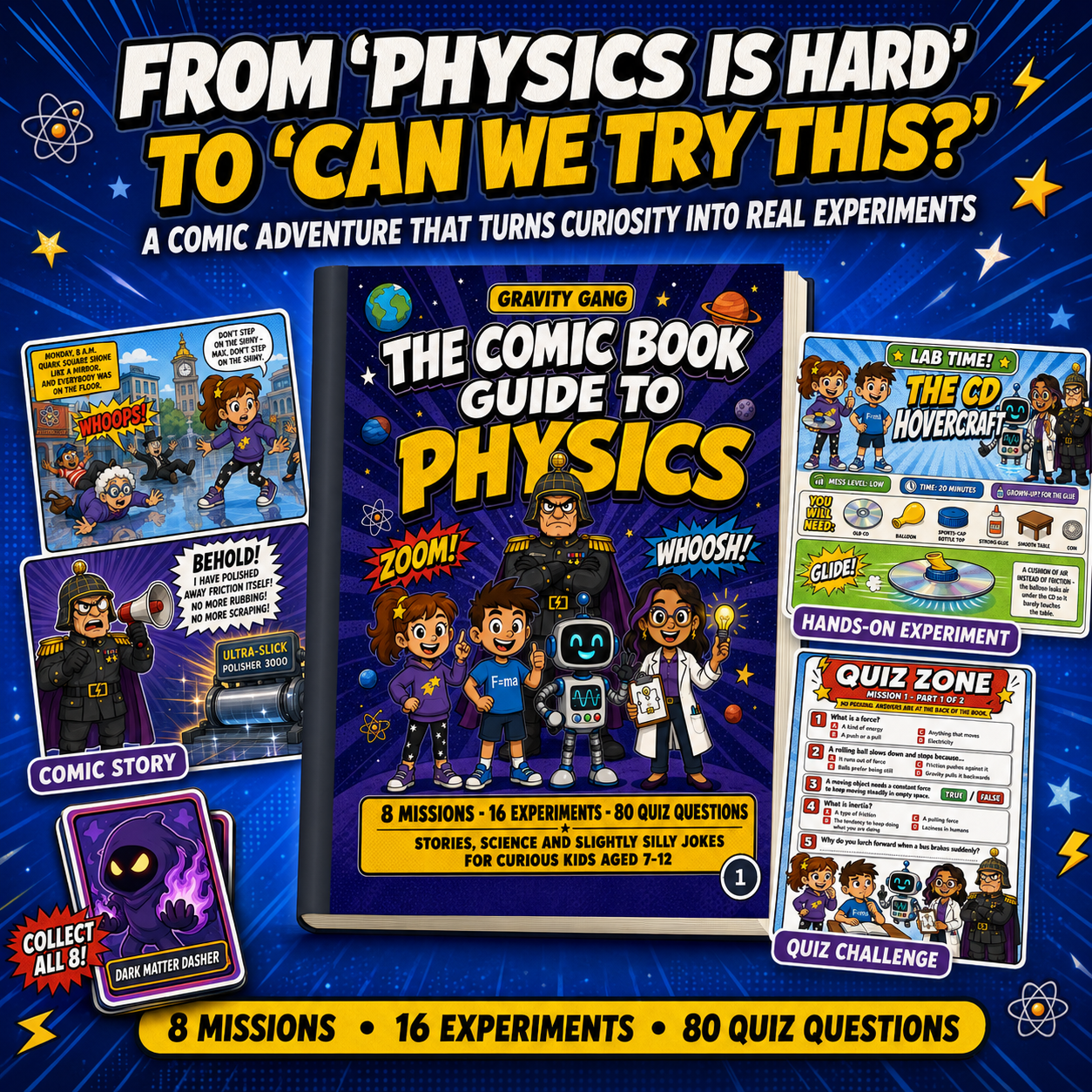
Every copy pairs the story with kitchen-safe experiments using everyday household items, so the science doesn’t stop when the page turns. No screens required, just a comic, a kitchen counter, and a curious kid. It comes with a money-back guarantee, providing confidence in trying it with a reluctant reader at home. Check out Fizz Force: Comic Book Guide to Chemistry available as a one-time purchase through Brainie Comics, or browse the full Brainie Comics collection to see it alongside Gravity Gang, the physics counterpart.
Quick Reference: Where to Go for Each Type of Comic
- xkcd: best for fast, single-panel science jokes.
- Chem Comics on Webtoon: best for longer, explanatory comic pages.
- Comic Book Periodic Table: best for element-indexed archival browsing.
- WebElements: best paired reference for factual element data.
- CartoonStock: best for searchable single-panel galleries.
Sources
FAQ
What Are Chemistry Comic Strips?
They’re illustrated jokes or short stories that use chemistry concepts as the source of the humor, ranging from single-panel gags on sites like xkcd to full narrative series like Chem Comics on Webtoon.
Are Chemistry Comics Good for Classroom Use?
Yes, especially when paired with a short activity like a prediction prompt or a matching kitchen experiment. Check the source site’s terms before projecting or printing, since most creators allow classroom display but not redistribution.
What Age Group Do Chemistry Comics Work Best For?
Single-panel jokes suit younger readers around ages 7 to 9, while longer explanatory series fit best for ages 10 and up once basic vocabulary is introduced. Brainie Comics designs its Fizz Force title specifically for the 7 to 12 range, blending story with hands-on experiments.
How Much Does Fizz Force Cost?
Fizz Force: Comic Book Guide to Chemistry is priced at $59.95 as a one-time purchase, available directly through the Brainie Comics product page.