

Age by Age Safe Kitchen Chemistry for Kids Parents Can Do With a Story
Safe chemistry for kids means low-toxicity, household materials, strict adult supervision, and basic protective gear so children can learn real science without real risk. The formula is simple: small quantities of things like baking soda, vinegar, and dish soap, an adult watching every step, and a contained workspace near a sink. Get those three right, and you can run legitimate chemistry experiments in your kitchen this weekend, scaled to suitable age groups.
TL;DR:
- Most kitchen experiments rely on household ingredients like baking soda, vinegar, and dish soap, with adult supervision and protective gear at all times.
- Safety habits such as labeling containers, wearing goggles, and conducting experiments on wipeable surfaces prevent accidents and cross-contamination.
- Younger children observe and describe reactions, while older kids measure, record data, and run controlled tests to develop scientific thinking skills.
- Cleanup involves rinsing safe mixtures down the sink and properly disposing of or storing materials, preventing household safety issues.
- Framing experiments through storytelling or ongoing challenges increases engagement and helps children retain scientific concepts over time.
Table of Contents
- What “Safe Chemistry for Kids” Actually Requires
- 8 Kitchen Chemistry Experiments Kids Can Actually Do
- How to Scale Experiments as Kids Get Older
- Setting Up and Cleaning Up Without the Mess
- Making Experiments Stick: Story, Data, and Extensions
- Why Safety and Story Both Matter Here
- A Story-Driven Way to Keep the Experiments Going
- Sources
- FAQ
What “Safe Chemistry for Kids” Actually Requires
Safety in kids’ chemistry isn’t a single rule. It’s a stack of small habits that add up to zero surprises. The American Chemical Society’s guidance for elementary classrooms treats adult supervision, eye protection, ventilation, and a strict no-ingestion rule as non-negotiable basics, and that same logic holds for a kitchen counter as much as a school lab.
Here’s what that looks like in practice:
- An adult supervises every step, and younger kids watch and narrate while an adult measures and pours
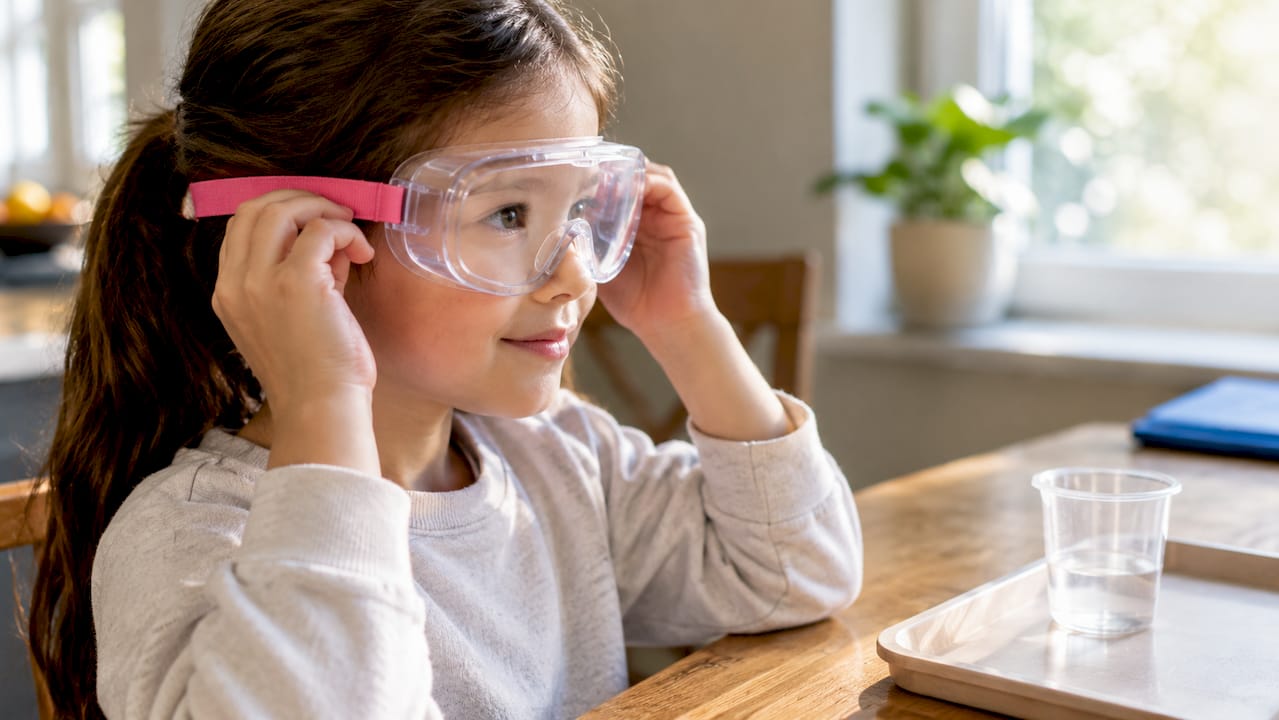
- Safety goggles go on before any liquid is mixed, no exceptions, even for “just water”
- Aprons or old clothes protect against stains, and long hair gets tied back
- Work happens on a tray or a wipeable surface, ideally within a few steps of a sink
- Containers get labeled immediately, so nobody mistakes a chemical mix for a drink
- Nothing gets tasted, ever, even when the ingredients are food-grade
The ACS’s kid-focused safety sheet frames this as a simple before-during-after checklist: ask an adult, read the directions, wear goggles, wash hands afterward. That rhythm works whether the child is five or twelve.
Pro Tip: Make goggles the first thing kids put on and the last thing they take off. Treating eye protection as a bookend to the whole activity, not just the “pouring part,” builds a habit that carries into more advanced experiments later.
8 Kitchen Chemistry Experiments Kids Can Actually Do
These run simplest to most advanced, using ingredients most households already have. Every one avoids toxic chemicals and works on a tray, a table, or a sink-side counter.
- Baking soda and vinegar volcano. Ages 5 and up. Kids see acid-base reactions produce carbon dioxide gas in real time. Keep it on a tray, pour vinegar slowly, and goggles stay on the whole time.
- Magic milk. A drop of dish soap dropped into milk with food coloring sends colors swirling. It teaches surface tension and how soap molecules disrupt fat. Keep it away from eyes and wash hands right after.
- Coffee filter chromatography. Washable marker dots separate into their component colors as water climbs the paper. It’s a gentle introduction to how mixtures separate. Use washable dyes only, and no tasting the filters.
- Crystal growth with Epsom salt. A saturated solution left overnight grows visible crystals, a hands-on lesson in solubility and patience. Label the container clearly and store it away from food.
- Oobleck. Cornstarch and water make a substance that acts solid under pressure and liquid at rest, a classic non-Newtonian fluid. Cleanup is dry, not wet, and it’s not for eating despite looking edible.
- Density tower. Layering water, oil, and syrup by density shows why some liquids float and others sink. Small quantities keep it manageable, and everything used should be washable.
- Invisible ink from lemon juice. Writing with lemon juice and revealing it with heat demonstrates oxidation. The heating step (a lamp bulb or a warm iron) is adult-only.
- Slime from glue and liquid starch. A hands-on introduction to polymers, where two liquids form a stretchy solid. Wash hands after, and don’t eat it, even though it smells like glue and glitter.
Several of these come straight from tested collections like ACS’s Adventures in Chemistry, which pairs kid-friendly activities with the same safety framing used here. For deeper variations on the volcano reaction, eight baking soda and vinegar experiment ideas show how one basic reaction can teach several different concepts.
How to Scale Experiments as Kids Get Older
Chemistry education for elementary-age kids follows a natural arc: from watching and describing toward measuring and testing. Teach Chemistry’s progression guidance frames this as moving from sensory observation in younger kids toward structured experimentation in older ones, and it maps neatly onto the activities above.
- Ages 5 to 7: An adult measures and mixes; the child watches, describes what happens, and draws or narrates the result.
- Ages 8 to 10: The child measures ingredients, records simple data, and tests one variable, like how much vinegar changes the size of a volcano’s fizz.
- Ages 11 to 12: The child runs controlled comparisons, repeats trials for consistency, and keeps a basic lab notebook with predictions and results.
Three questions push thinking at any age: What do you think will happen? What did you actually see? Why do you think that happened? Asking them in that order, every time, builds scientific habits that outlast any single experiment. For hands-on measuring practice that supports this progression, measuring tools and techniques for the kitchen covers what actually works with small hands and imprecise instruments.
Setting Up and Cleaning Up Without the Mess
A few minutes of setup prevents most chemistry accidents before they happen. The GSK Science in the Summer materials guide recommends a simple sequence: gather everything first, label tools and containers, and practice measuring before mixing anything.
Run through this before starting:
- Lay out a tray or wipeable surface, plus a towel and easy sink access
- Set out goggles and aprons for every child participating
- Label every container, including ones with plain water, since labeling prevents cross-contamination and models a real lab habit
- Pre-measure ingredients into small cups when working with younger kids
- Keep a trash bag or bin within arm’s reach for used disposables
Cleanup matters as much as setup. Most baking soda and vinegar mixtures are safe to rinse down the sink with water, according to the ACS classroom safety guidance, but used paper towels, plastic cups, and other disposables belong in regular trash, not back in the kitchen supply drawer. Store any reusable tools clean and dry, and keep leftover materials like Epsom salt or food coloring somewhere clearly separate from actual food. If your household or classroom follows specific waste rules, those take priority over general guidance.
Pro Tip: Keep a “chemistry only” bin of cups, spoons, and trays that never touches food prep. It removes the temptation to grab a used measuring cup for dinner, and it teaches kids that lab tools and kitchen tools serve different jobs.
Making Experiments Stick: Story, Data, and Extensions
A demonstration without context fades fast. Pairing an experiment with a story or a real-world connection, like linking a fizzing reaction to how bread rises, gives kids something to hang the concept on and helps it stick past the afternoon.
Simple data collection works at every age, adjusted to skill level:
- Younger kids draw what they saw or count bubbles out loud
- Middle-age kids tally results or time how long a reaction lasts
- Older kids log measurements and compare trials side by side
For extensions, try a “design your own test” challenge: let the child change one variable, like temperature or amount, and predict the outcome before testing it. Household connections, why bread rises, why metal rusts, why soap cuts grease, extend a single afternoon experiment into an ongoing curiosity habit. For more structured pedagogical approaches, homeschool science experiments that kids actually remember digs into what makes activities stick beyond the day they happen.
A story hook before the beakers come out changes how kids engage with the chemistry that follows. Framing a reaction as “solving a problem for a character” rather than “today’s experiment” turns a demo into something a child wants to finish, not just watch.
Why Safety and Story Both Matter Here
Kids who learn goggles-on, hands-off-the-mouth habits early carry those instincts into more advanced labs later, whether that’s middle school chemistry or a college workbench. That’s not a small thing. Pairing safety with narrative, giving a reaction a reason to exist beyond “watch this,” tends to keep reluctant readers and reluctant scientists in the room longer. None of this requires a lab. Nearly everything above comes from a kitchen cabinet, a grocery store, and a little patience.
— Brainie Comics
A Story-Driven Way to Keep the Experiments Going
Beyond single experiments, some kids need a reason to keep going after the first fizz fades. Brainie Comics built Fizz Force around exactly that gap: a comic book for ages 7 to 12 that wraps kitchen-safe chemistry experiments inside a story kids actually want to finish. Instead of a worksheet, the content follows a narrative that pauses at key moments for a real, hands-on experiment using the same low-toxicity household materials covered above.
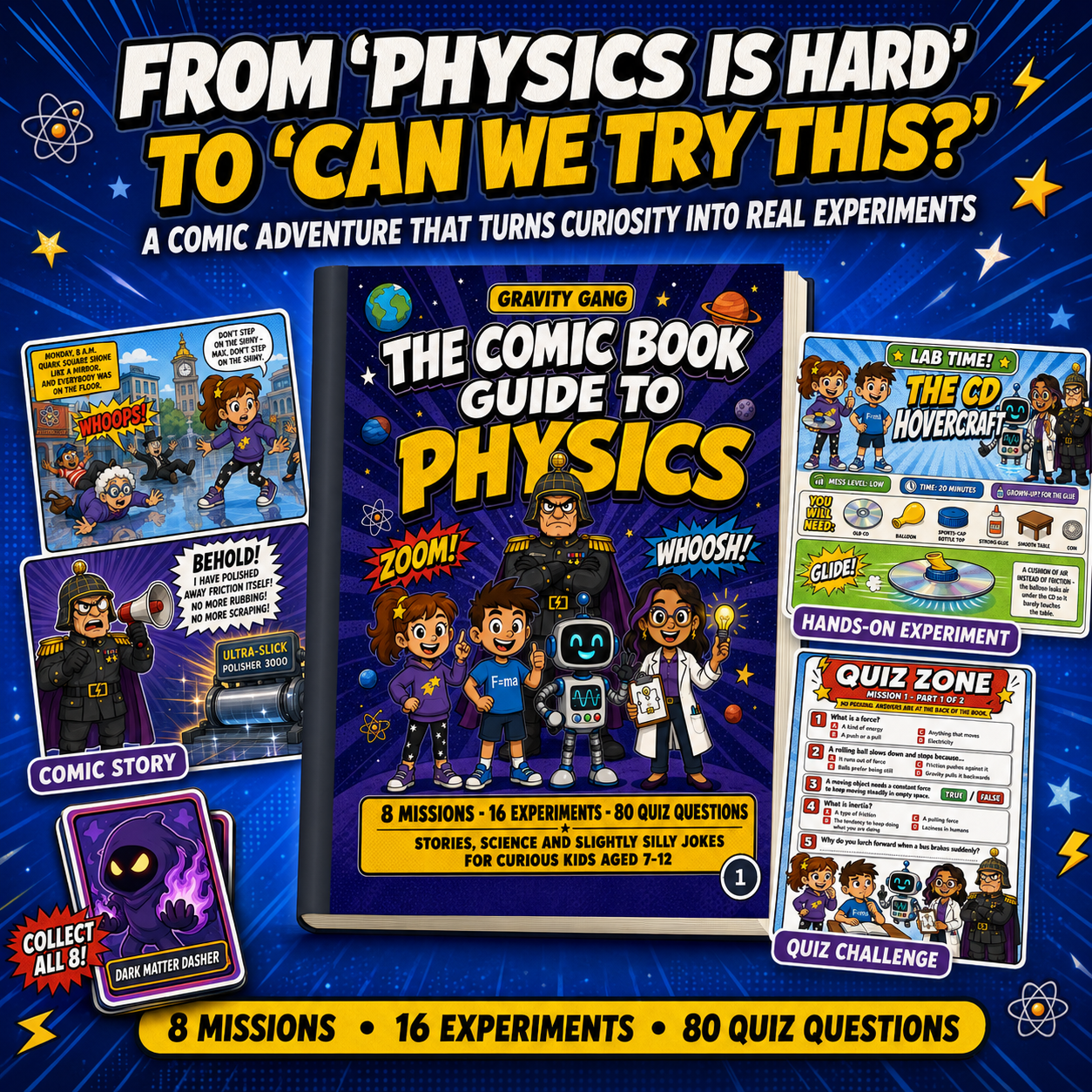
The pairing matters because safety guidance sticks better when a character is the one following it, and a reluctant reader will turn the page for a plot in a way they won’t for a lab manual. If your child has already tried the volcano and the crystal growth from this guide, Fizz Force gives them a next set of experiments with a story attached. Check the product page for what’s included and get a copy started this week.
Sources
- Safety in the elementary school science classroom — American Chemical Society
- Bridging the observable to the atom — Teach Chemistry
- GSK Science in the Summer: Materials Chemist — Franklin Institute
FAQ
What are some safe chemical reactions for kids?
Baking soda and vinegar (an acid-base reaction producing carbon dioxide), Magic Milk (soap disrupting surface tension), and Epsom salt crystal growth are all low-toxicity reactions that work well with adult supervision and basic PPE.
What are 10 common chemicals used at school?
Elementary science classrooms commonly use baking soda, vinegar, food coloring, dish soap, cornstarch, salt, sugar, water, cooking oil, and Epsom salt, all household-grade materials rather than laboratory chemicals.
What are some simple chemistry experiments for kids?
Simple options include the baking soda volcano, coffee filter chromatography, oobleck, and a density tower using water, oil, and syrup, each teachable in a relatively short time with materials already in most kitchens.
What are some easy experiments I can do in chemistry at home?
Invisible ink from lemon juice, glue-based slime, and Magic Milk all count as easy home chemistry experiments, and Brainie Comics’ Fizz Force walks through several of these inside a story format for ages 7 to 12.
Is it safe to pour experiment leftovers down the sink?
Most baking soda and vinegar mixtures are safe to rinse down the sink with water, but contaminated disposables like used cups or paper towels should go in regular trash, following ACS disposal guidance.