

Reading With Comics: A 25–40 Minute Kids’ Lesson With an Experiment
Yes, comics and graphic novels are a practical way to build reading skills and engagement for many children. Three things make this work: pictures scaffold meaning before a child decodes every word, the combined image-and-text format lowers the effort needed to follow a story, and the format itself keeps reluctant readers coming back for more. Below, we walk through the research, classroom strategies, and a ready-to-run lesson you can try today.
TL;DR:
- A classroom study of 33 students found a 58.43% normalized gain in narrative comprehension, but its small, noncausal design makes the result promising, not conclusive.
- A study of 15 high school students found faster reading, fewer word repetitions, and fewer navigation interruptions with print, so use paper for guided lessons.
- A four part routine works well: preview the art, read aloud, retell events panel by panel, then ask inference questions instead of simple recall.
- Match comics to reading level and interests; choose repeated sentence patterns for fluency, rich dialogue for vocabulary, or clear story structure for retelling.
- A 25 to 40 minute science lesson for ages 7 to 12 pairs a guided comic reading with an experiment, then checks vocabulary and understanding.
Table of Contents
- How comics support reading development: research and teacher evidence
- Ready-to-use activities and routines to teach reading with comics
- How to pick comics that strengthen reading skills
- One 25 to 40 minute lesson using a science comic and a simple experiment
- Brainie Comics’ perspective on comics as reading tools
- Where to get comics that combine reading practice and hands-on experiments
- FAQ
- Sources
How comics support reading development: research and teacher evidence
Comics work differently from plain text because readers process pictures and words together instead of decoding word by word. Research on multimodal processing explains that pictures in comics often produce faster semantic access than text alone, which lets a reader build a mental model of the story from the art and then refine that meaning once they read the dialogue or narration (Meuer, 2018). That sequencing matters for a child who struggles with decoding: the picture carries part of the meaning so the words carry less of the load.

Classroom data backs this up. A pre-experimental classroom study of 33 students found a mean normalized gain of 58.43% in narrative comprehension after short comic-based instruction, with improved posttest scores confirmed by a Wilcoxon signed-rank test (reading between panels, 2024). The authors are careful to note the sample was small and the design was not causal, so the result should be read as promising rather than conclusive.
Format matters too. A think-aloud study comparing digital and print comics among 15 high-school students found that print reading led to faster reading times and fewer word repetitions than screen reading, with fewer navigational disruptions overall (ACM, 2023). For a guided lesson, that’s a reason to reach for the printed page first and save digital formats for independent, take-home reading.
Teachers and librarians report similar patterns outside formal studies:
- Reading specialists describe graphic novels as valid tools for teaching plot, character, and theme, not just a bridge to “real” books.
- Educators interviewed about classroom comics report that students who resist traditional chapter books stay engaged with comics and often read them repeatedly (Teaching Channel, 2024).
- Literacy organizations compile booklists and classroom strategies specifically because comics build vocabulary, confidence, and reading stamina for struggling readers (Reading Rockets).
A pre-experimental classroom study reported substantial gains in narrative comprehension after a short comic-based unit (reading between panels, 2024), a result that underscores why so many teachers now treat comics as core instructional material rather than a reward for finishing “real” homework.
Ready-to-use activities and routines to teach reading with comics
A short, repeatable routine does more for a reluctant reader than an hour-long reading assignment. Try this four-step shared-reading sequence, whether you’re at the kitchen table or in front of a class:
- Preview the panels. Flip through a page or chapter together and ask what seems to be happening based on the art alone.
- Read aloud. Take turns reading dialogue and narration, using different voices for different characters.
- Retell by panel. Ask the child to point to a panel and explain what changed from the one before it.
- Ask targeted questions. Focus on inference (“Why do you think she looked surprised?”) rather than simple recall.
Panel sequencing builds comprehension in a way plain text can’t match, because a child has to infer what happened between two drawings, a skill that transfers directly to understanding cause and effect in longer novels. Speech bubbles also give you a built-in vocabulary tool: cover a word, ask the child to guess it from the character’s expression and the scene, then reveal it and use it in a new sentence right away.
For engagement, three approaches tend to work well across age groups. Reading an entire series keeps motivation high because the child already knows the characters and the stakes. Starting a small graphic-novel book club, even with two or three kids, turns reading into a shared experience with discussion built in. Letting a child draw their own three-panel comic based on something they read applies the structure they just learned, which reinforces narrative sequencing far better than a worksheet does.
For a family trying this for the first time, three short home hooks fit into a normal evening:
- Ten-minute panel hunt: page through a new comic together and predict the plot from pictures alone before reading a word.
- Fifteen-minute read-and-draw: read one chapter, then have the child sketch their favorite panel from memory.
- Twenty-five-minute full routine: run the complete preview, read, retell, and question sequence above.
Our research-backed picks and activities for reluctant readers walk through additional versions of this routine, and the 25-minute comic and experiment activity adapts it for a single evening at home.
Pro Tip: Keep the first read-through fast and low-pressure, save the vocabulary and inference questions for a second pass once the child already knows how the story ends.
How to pick comics that strengthen reading skills
Not every comic fits every reader, so match the book to the child’s current skill level and the specific gain you’re after. A quick checklist keeps browsing focused:
- Age and grade alignment: check the publisher’s stated age range against the child’s reading level, not just their age in years.
- Text-to-image balance: denser speech bubbles suit a stronger reader, while sparser text with expressive art suits an emerging or reluctant one.
- Series potential: a strong first volume with sequels keeps motivation going long after the first book is finished.
- Topical fit: a comic about dinosaurs, sports, or science hooks a reluctant reader far faster than a title chosen for its reading level alone.
Match the selection to your goal. If fluency is the target, choose shorter panels with repeated sentence patterns. If vocabulary is the target, look for rich, varied dialogue. If comprehension is the target, pick stories with a clear beginning, middle, and end so retelling activities have real structure to work with. If motivation is the only goal right now, let the child pick based on interest and worry about the rest later.
Our guide to the real benefits of graphic novels covers how to read these signals quickly while browsing a shelf or a library catalog.
One 25 to 40 minute lesson using a science comic and a simple experiment
This lesson works for ages 7 to 12, adjusted for reading level, and needs only a comic book and a few household items. It pairs a guided read with a hands-on experiment so the science concept gets reinforced twice, once through the story and once through the child’s own hands.
Materials: one science-themed comic chapter, a notebook, and household items specified by the comic’s experiment (for example, baking soda, vinegar, and a small container).
- Preview (5 minutes): look at the chapter’s art together and predict what scientific concept it covers.
- Guided read (10 minutes): read the chapter aloud, pausing at key panels to check understanding.
- Experiment (10 to 15 minutes): follow the comic’s built-in experiment steps using the household materials.
- Vocabulary check (5 minutes): pull three new words from the chapter and have the child use each one to describe what just happened in the experiment.
- Formative check (5 minutes): ask the child to explain the concept in their own words, as if teaching a younger sibling.
For assessment, a one-paragraph journal entry about what happened and why works well for older children, while younger ones can give a short verbal explanation or draw a labeled diagram. Extend the lesson by having the child present their experiment results to another family member or classmate.
- Educators who use guided notes alongside educational comics report that students follow instructions more independently and stay engaged longer (Teaching Channel, 2024).
- Teachers also note that comics make narrative structure explicit, since the distinction between speech bubbles and narration boxes gives a concrete way to teach dialogue and sequence.
Our interactive science books built around experiments describe this lesson structure in more detail, and teachers looking for a printable scaffold can adapt blank comic templates for the extension activity where kids create their own comic panel about what they learned.
Pro Tip: Run the experiment before the vocabulary check, not after, so new words attach to something the child just did with their own hands.

Brainie Comics’ perspective on comics as reading tools
We built our books around science specifically because reluctant readers need a reason to turn the page that has nothing to do with reading itself. A kid who wants to know whether the baking soda will actually erupt will push through dialogue and narration they’d otherwise skip. Pairing a comic chapter with a kitchen experiment gives the story a payoff beyond the last panel, which is often what turns a one-time read into a reread.
We see comics as a starting point rather than a destination. A child who finishes a science comic with a stained countertop and a working theory about chemical reactions has practiced inference, vocabulary, and sequencing without feeling like it was a lesson. Try one 25-minute routine from this guide with a science-themed comic this week and watch what sticks.
— Brainie Comics
Where to get comics that combine reading practice and hands-on experiments
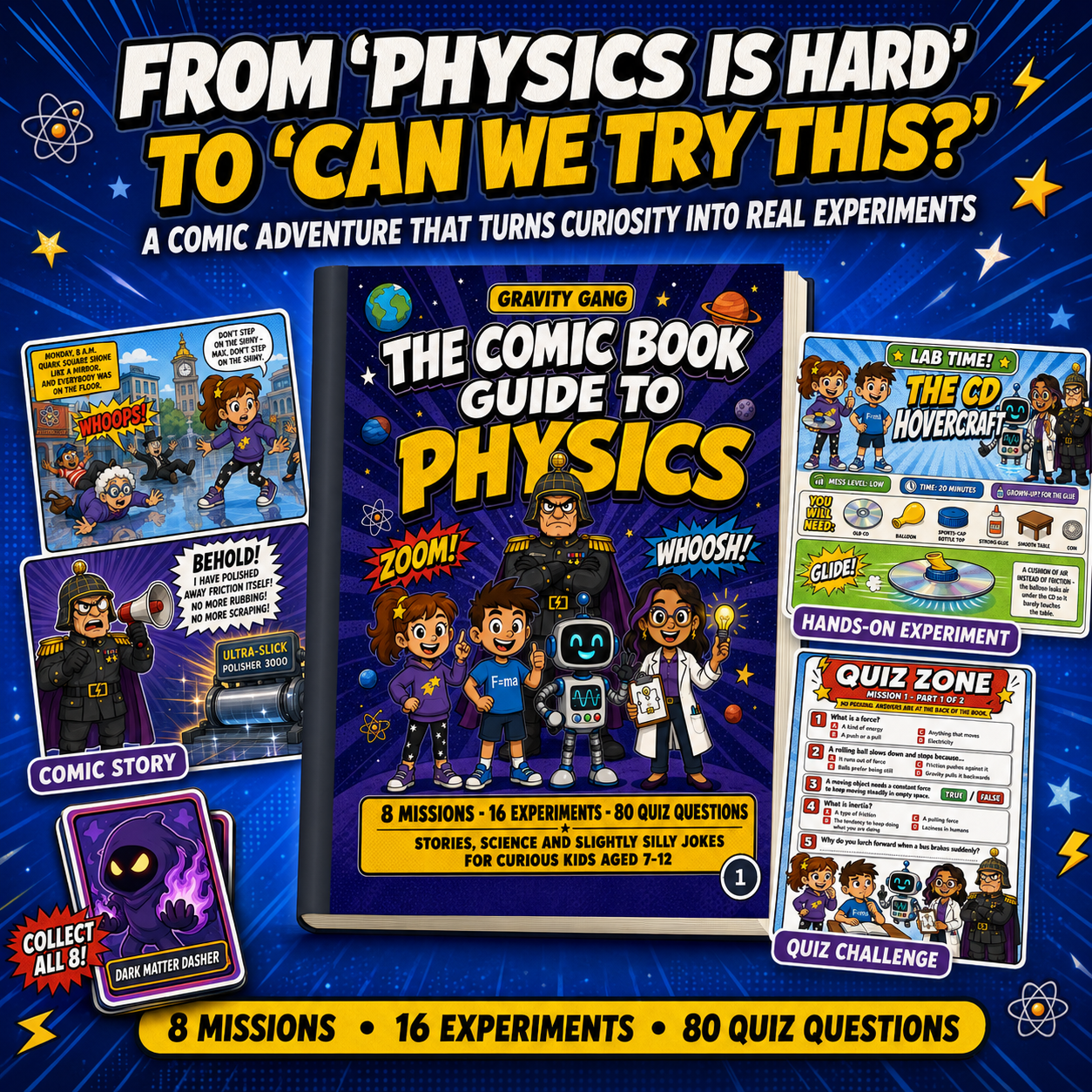
For families and classrooms ready to put this routine into practice, our full collection of comic books is built for ages 7 to 12 around real physics and chemistry concepts, with every chapter tied to an experiment using items already in most kitchens. Gravity Gang: Comic Book Guide to Physics and Fizz Force: Comic Book Guide to Chemistry are each priced at $59.95 one-off and work well as a single copy for home use or as a small set for a classroom reading corner. Start with one chapter and its matching experiment this week, then build the full shared-reading routine around whichever title grabs your reader first. Families looking to round out a STEAM corner at home might also find the STEAM literacy integration tips useful for pairing comics with other hands-on kits.
FAQ
How to get started with reading comics?
Start with a single chapter and the four-step routine: preview the panels, read aloud together, retell what happened panel by panel, then ask a few inference questions. Choose a topic the child already likes so the first session feels like fun rather than practice.
How can I read comics digitally?
Most publishers offer digital editions through apps or e-reader platforms, though a think-aloud study comparing formats found that print reading led to faster reading times and fewer navigational disruptions than screen reading. For structured lessons, print tends to work better, while digital formats suit independent or take-home reading.
Which comic is best to read?
The best comic matches the reader’s current skill level and interests rather than a fixed reading level alone. Look for a strong text-to-image balance for the child’s stage, a topic they’re curious about, and series potential so motivation carries into future books.
Does anyone still read comics?
Comics and graphic novels remain widely used in homes, libraries, and classrooms, with literacy organizations actively compiling booklists and classroom strategies built around them (Reading Rockets). Many teachers now treat them as standard instructional material for building vocabulary, confidence, and reading stamina.
Sources
- Teaching Channel Talks Episode 93: Making Science Fun with Educational Comics (w/ Laura Balliett, Cool School Comics)
- Reading comprehension through graphic novels (Meuer 2018)
- Reading between panels: Comic-book-based instruction and narrative comprehension
- A think-aloud study: Exploring the effects of digital vs. print comics on reading efficiency and comprehension
- Graphic novels for kids: Classroom ideas, booklists, and more | Reading Rockets