

Gravity Experiments: Six Tests for Kids by Age With Household Items
Try a center-of-gravity balance test (ages 6+), a paper drop race (ages 5+), an egg-drop parachute challenge (ages 8+), a pendulum swing (ages 6+), a coffee-filter terminal velocity test (ages 9+), and a video drop-and-calculate activity (ages 11+), all part of the benefits of hands-on learning and inquiry-based activities that engage young children. Each one uses household items, takes under 30 minutes, and teaches a different piece of how gravity actually behaves. The next section walks through materials and steps for all six.
TL;DR:
- The paper race isolates air resistance because both sheets weigh the same; crumple one, leave the other flat, and drop them together.
- For the egg parachute, children ages 8 and up can time descent, but adults should supervise and use a cleared landing area or soft mat.
- A shorter pendulum swings faster, while changing its weight alone barely affects speed; keep the string length fixed to test that comparison fairly.
- For ages 11 and up, record a falling ball at 30 frames per second and use roughly 0.033 second intervals to estimate acceleration.
- Repeat each test before changing one variable, record times or distances, and clear the landing area so results are easier to compare safely.
Table of Contents
- Step-by-step gravity experiments using household materials
- Setting up safely: materials, timing, and recording tips
- Turning the activity into a real science lesson
- Story-driven experiment packs from Brainie Comics
- Why story and hands-on science belong together
- Another way to run these experiments: Gravity Gang
- FAQ
- Sources
Step-by-step gravity experiments using household materials
1. Center-of-gravity balance test
Materials: a ruler, broom, or yardstick (a wooden spoon works too). Balance the stick across two fingers, then slowly slide your fingers together until they meet at one point: the center of gravity. Ask your child to predict where that point will be before testing it. Kids should notice that one finger always slides more than the other until they meet right at the balance point, a detail worth calling out as it happens, per the Exploratorium’s center-of-gravity demo. This shows that gravity acts as if it pulls from one single point on an object, not the whole surface. Age band: 6 and up. Prep time: under 2 minutes. Cost: $0. Variation to test: try an uneven object, like a hammer, and see how the balance point shifts toward the heavier end.
2. Paper drop race
Materials: two identical sheets of paper. Crumple one sheet into a tight ball, leave the other flat, and drop both from the same height at the same time. Children should watch which one lands first and guess why before dropping. Both sheets weigh the same, so the result isolates air resistance as the real variable, which is the central lesson of this experiment. Age band: 5 and up. Prep time: 1 minute. Cost: $0. Variation to test: fold the flat sheet into a paper airplane and compare its fall path to the ball.
3. Egg-drop parachute challenge
Materials: a plastic grocery bag or tissue paper, string, tape, a small cup, and a raw egg (or a water balloon for an easier cleanup). Cut a square of plastic or tissue, tie four strings to the corners, attach them to a cup holding the egg, and drop the whole rig from a second-story window or stairwell. The parachute’s surface area and shape control how much it slows the fall, exactly as described in the Exploratorium’s parachute plummet activity. Kids should time the descent and check whether the egg survives the landing. Age band: 8 and up, with adult supervision for the drop height. Prep time: 15 to 20 minutes. Cost: under $5. Variation to test: double the parachute’s surface area and compare descent time on video.
4. Pendulum swing
Materials: string, a washer or small weight, and a doorframe or sturdy branch. Tie the weight to one end of the string, hang it from a fixed point, pull it back to a measured angle, and release. Children count how many swings happen in 15 seconds, then shorten the string and repeat. A shorter pendulum swings faster, showing that gravity’s pull interacts with length and angle in a predictable way. Age band: 6 and up. Prep time: 5 minutes. Cost: $0. Variation to test: change the weight but keep the string length the same, then see that swing speed barely changes.

5. Coffee-filter terminal velocity test
Materials: 2 to 4 stacked coffee filters, or oversized party-supply filters for a more visible effect. Drop a single filter and a stack of two or three from the same height, timing each with a stopwatch. More filters stacked together fall faster because the added weight does not change the surface area catching air, a result documented in Stony Brook’s terminal velocity demos. This directly challenges the common idea that “heavier always falls faster,” since here the shape and air resistance matter just as much as weight. Age band: 9 and up. Prep time: 5 minutes. Cost: under $3. Variation to test: flatten one filter into a tight ball and compare its fall time to an unflattened one.
6. Video drop-and-calculate experiment
Materials: a smartphone camera, a small ball, a tape measure, and a wall marked in 10-centimeter intervals. Record the ball falling past the marked wall at 30 frames per second, then play back the video frame by frame to measure how far it travels in each roughly 0.033-second interval. This method, outlined in the Exploratorium’s falling and gravity guide, lets kids estimate acceleration due to gravity using nothing but a phone and a tape measure. Age band: 11 and up, since it involves basic math. Prep time: 10 minutes. Cost: $0 if you already own a smartphone. Variation to test: drop a heavier ball of the same size and compare the measured acceleration.

Pro Tip: Run the same experiment twice before changing anything: a repeat trial tells you whether a surprising result was real or just a fluke.
Setting up safely: materials, timing, and recording tips
A little prep keeps these experiments smooth and injury-free.
- Keep a basic kit on hand: string, tape, coffee filters, paper, a stopwatch, and a tape measure cover five of the six activities.
- Swap tissue paper for plastic bags in the parachute challenge, or regular coffee filters for the party-supply size when you want a slower, more visible fall.
- Run drop experiments over a cleared floor or soft rug, never over a staircase edge or a crowded room.
- Keep everyone except the person dropping the object out of the landing zone, especially for the egg-drop challenge.
- Record drops on a phone at 30 frames per second so you can review the fall frame by frame afterward, a technique the Exploratorium recommends for measuring acceleration.
- Use a simple two-column table (trial number, time or distance) to log results as you go instead of trying to remember numbers later.
Pro Tip: Do the parachute and egg-drop challenge outdoors or over a soft mat. It turns a possible mess into a non-issue.
Turning the activity into a real science lesson
The core move in all six experiments is testing one variable at a time. In the coffee-filter test, that means changing only the number of filters stacked, never the drop height or the person dropping them, so any speed difference can be traced to one cause. Ask these questions before, during, and after each trial: What do you think will happen? What did you actually see? Why do you think that happened? What would change if we altered one thing? Standard gravity accelerates falling objects at about 9.8 meters per second squared, and older kids can use that number to check how close their own video-based calculations come.
- Graph drop times across multiple trials to spot patterns a single test might miss.
- Challenge kids to design a parachute that lands in exactly 3 seconds, adjusting size until it works.
- Compare results across age groups or classrooms to see how consistent the findings are.
Story-driven experiment packs from Brainie Comics
For families and classrooms who want these ideas packaged with a narrative, our Gravity Gang comic weaves gravity experiments into an adventure story, built for readers ages 7 to 12. Each issue includes kitchen-safe experiments, quizzes, and a completion certificate, giving kids a reason to finish the book and try the science themselves. Some parents have noticed increased interest in science and improved reading habits in their children after reading similar educational stories. Our companion title, Fizz Force, applies the same approach to chemistry for kids who want to keep exploring beyond gravity. For more age-banded activity ideas outside the comics, see our elementary science experiments guide.
Why story and hands-on science belong together
Reluctant readers rarely finish a worksheet, but they will finish a comic if the story is good enough. Pairing a gravity experiment with a character who faces the same problem gives kids a reason to care about the outcome, not just the instructions. Repetition matters too: rerunning an experiment with one small change, dropping a different object, adding a filter, teaches more than running it once perfectly.
— Brainie Comics
Another way to run these experiments: Gravity Gang
If building a full lesson plan from scratch feels like a lot of extra work, our Gravity Gang comic hands you ready-made experiments wrapped inside a story kids actually want to finish.
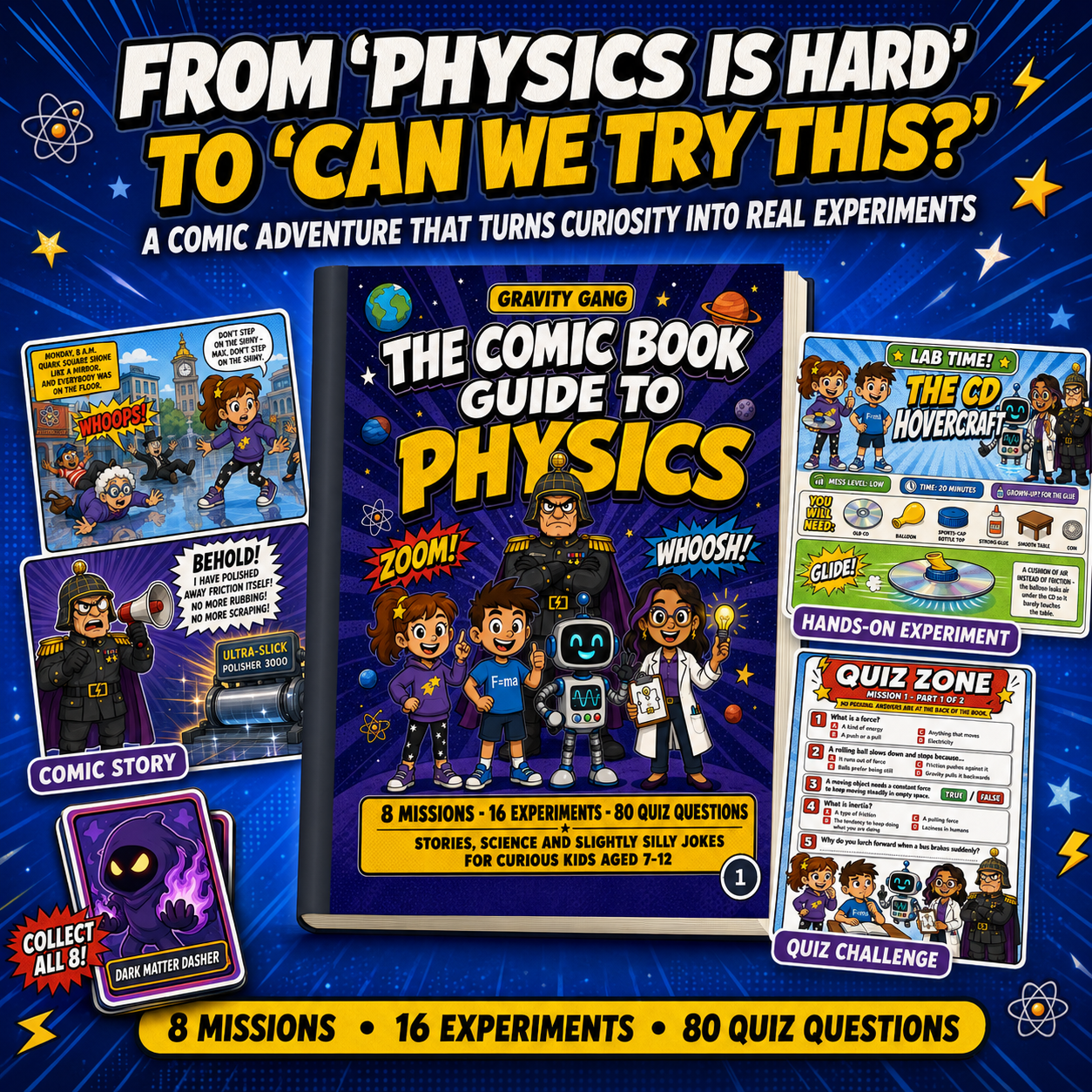
- Each book pairs a physics adventure with kitchen-safe experiments, quizzes, and a certificate on completion, built for ages 7 to 12.
- It comes with a satisfaction guarantee, aiming to provide confidence in trying it with your reader.
Browse the full comic book collection to find the right title for your young scientist, or order Gravity Gang directly for classroom or home use.
FAQ
What are 10 easy science experiments for kids?
Beyond the six gravity experiments above, other easy options include a baking soda volcano, a rainbow milk experiment with dish soap, a density tower using liquids of different weights, and a simple circuit with a battery and bulb. Most of these use items already in a typical kitchen or craft drawer, and take under 30 minutes.
How can I explain gravity to kids in a simple way?
Gravity is an invisible force that pulls objects toward each other, and on Earth it pulls everything toward the ground at the same steady rate, as NASA explains. A simple way to show this is dropping two different objects at once and asking a child to predict which lands first, then explaining that air resistance, not weight alone, usually explains the difference.
What are some fun games about gravity?
Balance challenges, like stacking blocks as high as possible before they tip, turn the idea of center of gravity into a game. Egg-drop parachute contests, where kids design a parachute to protect an egg from a height, combine competition with the same physics covered in the experiments above.
What are 5 examples of gravity?
Everyday examples include an apple falling from a tree, water flowing downhill, the moon orbiting Earth, tides rising and falling along a coastline, and a ball arcing back down after being thrown. Each one reflects the same pull NASA describes as gravity’s attractive force between objects.
Sources
- What Is Gravity? | NASA Space Place
- Terminal velocity / coffee filter demos | SUNY Stony Brook lab demos