

Six NGSS Aligned Force and Motion Experiments for Parents & Teachers
Six household-material experiments in this article demonstrate Newton’s three laws of motion using items already sitting in a kitchen drawer or recycling bin. Each one takes 10 to 30 minutes, works for kids roughly ages 3 to 8 depending on the setup, and comes with steps, safety notes, and a way to measure results. Parents, homeschoolers, and grades 2 through 8 teachers can pick one from the shortlist below and start in the next ten minutes.
TL;DR:
- Most experiments require only household materials and take less than 30 minutes, making them accessible for a wide age range from 2 to 8 years old.
- Accurate results depend on controlling one variable at a time and performing at least three trials to obtain consistent, reliable data.
- Experiments such as balloon cars and Newton cars visually demonstrate Newton’s second law, while canister rockets and hovercrafts illustrate action-reaction and friction concepts.
- Teachers and parents should prepare space and safety measures, including supervision and protective glasses, to ensure safe, effective testing.
- Extending experiments with different variables and graphing outcomes deepens understanding and aligns with key K-12 science standards on force and motion.
Table of Contents
- The Force and Motion Experiments That Actually Work
- How to Run These Experiments Well
- Connecting Each Experiment to Standards and Understanding
- Scaling Experiments Up or Down by Age
- Why Story-Driven Science Sticks With Reluctant Readers
- Common Mistakes That Ruin an Otherwise Good Experiment
- An Educator’s Take on Keeping Sessions Smooth
- Bring the Story Home With Brainie Comics
- Where to Go for Deeper Lesson Plans
- Sources
- FAQ
The Force and Motion Experiments That Actually Work
Every experiment below demonstrates a specific idea about how force acts as a push or a pull that starts, stops, speeds up, slows down, or redirects an object. That single sentence is the whole subject of physics called mechanics, and kids grasp it faster through their hands than through a textbook.
1. Balloon-powered car Materials: a small toy car chassis (or bottle caps and a cardboard base), one balloon, a straw, tape. Time: 15 to 30 minutes. Age range: 3 to 8, with adult help for assembly. Steps: Tape the straw to the car body. Slide the balloon’s neck over one end of the straw and secure it with tape. Inflate the balloon by blowing through the straw, then pinch it shut. Release and let the escaping air push the car forward. This shows Newton’s second law, F = ma, in action: the same push produces less acceleration once you add mass, so taping a few coins to the car and re-running the test gives kids a direct, visible link between mass and speed.
2. Film-canister rocket Materials: an empty film canister with a snap-tight lid, water, and an effervescent tablet (like Alka-Seltzer). A baking-soda-and-vinegar version works as a gentler substitute. Time: 10 to 20 minutes. Age range: 4 to 8, outdoors or over a washable surface. Drop a quarter tablet and a splash of water into the canister, snap the lid on fast, set it lid-down, and step back. Gas pressure builds until the lid pops off and launches the canister upward. This is a textbook case of Newton’s third law: the gas rushes down and out, and the canister shoots up in the opposite direction.
3. Ramp and toy car friction test Materials: a board or thick cardboard, books to prop it up, a toy car, and three surfaces to test (carpet scrap, foil, sandpaper). Time: 10 to 20 minutes. Age range: 2 to 6. Release the car from the same height on each surface and mark where it stops. Rougher surfaces create more friction and shorter rolls; smoother ones let gravity’s pull carry the car farther.
4. Newton car (rubber-band expulsion) Materials: a small cart or skateboard-style platform, rubber bands, and a fixed mass to launch (a small ball or washer works). NASA’s version varies the number of rubber bands to change the force applied. This setup, documented by NASA, isolates one variable at a time so kids can see that more rubber bands or less expelled mass both increase how far the cart travels.
5. Tissue-paper parachute or egg drop Materials: a tissue or plastic bag, string, tape, and a small weight (a plastic egg or toy figure). Air resistance pushes up against gravity’s pull, slowing the fall. Bigger canopies fall slower; comparing canopy sizes turns a fun drop into a real data set.

6. CD hovercraft Materials: an old CD, a pop-top bottle cap, a balloon, and hot glue. Air escaping from the balloon through the CD’s center hole creates a thin cushion that nearly eliminates friction with the floor, letting the disc glide with a light push.
How to Run These Experiments Well
A little setup turns a 15-minute demo into a real lesson. Clear a floor or table space at least six feet long for anything that rolls or launches, and keep a supervising adult present for every trial, especially the film-canister rocket.
- Use safety impact glasses for anyone within a few feet of the film-canister rocket, since the pressure release can be unpredictable.
- Run each trial three times, record the distance or time for each, then average the results before comparing setups.
- Swap lit-match releases for a tape-pull or scissors-cut release on any string-triggered device.
- Graph distance against the variable you changed (mass, rubber-band count, canopy size) on simple grid paper.
Pro Tip: Keep one variable fixed at a time. If you are testing how mass affects the balloon car, use the exact same balloon and breath count for every run, or the results will not mean anything.
If a balloon car stalls right at launch, check for a leaky tape seal at the straw. If the rocket fizzles instead of popping, the tablet may be too old or the lid too loose to build pressure.
Connecting Each Experiment to Standards and Understanding
The balloon car and Newton car both model F = ma, aligning loosely with performance expectations around motion and mass covered in middle-school physical science, including NASA’s own second-law demonstrations. The film-canister rocket and CD hovercraft map to action-reaction and friction concepts typically introduced in upper elementary grades.
For each experiment, ask two quick questions: What did you observe when the mass or surface changed? What evidence from your data supports that explanation? A student who says “the car with coins went slower” and points to the measured distance is doing real science, not guessing.
Extend any experiment into an investigation by changing a single variable and graphing the outcome, such as testing five different masses on the balloon car instead of two, or timing the hovercraft glide across three floor types.

Scaling Experiments Up or Down by Age
Younger kids need fewer variables and shorter trials; older kids get more out of controlled comparisons and real measurement tools.
- Balloon car: K to 2 kids just race two cars and describe which “went farther.” Grades 5 to 8 add a stopwatch and graph speed against added mass.
- Film-canister rocket: young kids count how many seconds until launch; older kids test tablet quantity against launch height.
- Ramp and toy car: swap pennies for washers if coins are scarce, and add a $5 stopwatch for older students timing instead of just measuring distance.
- Parachute drop: little kids compare “fast” versus “slow” falls; older kids time drops from a fixed height and calculate average descent speed.
Letting kids propose their own test, rather than following a fixed script, keeps the activity closer to real investigation than a scripted lab exercise.
Why Story-Driven Science Sticks With Reluctant Readers
Kids who resist a worksheet will often chase a story to its ending, and Brainiecomics builds its physics and chemistry content around exactly that pull. A comic that hands a character a problem to solve with a real experiment gives a reluctant reader a reason to turn the page and then a reason to grab a balloon or a spoon of baking soda.
Each Brainiecomics title pairs a full story arc with step-by-step tasks using items already in the house, plus a quiz and a completion certificate at the end. Families use the books as take-home activities; teachers use them as small-group stations or extra practice for kids who tune out standard lab handouts.
Common Mistakes That Ruin an Otherwise Good Experiment
The most frequent error is changing more than one variable at a time. If a balloon car gets a bigger balloon and extra coins in the same trial, nobody can tell which change caused the difference in speed. Isolate one variable per test run.
A second common mistake is skipping repeat trials. A single run of any experiment, especially the film-canister rocket, can be thrown off by a loose lid, a slightly damp surface, or an uneven table. Three trials, averaged, give a far more honest result than one lucky (or unlucky) launch.
Rushing setup causes a third problem. A balloon car with a crooked straw or a hovercraft with an off-center cap hole will wobble or stall regardless of the physics involved, and kids will blame the wrong variable for a bad run. Take the extra two minutes to check alignment before calling a trial a failure.
Finally, avoid over-explaining the answer before kids test it themselves. Telling a class “heavier objects go slower” before they run the balloon car turns an investigation into a confirmation exercise. Let the data surprise them first, then connect it to the concept.
An Educator’s Take on Keeping Sessions Smooth
Assign roles before the first trial starts. One kid records data, one runs the stopwatch, one manages materials. That structure alone prevents the chaos that kills momentum in a group setting.
Rotate through stations quickly and keep each trial under five minutes. Attention fades fast once the novelty of the first launch wears off. Push for explanations backed by evidence over a “correct” outcome. A wrong prediction defended with real data teaches more physics than a right guess repeated by rote.
— Brainie Comics
Bring the Story Home With Brainie Comics
Brainiecomics turns kitchen-table experiments into a plot kids actually want to finish, which is the gap most standalone activity sheets never close. Gravity Gang walks readers through physics adventures built around hands-on tasks like the ones above, while Fizz Force does the same for chemistry, both using household items and zero screen time.
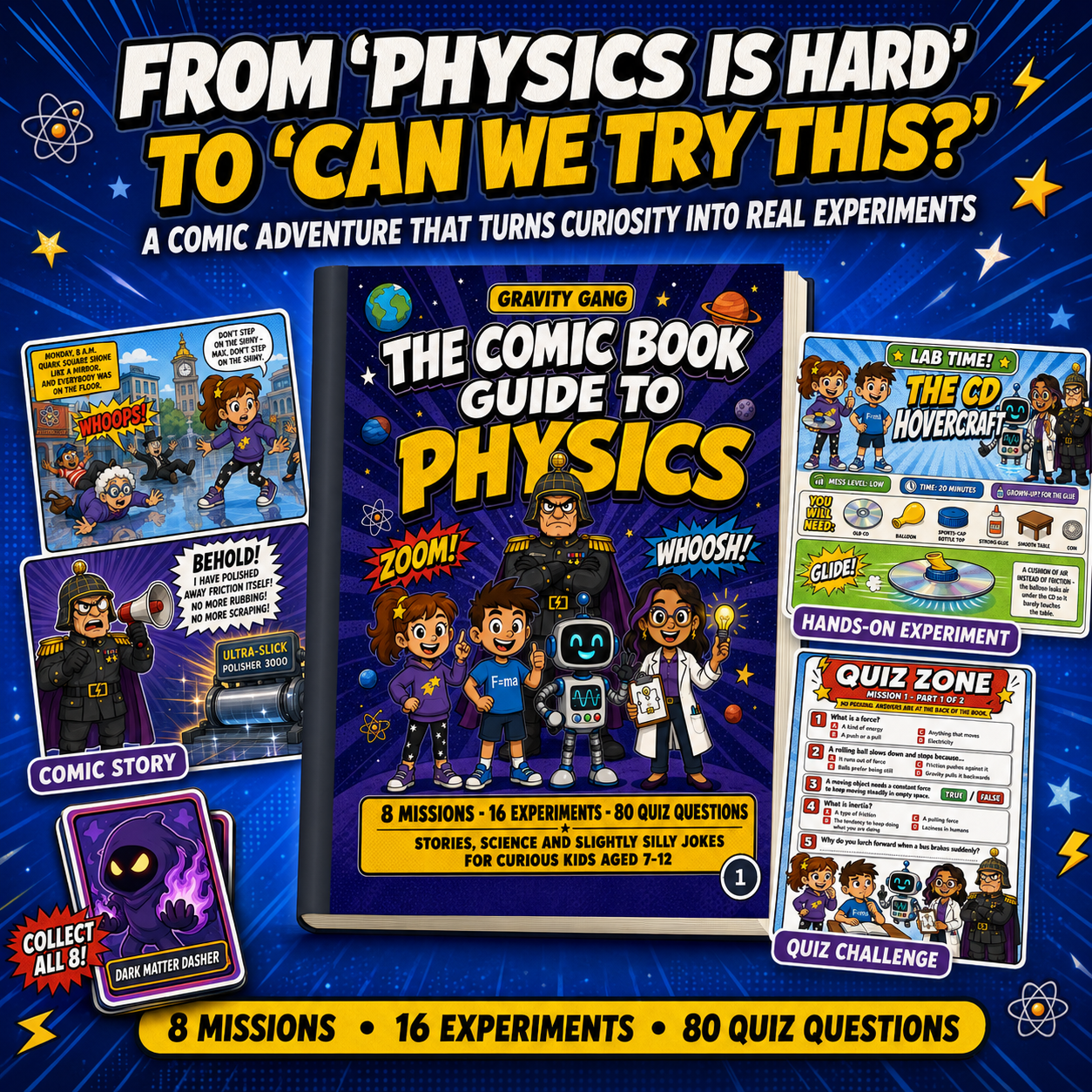
Parents use the books for weekend family science hours; teachers hand them out as small-group stations or send them home as extra practice for kids who resist standard worksheets. Both titles run $59.95 each and come with a 30-day money-back guarantee, so there’s no risk in trying one with a reluctant reader. Browse the comic book collection or go straight to the Gravity Gang physics guide to see a sample activity before you buy.
Where to Go for Deeper Lesson Plans
- Science Buddies force and motion lesson plans: five free, classroom-tested activity guides.
- NASA Newton Car procedure: full steps and safety notes for the rubber-band launch demo.
- NGSS vision for science education: guidance on building investigations instead of scripted labs.
- OpenSciEd K.3 Forces & Motion unit: design-challenge framing for younger grades.
Sources
- Push and pull lesson plan | Science Buddies
- Newton’s third law experiments | JoVE Science Education
- Rocket Activities - Newton Car | NASA
- A new vision for science education | NGSS/NSTA
FAQ
What are five examples of force and motion?
A push on a swing, a pull on a wagon, a ball rolling to a stop from friction, a rocket launching from expelled gas, and a car speeding up when you press the gas pedal all show force changing motion. Each example ties back to the same basic idea: a push or pull starts, stops, speeds up, slows down, or redirects an object.
What are some fun activities to teach force and motion?
Balloon-powered cars, film-canister rockets, ramp-and-car friction races, and tissue-paper parachute drops are all classroom-tested favorites that use materials most households already have. Story-based options like Brainiecomics’s Gravity Gang pair those same experiments with a narrative that keeps reluctant readers engaged through the whole activity.
What are some good experiments to teach force and motion in fifth grade?
The Newton car and balloon car both work well at this age because students can hold force constant while changing mass, which makes Newton’s second law visible in the data. Adding a stopwatch and a simple distance-versus-mass graph, as NASA’s second-law demonstration recommends, turns the demo into a real investigation.
What are some real-life examples of force and motion?
A car braking at a red light, a soccer ball curving after a kick, and a rocket lifting off a launch pad are everyday cases of the same laws these six experiments demonstrate at kitchen-table scale. Even a shopping cart rolling more easily on smooth tile than on carpet is friction and force at work.