

Age Appropriate Science for Kids: Why Play Comes Before Fair Tests
Age appropriate science means matching an activity to a child’s developmental skills rather than handing every kid the same experiment. The single most useful move is to pick the right age band, grab a few household items, and run one short hands-on activity while asking prediction and observation questions alongside your child. Start below with the age group that fits, and treat the activity as a starting point you can return to again.
TL;DR:
- Keep activities to five to fifteen minutes; for children ages 0 to 2, supervise closely around water and small objects, and narrate their observations.
- Preschoolers can predict outcomes before simple tests; around age five, add a magnifier and record observations with drawings or photos.
- For ages 6 to 8, change one variable at a time and track countable results, such as seconds, drops, or centimeters, to keep comparisons clear.
- From ages 9 to 12, let children plan and revise investigations, collect evidence, and explain conclusions through a poster or short video.
- Revisit a familiar phenomenon across several sessions instead of cycling through separate demonstrations, and match the explanation to the child’s skills, not age alone.
Table of Contents
- 0 to 2 years: sensory exploration and adult-led investigations
- 3 to 5 years: play-based investigation with simple tools
- 6 to 8 years: guided fair tests, variables, and simple measurement
- 9 to 12 years: design challenges, models, and communicating evidence
- How to choose, adapt, and extend activities across ages
- Brainie Comics: story-led, kitchen-safe experiments for ages 7 to 12
- Connecting activities to early learning standards
- How 7 to 12 year olds think and feel about science
- Evaluating whether science content fits a child’s level
- Pairing comic-based science with classroom curriculum
- Why repeated, deeper investigation matters more than many one-off demos
- Where to find story-driven, age-banded experiments
- FAQ
- Sources
0 to 2 years: sensory exploration and adult-led investigations
At this stage, science is mostly about the senses. A toddler does not need a hypothesis; they need to touch, dump, and watch things happen.
- Sensory tub: fill a bin with rice, dried beans, or water beads, then let your child scoop and pour for a few minutes while you name textures and temperatures.
- Cause-and-effect bottles: fill clear bottles with water, oil, and glitter, seal tightly, and let your child shake and watch the layers move.
- Water pour play: set out cups and a shallow basin so your child can pour between containers and notice what sinks or floats.
Each of these builds sensing, early observation, and fine motor control. Adults acting as co-investigators, narrating what’s happening and asking simple questions like “what do you feel?”, amplifies learning at this age. Keep sessions brief, supervise closely around water and small objects, and swap materials seasonally to keep interest fresh.
Pro Tip: Narrate instead of instruct: “the glitter is falling slowly” teaches more than “watch this.”
3 to 5 years: play-based investigation with simple tools
Preschoolers can start predicting, not just observing. This is the age where “what do you think will happen?” becomes a real question they can answer.
- Sink or float: gather small toys and kitchen items, ask your child to guess before dropping each into water, then sort them into two piles.
- Plant growth observation: plant a bean in a clear cup against the glass so roots are visible, and check it together every few days.
- Magic milk: add drops of food coloring to a shallow dish of milk, then touch a cotton swab dipped in dish soap to the surface.
- Shadow tracing: trace a toy’s shadow on paper at two different times of day and compare the shapes.
By around age five, children can start using a magnifying glass to extend their observations, and recommended practice at this stage centers on play-based investigation paired with drawing or photographing results instead of writing. Watch for food allergies in taste-based activities, keep small parts away from children still mouthing objects, and never leave a child unattended near open water.
Pro Tip: Ask “what changed?” after every activity. It trains observation skills faster than any new material would.
6 to 8 years: guided fair tests, variables, and simple measurement
Early elementary kids are ready for their first real experiments: comparing two conditions and measuring what happens.
- Paper parachutes: build two parachutes of different sizes, drop them from the same height, and time which one falls slower.
- Dissolving rates: drop sugar cubes into cold water and warm water, then count seconds until each fully dissolves.
- Seed germination comparisons: plant seeds in two cups, one in sunlight and one in a dark closet, and track daily growth in a simple chart.
For this age, NGSS guidance suggests keeping a single independent variable and clear controls, using countable data like drops, seconds, or centimeters so the results stay easy to track. Ask evidence-based questions afterward: “which condition changed faster, and why do you think that happened?” To make a task easier, cut the comparison to one clear contrast; to stretch it, add a third condition or have your child predict the outcome in writing before testing.
9 to 12 years: design challenges, models, and communicating evidence
By upper elementary, kids can plan an investigation themselves instead of just following steps.
- Simple circuits: use a battery, wires, and a small bulb to build a working circuit, then test what happens when a switch is added.
- Filtration models: layer sand, gravel, and cotton in a bottle to filter muddy water, then compare clarity before and after.
- Balloon rockets: thread a straw on fishing line, tape a balloon to it, and test how distance changes with different balloon sizes.
Scientific literacy at this age shifts toward interpreting data, predicting outcomes based on variables, and communicating evidence-based conclusions, which maps closely to the plan, test, collect, and communicate practices in NGSS. A short rubric covering plan, test, revise, and explain, paired with a public-sharing step like a poster or short video, gives kids practice communicating results and gives teachers an easy way to assess the work. For extension, ask students to redesign their test after one failed attempt and explain what they changed and why.
How to choose, adapt, and extend activities across ages
A simple four-step framework works for almost any activity: pick a question your child is curious about, check safety and gather materials, scaffold your prompts and tool use to their age, then extend the investigation once they’ve mastered the basics.
Water play shows how this scales. A one-year-old pours water between cups for sensory input. A three-year-old predicts which cup holds more before pouring. A seven-year-old tests how pour speed changes with different cup shapes and times the results with a stopwatch.
- Confirm the activity matches your child’s current skills, not just their age.
- Keep sessions short: five to fifteen minutes holds attention better than a long block.
- Reuse household materials across age bands instead of buying new kits each time.
One widely cited finding in science education: instruction that stays on fewer core ideas and allows repeated, deeper investigation builds stronger understanding than cycling through many one-off demonstrations. Revisiting the same phenomenon across sessions, rather than constantly switching topics, is often the better use of limited time.
Brainie Comics: story-led, kitchen-safe experiments for ages 7 to 12
For the 7 to 12 age band specifically, comic-led science can bridge the gap between curiosity and reluctant reading. Some comic books weave physics and chemistry concepts into adventure stories and pair them with kitchen-safe experiments using everyday household items.
- Each book pairs a story chapter with a hands-on experiment to encourage reading and exploration of science.
- Experiments use household materials, so no specialty kit is required.
- Some parents report increased interest in science and improved reading skills after using the books.
Pairing a comic chapter with its matching experiment gives a reluctant reader a reason to finish the page before touching the materials.
Connecting activities to early learning standards
Caregivers do not need to memorize a standards document to run good science activities, but knowing the broad framework helps explain why certain approaches work. Head Start guidance on early science learning notes that meaningful investigation does not require complex equipment: everyday household items, measuring cups, string, bowls, and balloons, reliably support scaffolded experiments across every age band in this guide.
As children move into kindergarten and early elementary, learning progressions connect preschool foundations directly into NGSS practices, building from observation and simple questions toward modeling and interpreting data by upper elementary. These progressions also stress using phenomena relevant to a child’s own life and community rather than abstract or unfamiliar examples. A seed growing on a windowsill, water collecting in a backyard puddle, or ice melting on a sidewalk works better as a teaching moment than a concept pulled from a textbook with no connection to daily life.
The through line across both Head Start and NGSS guidance is consistency: the same core skills, observing, predicting, testing, and explaining, show up at every age, just with increasing independence and more structured data collection as children get older. That consistency is why a single activity, like growing a seed or pouring water, can be adapted across years instead of discarded once a child outgrows the simplest version.
How 7 to 12 year olds think and feel about science
Kids between 7 and 12 move through a noticeable shift in how they reason. Early in this range, thinking is concrete: they understand what they can see, touch, and directly test, which is why fair-test experiments with obvious physical results work well around age 7 or 8. By 11 or 12, many children start reasoning more abstractly, holding multiple variables in mind and considering “what if” scenarios without needing to see them acted out.
Emotionally, this age range is sensitive to feeling capable or incapable in front of peers and adults. A child who struggles to read a dense instruction sheet may disengage from the experiment entirely, not because the science is too hard, but because the reading feels like a test they might fail. This is part of why narrative framing, a story that carries a kid into the experiment rather than a worksheet that announces itself as schoolwork, tends to lower that resistance.
Attention span also grows steadily across this range. A 7-year-old may stay engaged with one experiment step for a few minutes before needing a new prompt, while a 12-year-old can plan, test, and revise across a longer session. Matching the pacing and complexity of an activity to where a specific child sits in this range, rather than to their grade level alone, tends to produce better engagement and fewer moments of frustration or boredom.

Evaluating whether science content fits a child’s level
Not every experiment labeled “for kids” is actually matched to a specific child’s stage, and mismatched content causes two common problems: misconceptions from oversimplified explanations, or overload from content that assumes too much prior knowledge.
A few checks help filter content before using it. First, look at the vocabulary: if an explanation leans on terms a child hasn’t encountered yet without defining them in context, the content was likely written for an older audience. Second, check whether the activity asks for a single observation or a full multi-variable test. A single-variable comparison fits younger elementary kids; multi-variable design work fits closer to age 10 and up. Third, watch for oversimplified mechanisms that will need to be unlearned later, such as describing gravity only as “things falling down” without any mention of mass or force once a child is old enough to handle that idea.
A practical rule of thumb: if an activity requires more reading or math than hands-on doing, it’s probably pitched for an older child than the one in front of you. If a child finishes an activity and still can’t answer “what did you learn?” in their own words, the content was either too advanced or too thin to make the point land. Adjusting the explanation’s depth, not necessarily the experiment itself, is often the simplest fix.

Pairing comic-based science with classroom curriculum
Comic-led science content works well as a supplement rather than a replacement for classroom instruction, and a few habits help it fit naturally alongside schoolwork. Teachers and parents can match a comic’s chapter topic to whatever unit a student is currently covering in school, using the story as a preview or a reinforcement rather than a separate track.
After a student finishes a chapter and its paired experiment, asking them to connect it back to a recent class lesson, “how is this like what you learned about states of matter last week?”, turns reading time into active recall instead of passive entertainment. For teachers managing group settings, these elementary science experiments organized by grade band offer a reference point for pacing a comic-based unit alongside standard curriculum timelines.
Completion certificates and quizzes built into a comic-and-experiment format also give teachers a lightweight way to confirm a student engaged with the material, without adding a separate grading task on top of an already packed schedule.
Why repeated, deeper investigation matters more than many one-off demos
The research is consistent on one point: a child who revisits the same phenomenon across several sessions builds deeper understanding than one who moves through a dozen disconnected demos in the same amount of time. Document your child’s questions as they come up, repeat the investigation a few days later, and adjust based on what confused or excited them the first time. Favor phenomena from your own backyard or kitchen over generic kit experiments; local, familiar examples tend to stick better than abstract ones.
— Brainie Comics
Where to find story-driven, age-banded experiments
For caregivers of 7 to 12 year olds who want science activities that a reluctant reader may engage with, some comic books pair adventure stories with kitchen-safe experiments in each chapter. Some titles cover physics concepts and others cover chemistry; they use household materials and offer a satisfaction guarantee.
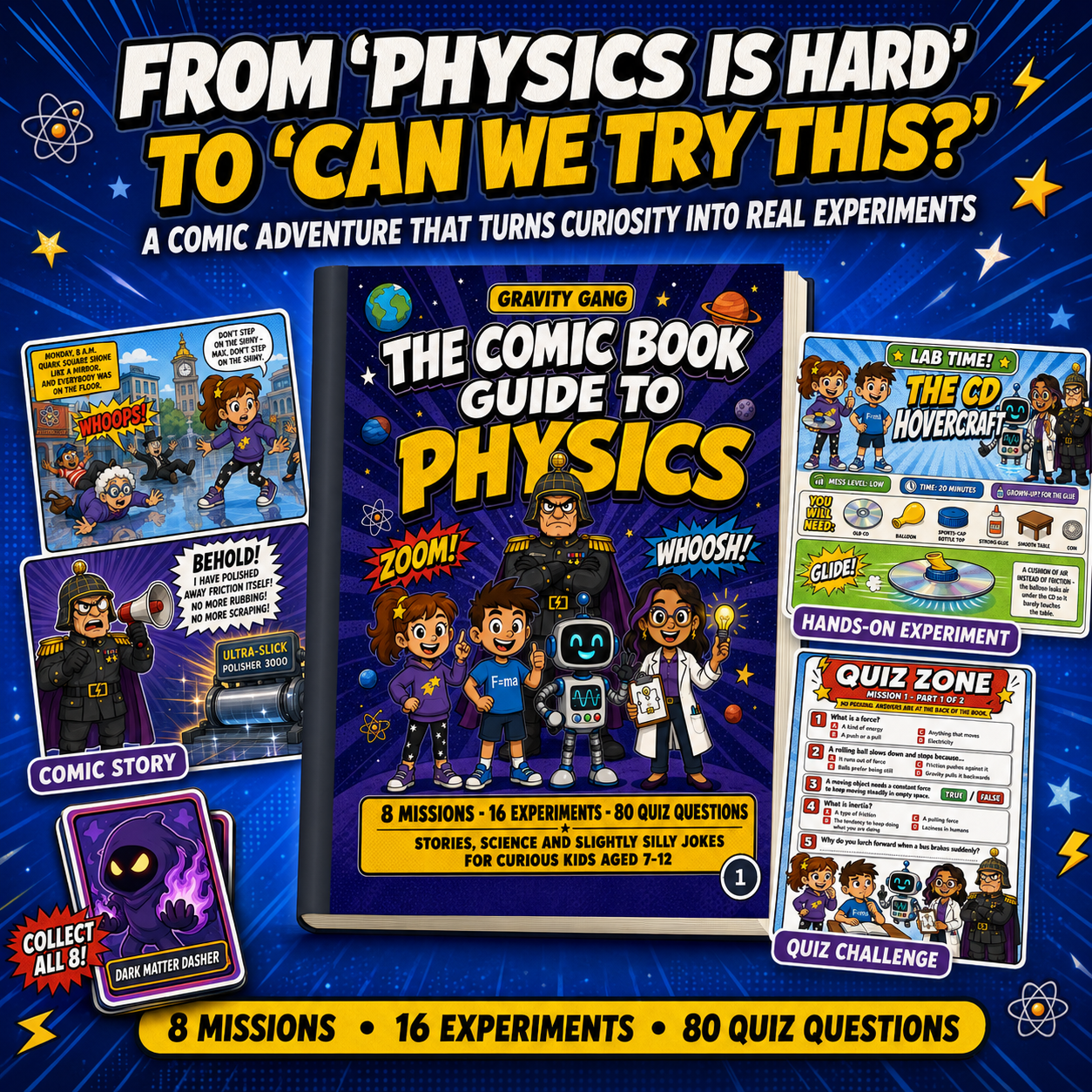
- Browse the full comic book collection to compare both titles.
- Start with Fizz Force: Comic Book Guide to Chemistry for chemistry-themed stories and experiments.
- Or try Gravity Gang: Comic Book Guide to Physics for physics-themed adventures.
Either title makes a solid starting point for a kid who loves a good story more than a worksheet.
FAQ
What should a 5 year old be able to do in science?
By around age 5, children are expected to identify and use all five senses to make observations about the world, a milestone outlined in Head Start’s early science guidance. They should also be able to describe and compare simple phenomena, like which object is heavier or which color changed, with adult prompting.
What are 10 easy science experiments for kids?
Easy options vary by age: sensory bins and pour play for toddlers, sink-or-float and magic milk for preschoolers, paper parachutes and dissolving rate tests for early elementary kids, and simple circuits or filtration models for upper elementary. Picking one from each band above and rotating through them covers a solid range without needing a specialty kit.
What are some cool science experiments for a 12 year old?
Twelve-year-olds do well with design-based projects like building a working circuit with a switch, constructing a multi-layer water filtration model, or testing balloon rocket distance across different balloon sizes. These projects ask kids to plan, test, and explain results, which fits the communication-focused skills expected at this age.
What are some good science experiments for older kids?
Older elementary and middle-school kids benefit most from fair-test experiments with a single clear variable, such as comparing seed germination in light versus dark conditions, paired with simple measurement like counting days or centimeters of growth. Adding a rubric step, plan, test, revise, explain, helps structure the project and makes it easier to assess.
Sources
- Early Science Learning in Infants, Toddlers, and Preschoolers — Head Start
- Science and Engineering in Preschool Through Elementary Grades: The Brilliance of Children and the Strengths of Educators — National Academies
- Scientific literacy for informed decision-making — ResearchGate