

STEM Storytelling for Teachers: Try a Hook That Takes 2 to 3 Minutes
Storytelling in STEM means wrapping a scientific concept in a narrative with a character, a problem, and a cause-and-effect chain, and it boosts engagement, long-term retention, and conceptual understanding. The fastest way to try it is a 2–3 minute character hook at the start of class that poses a question your students will then investigate with their own hands.
TL;DR:
- A 2023 review of 36 studies found medium to large effects, strongest on delayed assessments and interventions that revisited stories across several weeks.
- Use a 2 to 3 minute hook, then give students 10 to 20 minutes to test the story conflict before explaining the concept.
- Keep early grade stories to two or three causal steps; older students can compare evidence, challenge weak claims, and answer counterarguments.
- Choose read or heard stories for comprehension and retention, but use narratives written by students when creativity, reflection, and critical thinking are the goals.
- Close with a claim, evidence, and reasoning prompt to see quickly which students understand the concept and who needs another explanation.
Table of Contents
- Why do stories help students remember and understand science?
- Which story elements and teaching moves work best?
- How do you fit storytelling into a BSCS 5E lesson?
- What do storytelling lessons look like in a real classroom?
- Should students listen to stories, or create their own?
- Where we stand on stories and classroom fit
- Ready-made comics for your next story-based lesson
- FAQ
- Sources
Why do stories help students remember and understand science?
A 2023 theoretical review of 36 studies found that students gain significant long-term memory and conceptual understanding from narrative-based science texts compared with fact-based instruction.
Effect sizes for narrative-based interventions were primarily medium to large, with the strongest results on delayed assessments and multi-week interventions. That means a story pays off most when you return to it across several lessons and test students days later, not just at the end of the period.
Not every story works equally well. NSTA practitioner guidance notes that stories yield greater retention when learners do something with them: predicting outcomes, resolving a narrative conflict, or writing their own continuation inside an inquiry cycle. A story students only listen to is a nice break. A story students must solve is a learning tool.
If you need to explain the choice to a colleague or an administrator, some outcomes are easy to track:
- Higher scores on delayed quizzes after the lesson.
- More “Why?” questions during investigations.
- Better transfer, meaning students can apply the idea to a situation the story never mentioned.
Storytelling also is not just for little kids. Research on narrative learning describes support for cognitive development, creativity, and conceptual change from early childhood through adulthood, so middle schoolers and older students benefit too.
Which story elements and teaching moves work best?
A good STEM story is built from a few parts you can plug into any topic:
- A relatable protagonist students can picture, such as a kid, a scientist, or an animal.
- A clear problem or mystery that depends on the target concept, like “Where did the puddle go?”
- A causal chain that links evidence to explanation, one step at a time.
- Real stakes, something the character (and your students) care about resolving.
- A metaphor that maps neatly onto the concept, such as a crowd squeezing through a doorway for particles moving through a membrane.
The story only does its work when students act on it. Add prediction checkpoints (“What do you think happens next?”), ask students to resolve the conflict using evidence, and have them write the next scene to show what they understood.
Adjust by grade. Early grades need short causal chains, two or three steps at most. Older students can weigh competing evidence, spot a weak claim, and answer a counterargument. For a deeper walk through one method, our post on an evidence-backed 4-step approach to storytelling in science lays it out for teachers and parents.
Pro Tip: Build the story’s conflict so students can only resolve it by testing a hypothesis or running a simple experiment. Productive struggle beats a tidy ending handed over by the teacher.

How do you fit storytelling into a BSCS 5E lesson?
The BSCS 5E model (Engage, Explore, Explain, Elaborate, Evaluate) is a natural home for stories. Educators commonly use a narrative hook in Engage and stories in Elaborate to apply knowledge to new contexts. The 5E framework also stresses active exploration before formal explanation, which is exactly what a story conflict sets up: students gather shared experience first, then name the concept.
Here is a skeleton you can adapt to any topic:
- State the objective in student-friendly words, tied to an NGSS performance expectation.
- Tell a 2–3 minute story hook that ends with a question.
- Run a 10–20 minute exploration where students test ideas that bear on the story’s conflict.
- Hold a class explanation, with students mapping their evidence back to the story.
- Extend the story into a new context, or let students write what happens next.
- Close with an assessment prompt in claim-evidence-reasoning form: “What did the character get right, and what’s your evidence?”
The claim-evidence-reasoning prompt doubles as a formative check, so you can see in minutes who has the idea and who needs another pass. If you teach grades 3–5, our NGSS-mapped third grade experiments with story prompts show this skeleton in action.
What do storytelling lessons look like in a real classroom?
Here are ready-to-run ideas, all built from everyday materials:
- Early elementary, “Where did the water go?” Introduce a character whose puddle vanished. Students test cups and small objects in a sink-or-float mini-investigation using household items, then draw and explain what they found.
- Upper elementary, comic strip cause and effect. Students sequence comic panels that model a chemical reaction, run a simple vinegar and baking soda experiment, and match what they observe to the panels that show the same step.
- Middle grades, “Resolve the lab conflict.” Give students a short scientist’s story in which two characters make conflicting claims. Students design a quick test to support one claim and defend it with evidence.
- Low-prep comics lesson. Pair a short printed comic with a kitchen-safe experiment and one reflective prompt, such as “Which panel matched what you saw, and why?” Plan on one class period and pantry-level materials.
For more templates, see our resources on low-cost materials for project-based STEM teachers and how interactive science books pair narrative with hands-on activity.
Should students listen to stories, or create their own?
A critical review of storytelling pedagogy mapped six configurations: digital storytelling, learner-generated narrative, collaborative storytelling, narrative pedagogy, game-mediated storytelling, and multimodal or immersive storytelling. Your choice depends on the goal:
- Receptive stories (read, heard, or watched) suit comprehension and retention.
- Learner-authored stories suit creativity, reflection, and critical thinking. Classroom storytelling projects also build student identity, confidence, and a sense of belonging.
- Digital video projects let students narrate an investigation. A tool like Kudoflix’s documentary video editor can work for short student-made science documentaries.
- Low-tech substitutes such as paper comics, spoken stories, or role-play fit when devices are scarce.
Weigh time, device access, scaffolding needs, and how you will assess the result before you commit. To make hooks matter to students, start from their lives, as this page on connecting interactive science activities to children’s lives suggests.
Where we stand on stories and classroom fit
We write story-first comics with hands-on experiments because reluctant readers and hands-on learners are the students traditional science texts lose first. We design our stories to serve a learning objective and fit the real limits of a classroom, from the clock to the supply closet. Our pledge is simple: every story we make should serve a learning objective and fit the real limits of a classroom, from the clock to the supply closet.
— Brainie Comics
Ready-made comics for your next story-based lesson
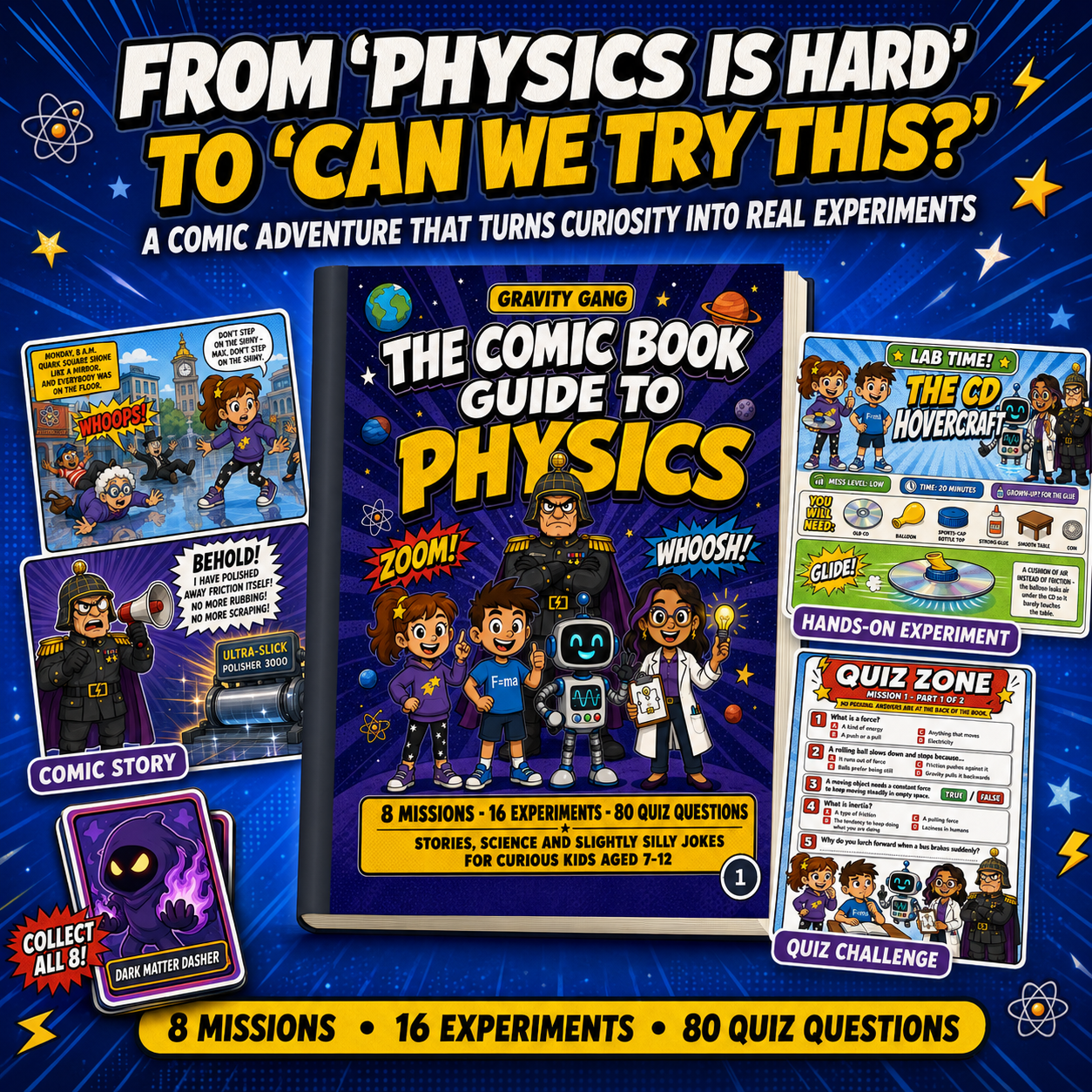
Our printed comics, Gravity Gang and Fizz Force, supply the narrative hook, the kitchen-safe experiment, the quiz, and a completion certificate in one book, and each is $59.95. They cover the Engage, Explore, and Evaluate steps above. Preview sample pages on our collection page.
FAQ
What are some popular STEM books?
Picture books that blend narrative with science, such as Ada Twist, Scientist, are recognized for sparking early interest and encouraging “Why?” questions. Comics like our Gravity Gang and Fizz Force add hands-on experiments.
What is the storytelling method in science teaching?
It embeds a concept in a narrative with a character, a problem, and a cause-and-effect chain, then asks students to predict, test, and resolve it. Reviews note that learner authorship, where students write their own stories, supports creativity and critical thinking.
What are the five E’s of teaching science?
They are Engage, Explore, Explain, Elaborate, and Evaluate, the stages of the BSCS 5E model. A story hook fits Engage, and story extensions fit Elaborate.
What are examples of STEM skills?
Common examples include asking questions, making predictions, designing a fair test, interpreting evidence, and explaining a result. Storytelling practices several of these at once when students must resolve a story’s conflict.
How can I match a story to my audience?
Start with why the audience should care, then limit yourself to a few key points. AAAS communication guidance recommends framing goal, audience, and message, and choosing three key points for recall.
Sources
- Pmc
- Nsta
- [Mapping the Narrative Landscape: A Critical Review of Storytelling-Based Pedagogical Models in 21st Century Education | International Journal of Educational Narratives](https://www.research.adra.ac.id/index.php/ijen/article/view/4444)